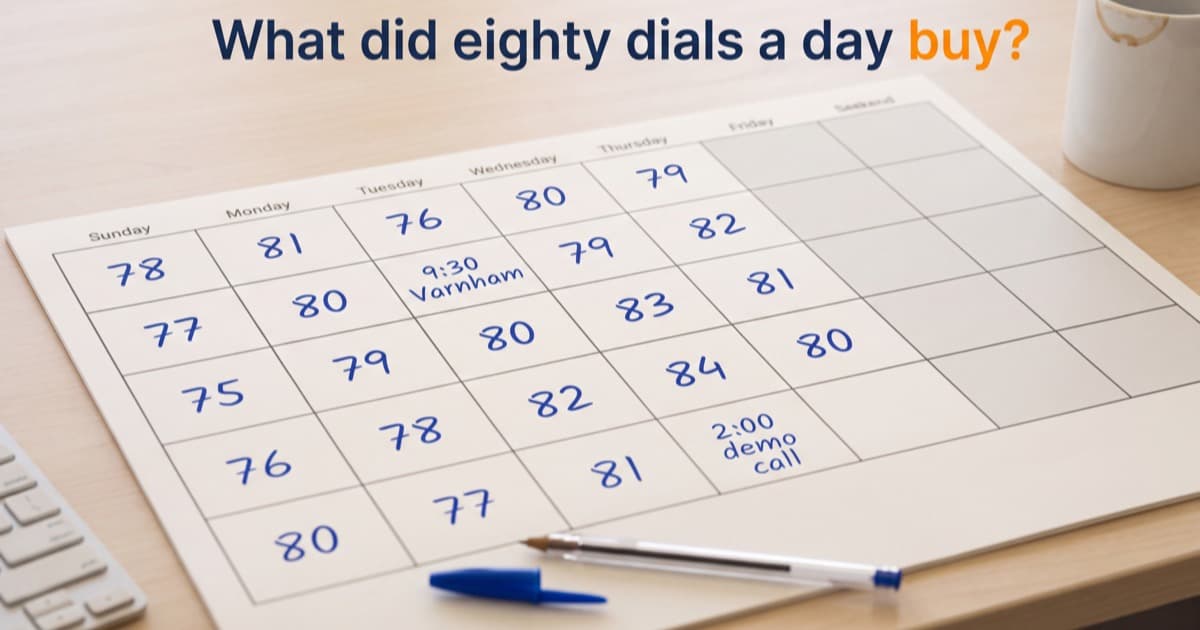

You can dial a hundred numbers a week and still sound exactly like you did a year ago. Volume is not the same thing as cold call practice. A rep who takes eighty live calls and gets hung up on eighty times has learned that cold calling feels bad, which is a lesson, just not a useful one.
Real cold call practice is narrower and more deliberate than "make more calls." It isolates one skill at a time, gives you feedback on that skill specifically, and repeats it enough times that the reflex moves from your brain to your mouth. This is what that actually looks like, plus the drills that build it and a worked example of what changes when a rep does it right.
Why doesn't more dialing make you better?
Three things quietly sabotage practice that looks productive from the outside.
It practices the whole call at once. A cold call has an opener, a pattern interrupt, a reason for calling, an objection or two, and a close. Cramming all five into every rep means you spend most of your practice time on the parts that were already fine, and get maybe one rep at the part that actually breaks: usually the first fifteen seconds.
It has no feedback loop. If a colleague roleplays "prospect" for five minutes and you both move on, neither of you learns anything specific. Feedback needs to be immediate, specific, and about the thing you were trying to fix, not a vague "that was better."
It never includes resistance. Practicing an opener into a mirror is fine for delivery, but if nobody ever pushes back, interrupts, or asks "is this a cold call?", you are training for a conversation that will not happen. Real cold calls involve friction almost every time.
Fix these three and volume starts to compound instead of just repeating the same call.
The drills that build the skill
Opener isolation. Run just the first fifteen seconds, over and over, twenty times in a row if you have to. Not the whole call. The opener is where most calls die, so it deserves ten times the rep count of the rest of the script combined.
Objection recovery reps. Write your five most common brush-offs on cards ("send me an email", "not interested", "we already have a vendor", "call me back next quarter", "no budget"). Draw one at random and answer out loud within two seconds. You are training the pause-then-recover reflex, not memorizing a rebuttal script.
Full call against resistance. Once the opener and objection recovery are solid individually, chain them together against something that actually pushes back, whether that is a colleague briefed to be difficult or an AI buyer that interrupts and objects unpredictably. This is the only drill that tests whether the pieces hold up under pressure.
Recorded playback. Record any of the above and listen back once for content, once for delivery: pace, filler words, whether you sound like you are reading. This is the fastest way to hear the thing you cannot hear while you are talking.
What two weeks of opener drills actually changes
Here is a fictional SDR, Ines, selling scheduling software, on the same opener two weeks apart. The prospect is a fictional office manager at a mid-size dental group.
Before, no isolation drills, just "practicing by dialing":
Ines: Hi, is this Marcus? Hey Marcus, this is Ines calling from Slotwise, hope I'm not catching you at a bad time?
Marcus: Kind of in the middle of something, what's this about?
Ines: No worries, this'll be quick! So Slotwise helps dental practices reduce no-shows and streamline scheduling across multiple locations, and I know a lot of offices your size struggle with double-bookings, so I wanted to see if we could grab fifteen minutes this week to walk you through how it works?
Marcus: We're not really looking at new software right now. (click)
What went wrong: "hope I'm not catching you at a bad time" invites the exit before Ines has said anything worth staying for. Marcus told her he was busy and asked what this was about, and got a features pitch and a meeting ask with zero acknowledgment of what he just said. There was no pause for him, so there was no reason for him to stay.
After, two weeks of opener isolation plus objection recovery reps:
Ines: Marcus, it's Ines, I know you don't know me and this is out of the blue. Can I get fifteen seconds?
Marcus: ...sure, fifteen seconds.
Ines: I work with dental groups running three or more locations, and the front desk teams usually tell me double-bookings and no-shows eat a few hours a week per office. Does that sound familiar or is scheduling not really a pain point for you?
Marcus: Honestly, no-shows are a bigger issue for us than double-booking, but yeah, it's a pain.
Ines: Got it, that's actually the more common one. Mind if I ask how you're handling no-show follow-up today?
What changed: Ines named the interruption directly and asked for permission in a specific unit of time, which is a smaller, easier yes than "fifteen minutes this week." Then she led with a plausible, specific pain instead of a product description, and phrased it as a question Marcus could disagree with, which made his answer honest instead of polite. None of this was improvised. It came out smoothly because the opener alone had been drilled forty times that week, separate from everything else.
Where structured practice still goes wrong
Practicing silently or in your head. If the words have never left your mouth, they have not been practiced. Reading a script is rehearsal for reading, not for talking.
Skipping straight to full calls. Full-call reps feel more "real," but without isolating the opener and objections first, you are just repeating whatever bad habits you already have, at full speed.
No plan for the plateau. After the first week or two, gains slow down. That is the signal to raise difficulty (a tougher persona, faster objections, less patience) rather than to assume you have plateaued for good.
Practicing against something too easy. A practice partner who always plays nice, or an AI set to its easiest mode, will not expose the gaps that a genuinely resistant prospect will find in seconds.
Cold calling is a motor skill wearing a knowledge-work costume. Reps who treat it like tennis, isolating the serve before playing a full match, get better faster than reps who just play more matches. Structure the reps, add real resistance, and the volume you were already putting in will finally start to pay off.
A simple weekly structure
You do not need a complicated program, just a repeatable one. A version that holds up over a full quarter:
- Two sessions a week on the opener alone. Ten to fifteen reps each, out loud, recorded if you can manage it. This is non-negotiable even for reps who feel "past" this stage; the opener decays fastest without upkeep.
- One session a week on objection recovery. Rotate in whatever objection has come up most in your last week of real calls, not just the same five cards forever.
- One session a week of full calls against real resistance. This is where you find out whether the isolated pieces actually chain together under pressure, and it is the session most reps skip because it is the least comfortable.
- Ten minutes before your first real call block, every day. A short warm-up, not a full session, just enough to loosen up before the stakes are real.
The order matters more than the volume. Isolate first, chain second, and warm up daily so the skill does not go cold between sessions. Reps who follow some version of this structure for a month report the same thing: the calls start feeling less like a performance and more like a conversation, because the mechanics stopped requiring conscious effort somewhere around week two.
If you are not sure which moment to isolate first, the cold calling guide walks the call in order so you can find the one where your own calls actually end.