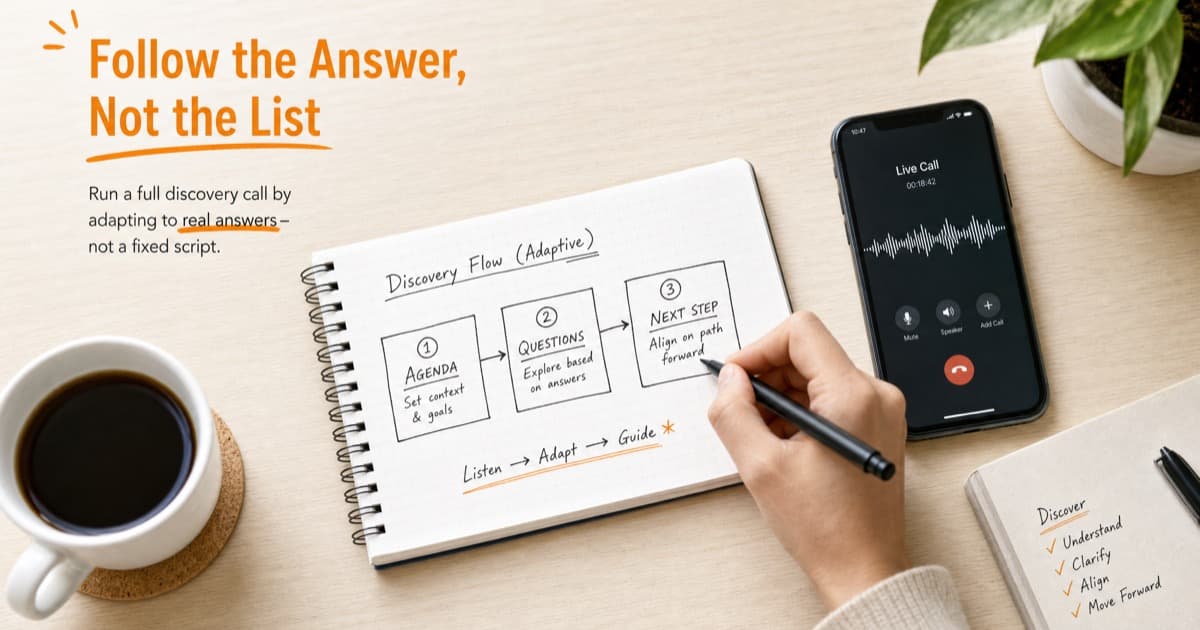
A mock discovery call scenario is only useful if it rehearses the whole shape of the call, not the question list. Set an agenda in the first thirty seconds, follow the most specific detail in each answer instead of advancing your list, and close on something the buyer actually said. Here is that run twice.
Preparation usually stops where the call starts
The call is booked. Thirty minutes, calendar invite sent, prospect confirmed. You know the company, you've read the LinkedIn profile, you've got your questions listed on a notepad. And that's usually where the preparation stops, because there's nothing left to rehearse against. You can practice an opener in the mirror and you can prep answers to objections you expect, but a discovery call isn't a script with predictable gaps, it's thirty minutes of following an answer somewhere you didn't plan for.
That's the part a mock discovery call scenario is actually for. Not rehearsing a single line, rehearsing the whole shape of the call: how you open it, how you hand control of the agenda without losing it, how you follow a real answer instead of moving to your next scripted question, and how you close without either pushing too hard or letting it drift into "let's circle back." Reps who only prep their questions walk in ready for a monologue. Reps who prep the whole conversation walk in ready for whatever the prospect actually says.
Three habits that turn discovery into a form
Running a list instead of a conversation. A rep with eight discovery questions on a notepad tends to ask them in order regardless of what the answer to question three just revealed. The prospect notices. It reads as a form being filled out, not a diagnosis being made, and the best answers in the call get walked past because the next scripted question was already queued up.
Skipping the agenda-setting. Reps who jump straight into "so tell me about your current process" without first naming what the next thirty minutes are for leave the prospect unsure whether this is a sales pitch, a needs assessment, or a demo. That ambiguity makes people guarded. A short, explicit frame at the top does more to open someone up than any individual question does.
Summarizing too early or not at all. Some reps never play back what they heard, so the call ends with the prospect unsure the rep actually understood the problem. Others summarize after the first answer, before there's enough on the table to summarize accurately, which reads as a rep already reaching for their pitch instead of still listening.
What is the buyer deciding while you ask questions?
The prospect on a discovery call is not evaluating your product yet. They're evaluating whether this conversation is worth the rest of the thirty minutes, and separately, whether you understood a single word of what they just told you.
They're testing whether you'll actually follow their answer. When a prospect gives a real, specific answer, like a number, a deadline, a name of a tool that's failing them, they're watching to see if the next question builds on that detail or ignores it. Ignoring it signals the questions were never really about them.
They're deciding how much time this deserves. A vague, unfocused call gets thirty minutes and nothing more. A focused one, where the rep clearly knows what they're trying to find out and gets there efficiently, earns a second call and often more candor along the way.
They're gauging whether you'll push before you understand. Prospects can tell within the first few minutes whether a rep is diagnosing a problem or just working toward a pitch they already had loaded. The ones who feel heard before anything is proposed are the ones who stay engaged when the call eventually turns toward a solution.
Following the answer instead of the list
The rep sells operations scheduling software and is on a discovery call with Yuki, VP of Operations at Halvern Freightways, a regional freight and warehousing company. This is their first conversation.
Working the list:
Rep: Thanks for making time, Yuki. So I've got a few questions here, first one, how many people are on your ops team right now?
Yuki: About forty across three warehouses.
Rep: Got it. And what tool are you using for scheduling today?
Yuki: Mostly spreadsheets, honestly, plus a lot of texting between shift leads. It's a mess during peak season, we had two warehouses double-booked the same crew last month.
Rep: Okay, makes sense. Next question, what's your budget range for something like this?
Yuki: We haven't really scoped that out yet.
Rep: No problem. So let me show you a quick rundown of how our platform handles shift scheduling.
The double-booking detail was the most important thing said in the entire call, and the rep walked straight past it to the next question on the list. Yuki handed over a specific, costly failure, and got a budget question in return instead of a single follow-up. By the time the rep pivoted to a demo, there was no evidence they understood the problem well enough for the demo to land as relevant.
Following the answer:
Rep: Thanks for making time, Yuki. Before we get into it, here's what I'd like to cover in the next twenty-five minutes: how scheduling works today across your warehouses, where it's actually breaking down, and whether what we've built is a fit worth a longer look. Sound right?
Yuki: Yep, that works.
Rep: Great. Walk me through how scheduling happens today, across the three sites.
Yuki: Mostly spreadsheets, plus a lot of texting between shift leads. It's a mess during peak season, we had two warehouses double-booked the same crew last month.
Rep: Same crew, double-booked across two sites, that's a real cost, not just an inconvenience. What happened after you caught it?
Yuki: We had to pull people off another job to cover, which pushed that shipment back a day.
Rep: So it's not just a scheduling headache, it cascades into delivery timelines. Is that double-booking a one-off, or has it happened enough that leadership's noticed?
Yuki: It's happened three times this year that I know of. My director's asked about it twice.
Rep: That's useful to know going in. Based on what you've described, cross-site visibility into who's already booked is the piece that's missing, that's exactly the gap we're built to close. Would it be worth a second call with your director in the room, now that you've got two concrete incidents to point to?
Naming the twenty-five-minute agenda up front gave Yuki a reason to relax into specifics instead of guessing what the call was for. The rep's follow-up questions built directly on what she'd already said instead of moving down a fixed list, which is what pulled the real cost, a delayed shipment, out of what started as a scheduling complaint. Reflecting the pattern back ("that's not just a scheduling headache, it cascades into delivery timelines") showed Yuki she'd actually been understood, and made the next-step ask land as a logical continuation of the conversation rather than a pitch bolted onto the end of it.
Rehearsing the shape instead of the questions
Set up a discovery call scenario against a buyer persona who gives real, specific answers rather than generic ones, so you have to actually listen and adapt instead of working through a fixed list. Goals for the practice run:
- State a short agenda at the top before asking a single question.
- Ask a genuine follow-up on the most specific detail in each answer, instead of moving to your next scripted question.
- Summarize what you heard once you've actually got enough to summarize accurately, and check it against the buyer's own words.
- End on a next step that references something specific the buyer told you, not a generic "let's schedule a follow-up."
Run it once letting the buyer drive off-script into an unplanned tangent, and once where the buyer gives short, guarded answers you have to work to open up. Handling both without falling back on your notepad is what this drill is for.