
"Send me an email" is the most polite hang-up in sales, and agreeing to it ends the call with nothing. Agree first, then ask one honest question that sorts the request into go-away, wrong-moment, or genuinely-prefers-reading, and close on the smallest concrete step their answer supports.
The exit that feels like progress
You are forty seconds into a cold call. You got through the opener, you have started describing the problem you solve, and the prospect cuts in with the most polite hang-up in business: "Sounds interesting. Why don't you send me an email and I'll take a look."
It arrives early, it sounds cooperative, and it works on almost every rep, which is exactly why buyers use it. Agree, and the call is over. The email you send will land in a folder with every other email a stranger ever sent them, and both of you know it.
Why relief beats training on this one
Because it does not feel like an objection. "Not interested" triggers a rep's training; "send me an email" triggers their relief. The rep gets to end an uncomfortable call while telling themselves it went well. They even log it as a positive outcome: "prospect requested info."
The other reason is speed. The brush-off comes fast, mid-sentence, and the untrained response ("Sure! What's the best address for you?") is out of the rep's mouth before their brain has voted. This is a reflex problem, not a knowledge problem, which is why reading about it once does not fix it.
Does "send me an email" ever mean send me an email?
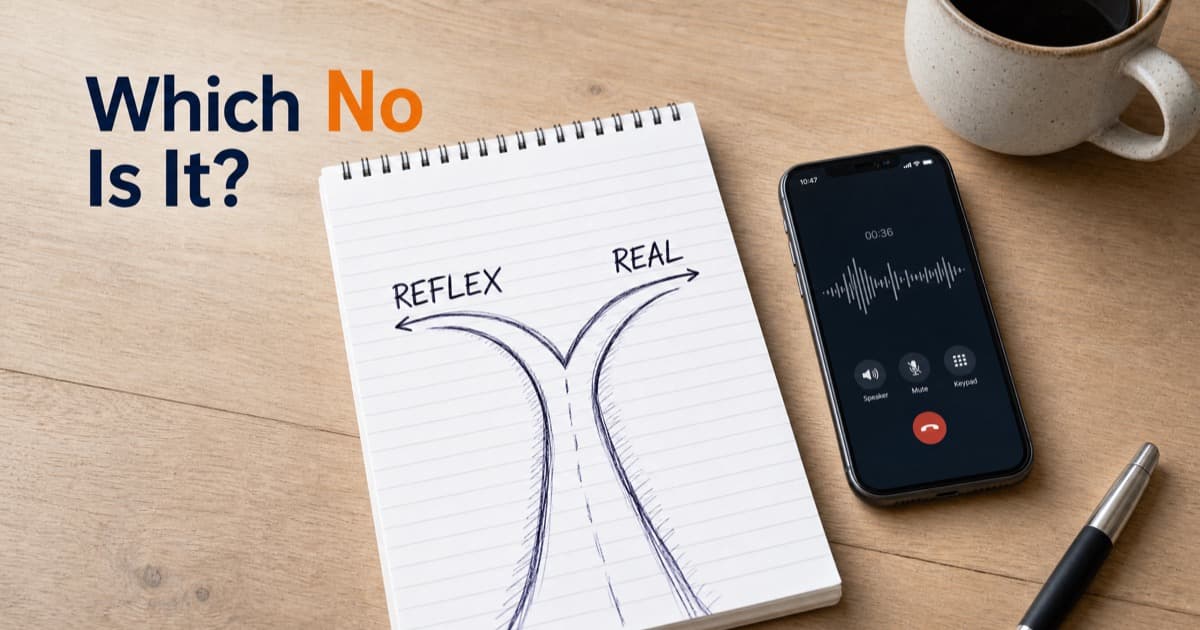
"Send me an email" almost always means one of three things, and only one of them is good news:
- "Go away nicely." The majority case. They have no intention of reading anything. The email request is a socially acceptable trapdoor.
- "I'm genuinely busy right now." A real conflict, not a rejection. These buyers would take a scheduled call; they just cannot take this one.
- "I prefer reading." Rare but real. Some buyers genuinely evaluate in writing.
Your job in the next ten seconds is not to fight the request. It is to find out which of the three you are holding, because the right move is different for each.
The question that decides which email to write
The prospect is a fictional head of customer support at a mid-size e-commerce company. The rep sells a support analytics tool.
Taking the address:
Prospect: You know what, this sounds like it could be relevant. Send me an email with the details and I'll take a look.
Rep: Absolutely, happy to! What's the best email for you?
Prospect: Just use jordan at the company domain.
Rep: Perfect, I'll include a one-pager and some case studies. When should I follow up?
Prospect: Give me a couple of weeks.
Rep: Sounds great, thanks Jordan!
The rep got an email address and a two-week snooze button and walked away feeling productive. Nothing here moved. He never learned which of the three buyers he was talking to, so his email will be written for nobody, and the two-week follow-up call will start from zero, against a prospect who now has a script for getting rid of him.
Asking which email to write:
Prospect: This sounds like it could be relevant. Send me an email with the details and I'll take a look.
Rep: Happy to. Before I write it, can I ask you one thing so I don't send you a novel you delete?
Prospect: ...sure.
Rep: Straight answer appreciated: is this a "genuinely curious, wrong moment" email, or a polite "please go away" email? Both are fine, I just want to write the right one.
Prospect: (laughs) Honestly, a bit of both. We do have a reporting mess in support, but this quarter is a write-off.
Rep: That's fair, and useful. Then here's what I'll do: two paragraphs, specifically on the reporting mess, nothing else. And rather than me cold-calling you again at random, does it make sense to put fifteen minutes on the calendar for early next quarter, and you can cancel it if the email doesn't land?
Prospect: Yeah, that works. Send the invite.
Look at what each line did. The rep agreed first, which kills the tug-of-war before it starts. The "which email should I write" question is disarming because it is honest, and it forces the buyer to reveal which of the three cases this is. The answer ("a bit of both, reporting mess, this quarter is dead") is more qualification than most full discovery calls produce. And the close converts a vague email into a concrete, cancellable calendar slot, which respects the buyer's stated reality instead of bulldozing it.
Notice also what the rep did not do: he did not argue, did not say "emails get lost, let's just talk now", and did not pitch harder. Pushing against a brush-off confirms the buyer's decision to deploy it.
Drilling the reflex out of your own mouth
Set up a cold call scenario and pick a busy, mildly skeptical buyer persona. Your goals for the practice run, in order:
- When the brush-off comes, agree first. No pushback in the first sentence.
- Ask one question that sorts the buyer into "go away", "wrong moment", or "prefers reading".
- Close on the smallest concrete next step that matches their answer, not the meeting you originally wanted.
Run it at least five times. The first two, you will hear yourself say "Sure, what's the best address?" before you can stop it. That reflex is the entire reason to practice.