
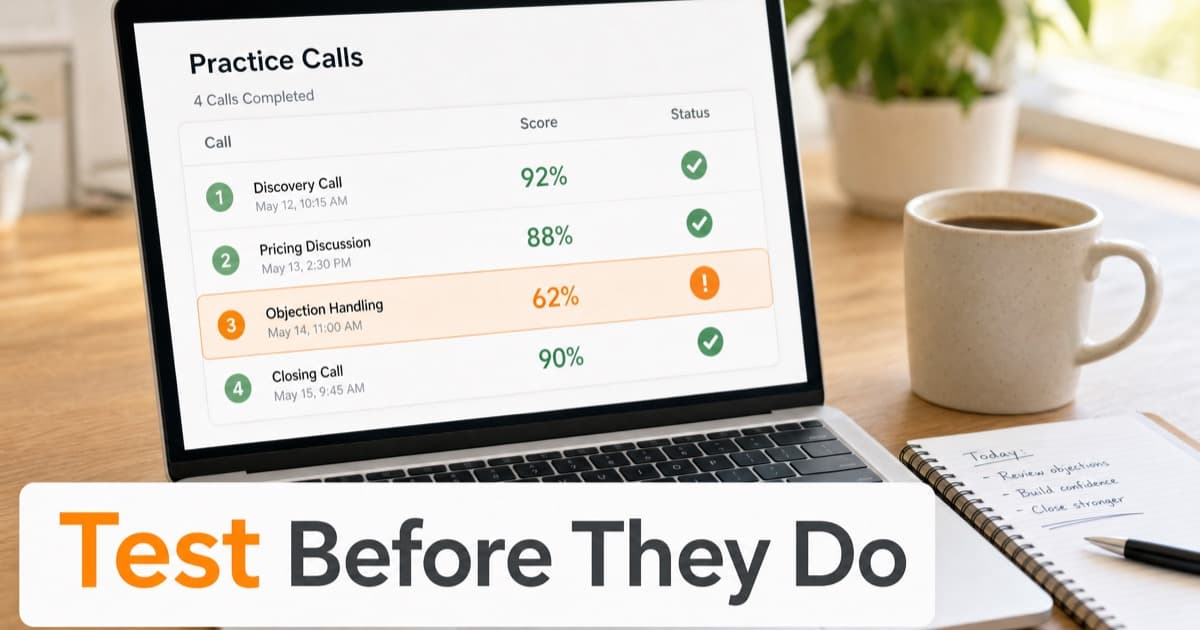
A new SDR class starts, and the ramp looks the same every quarter: two weeks of product training, a handful of shadowed calls, then the dial tone. Some of them figure it out by week three. Others take two months, if they don't quit first, and the gap between the two groups usually has nothing to do with talent. It's reps, and how many real objections they've handled before a prospect handled one back at them for the first time on a call that counted.
An AI sales training tool gets bought to close that gap. The pitch is straightforward: give every new SDR unlimited reps against a buyer that talks back, instead of three shadowed calls and a stack of call recordings nobody has time to review. What the pitch doesn't cover is that most tools in this category are built around a chatbot that plays along, and a chatbot that plays along teaches a new rep that selling is easier than it is. That lesson gets corrected on a real call, at a much worse time.
What does a manager actually need from an SDR training tool?
Three things distinguish an AI sales training tool that actually changes ramp time from one that just looks good in a sales demo.
It resists instead of complying. A buyer persona that says "sure, send me a calendar link" after one line of pitch isn't practice, it's a script the rep already knows how to read. The tool needs a persona that raises real objections (no budget, wrong timing, already has a vendor) and holds that position until the rep actually addresses it, not just restates the value prop louder.
It gives the manager something to look at besides a completion checkbox. "Priya finished 12 practice calls" tells a manager nothing about whether Priya can handle a skeptical buyer. A usable tool scores specific behaviors, opener retention, whether the rep asked a follow-up question instead of pivoting back to script, whether they held their position under a price objection, so a manager can see where a specific rep is stuck instead of guessing from a raw call count.
It doesn't reset to the same difficulty every time. A new SDR in week one and the same SDR in week six shouldn't be running the identical scenario at the identical resistance level. If the tool can't escalate as a rep improves, the reps plateau against a training wall instead of against a market.
Get those three right and a manager can put a new SDR through fifty realistic objection sequences before that rep ever dials a live prospect. Get them wrong and the tool becomes a fancier version of reading a script out loud to a colleague who's only half listening.
What a ramp curve looks like in the scoring
The point of the tool is not any single call. It is the line a manager can draw between week one and week six for one named rep, on the same objection, at rising resistance. Below is Devon, an SDR at Harrow Freight Systems, running the warehouse-operations persona twice, five weeks apart.
Week one, resistance at the entry setting:
AI buyer: We already get delay alerts through our WMS.
Devon: Right, but ours are predictive rather than after the fact, so you'd know before the delivery is missed. Could I grab fifteen minutes to walk through it?
AI buyer: Send me something and I'll take a look.
The dashboard logs a completed call. What a manager should read off it is narrower and more useful: Devon answered a capability question with a capability claim, then asked for a meeting without ever finding out whether missed deliveries are actually a problem at this account. The scored line is "no diagnostic question before the ask." That is a coachable sentence, which "12 calls completed" is not.
Week six, same persona, resistance raised two steps:
AI buyer: We already get delay alerts through our WMS, and I've sat through two of these pitches this quarter.
Devon: Then you can tell me faster than I can guess. When a shipment does slip, who finds out first, your team or the customer?
AI buyer: Customer, more often than I'd like.
Devon: How often is more often than you'd like, roughly, in a normal month?
AI buyer: Three or four. Two of those turn into credits.
Devon: That's the number I'd want to put in front of whoever signs this, not my alerting story. Can I take twenty minutes with you and whoever owns those credits?
AI buyer: That'd be my ops director. Send some times.
Same rep, same objection, five weeks apart. What changed is not confidence, it is that Devon asked twice before proposing anything and left with a quantity and a second name. A manager watching only call counts sees two completed sessions. A manager watching the scored behaviors sees a rep who moved from claim-first to diagnosis-first, which is the specific thing that separates a two-week ramp from a two-month one.
That trend line is the product. A tool that cannot raise resistance between week one and week six cannot produce it, because both runs would be scored against the same easy buyer and the curve would look flat when the rep had genuinely improved.
Common mistakes when rolling this out to an SDR team
Treating it as a one-time onboarding checkbox. A tool run once during week one and never touched again catches almost nothing, because ramp isn't a single event. The scoring only becomes useful when there's a trend line across weeks to compare against.
Leaving every persona at the default resistance level. If the AI buyer never gets harder to handle, week-six reps are training against the same wall as week-one reps. The tool should let a manager dial up objection difficulty as a specific rep improves, not apply one setting to the whole team.
Skipping the manager review. A dashboard full of scores nobody looks at is the same as no dashboard. The value of the tool isn't the call itself, it's the five minutes a manager spends afterward pointing at the one moment a rep folded and explaining what to do differently next time.
Buying it to replace live coaching instead of to prepare for it. The tool multiplies reps a manager can't personally sit through, it doesn't replace the manager. Teams that get the most out of an AI sales training tool use it to surface which reps need a live coaching session, not as a substitute for having one.
Ignoring whether the persona matches the actual buyer the team sells to. A generic "skeptical buyer" persona teaches generic skills. If the team sells into warehouse operations, the persona needs warehouse-specific objections, not a one-size-fits-all voice that could be selling anything to anyone.
The gap between a two-week ramp and a two-month ramp usually isn't aptitude. It's how many real objections a rep has already sat across from before a live prospect throws the first one at them for real. An AI sales training tool that resists, scores specifics, and escalates with the rep closes that gap. One that just plays along adds a green checkmark to a dashboard and calls it training.
The objections themselves, and the five moments in a cold call where they arrive, are mapped in the cold calling guide.