
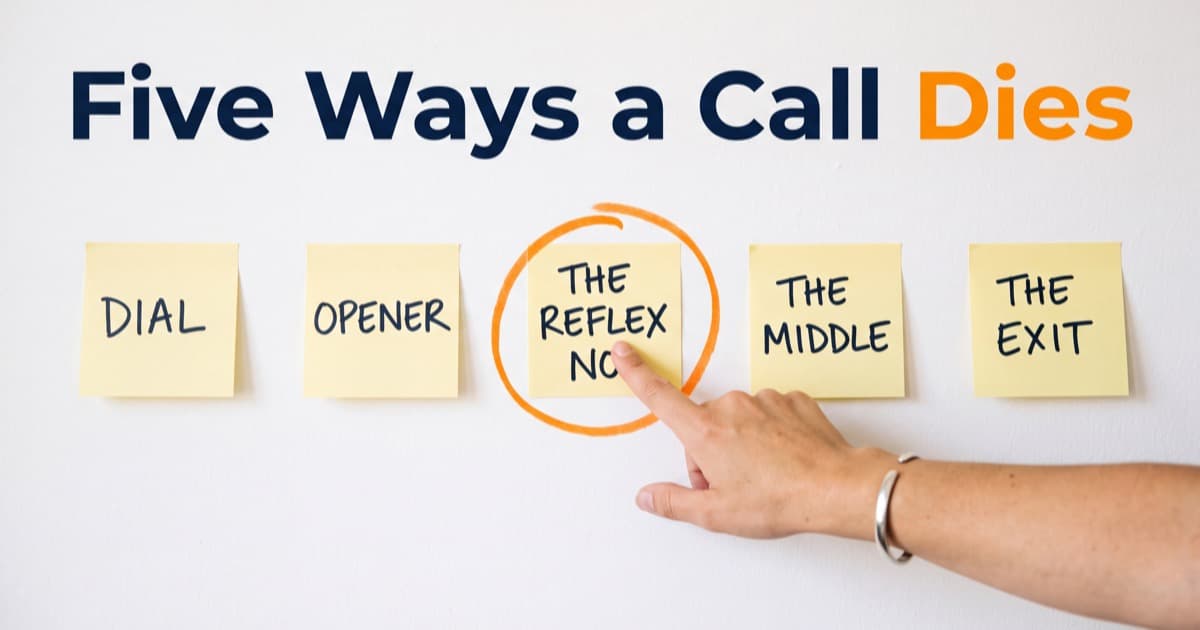
Most cold calling advice is organized around topics. Openers here, objections there, voicemail in its own post, discovery somewhere else. That is a fine way to file information and a terrible way to fix a call, because a call does not fail at a topic. It fails at a moment, and there are only five of them.
Watch a hundred recorded cold calls and the endings cluster hard. The rep never dials. The prospect checks out inside the first ten seconds. The first pushback gets answered with a rebuttal and the call goes cold. The middle drifts into a monologue that nobody interrupts because nobody is listening. Or the call goes well and then ends with "I'll send something over," which is not a next step, it is a polite burial.
This guide walks the call in order, moment by moment, with the specific language that works at each one and a full worked call at the end in both a weak and a strong version. If you only fix one thing, fix the moment where your calls actually end, not the one you find most interesting to read about.
Moment one: the dial, before a single word is spoken
The first place calls die is before they exist. A rep with a list of sixty numbers who makes eleven calls did not have a scripting problem that day.
The stall is almost never about the pitch. It is about the ambiguity of what happens after your first sentence, which your nervous system reads as an unresolved threat and would rather you avoid. That is why "believe in the product" advice bounces off. It aims at confidence when the problem is a body deciding the next four seconds are dangerous.
Three things move this reliably.
Decide the first sentence, and only the first sentence. Do not rehearse the whole call before dialing. Commit to eight words you have already chosen. A call cannot go badly during your opening line, only after it, and shrinking the commitment is what gets the thumb to move.
Batch the dials so there is no decision between them. Every gap where you choose whether to call again is a gap where you can choose not to. Twenty numbers, back to back, then a break. The decision happens once, at the start of the block, not sixty times.
Do the ugly numbers first. The account you most want to talk to should not be your first call of the day, because your first call is your worst call. Spend it somewhere cheap.
If the dial is genuinely where your calls die, the longer treatment is in the three seconds before you dial, which is about the physical routine rather than the block structure.
Moment two: the first ten seconds
The opener is not where you persuade anyone. It is where you answer the only question the prospect is actually asking, which is "do I have to deal with this right now."
Everything that fails here fails the same way: it hides what the call is. "How are you doing today" hides it. "I'm calling to see if you'd be interested in learning more about" hides it. "Sorry to bother you" hides it and apologizes for existing at the same time. Prospects have heard thousands of these, and the hiding is the tell.
The openers that survive share a shape:
- Name yourself and the company in one short clause. Not a sentence about the company. A clause.
- Say what this is. "This is a cold call" is not a weakness, it is the single fastest way to stop sounding like every evasive script the prospect has hung up on. Honesty buys attention because it is rare.
- Ask for a small, specific yes. "Can I take thirty seconds and you can tell me to go away?" gives them control, which is the thing they were about to take by force.
What that sounds like: "Ray, it's Elena at Tallgrass. You don't know me and this is a cold call. Thirty seconds and you can tell me to get lost, fair?"
That is nine seconds. It contains no value proposition, no discovery question, and no attempt to be interesting. It does exactly one job, which is to convert an ambush into a conversation the prospect agreed to.
One thing to avoid: do not ask "is now a bad time." It offers a free exit and a lot of people take it out of reflex. Ask for a bounded yes instead, and say the bound out loud.
Moment three: is the first no actually an objection?
Right after the opener, something comes back. "We're all set." "Not interested." "Just send me an email." Most reps treat this as an objection and reach for a rebuttal, and the call is over four seconds later.
It is almost never an objection. An objection is a considered position about your offer, which is impossible eight seconds into a call about a product they have not heard described. What you got is a reflex: a scripted brush-off aimed at a category, not at you. Those two things need completely different responses, and confusing them is the most expensive habit in cold calling. The distinction is worth its own read in brush-off versus real objection.
The move on a reflex is not to argue. It is to acknowledge it honestly, then swap the abstract thing they are refusing for a concrete thing they can react to.
"We're all set" answered badly: "Sure, but a lot of companies think they're all set until they see what we do differently."
Answered well: "Totally fair, you don't know why I'm calling yet. The reason I picked up the phone is that dispatchers at regional carriers keep telling me the same thing about overtime creeping in at the end of the week. If that's not a thing for you, I'll leave you alone."
The second version does three things the first does not. It agrees, which removes the fight. It gives a specific, checkable reason for the call. And it hands them a clean exit, which paradoxically is why they stay: nobody needs to escape a conversation they can leave at any time.
A real objection sounds different. "We signed with a vendor in March and we're locked in for two years" is a fact about their world, not a reflex. That one you take at face value, get the renewal month, and stop selling.
Moment four: the middle, where good calls quietly flatten
You got permission. You said something specific. They did not hang up. This is where most reps blow the call, and they blow it by talking.
The middle of a cold call has one job: find out whether the thing you assumed is actually true for this account, in their words, with a number attached if you can get one. That is it. It is not a demo, not a pitch, and not a discovery call, which is a separate conversation you have not earned yet.
The failure mode is the monologue. The prospect says something mildly encouraging, the rep feels the opening, and out comes ninety seconds of product. Watch the talk ratio on any recorded call that went nowhere and it will be lopsided in exactly this stretch. Reps who fix nothing else but this get better results within a week, which is the whole argument in you are probably talking too much.
What to do instead is unglamorous: ask one question, then ask a follow-up to the answer rather than moving to your next prepared question.
- "How are you handling that today?" then "How long does that usually take?"
- "Is that a monthly headache or an every-week one?" then "What does it cost you when it slips?"
- "Who ends up dealing with it when it goes wrong?" then "Is that the person who'd care about fixing it?"
Two questions deep on one thread beats one question each on six threads, every time. The first answer is the version everyone gives. The second is the one with the detail your follow-up email can actually use.
Keep it short. Four or five minutes is a good cold call. You are not trying to close anything here. You are trying to earn thirty minutes on a calendar with enough context that the thirty minutes is worth having.
Moment five: the exit
A call can go well for six minutes and still produce nothing, and the way that happens is the soft ending. "I'll send you some information." "Let me follow up next week." "I'll shoot you an email and we can go from there."
None of those are next steps. They are the sound of a rep who did not want to risk the ask at the end after a friendly conversation.
Ask for the specific thing, with a time attached, and shut up:
"Based on what you just said about the end-of-week overtime, I'd want twenty minutes to show you what two other regional carriers changed. Thursday at 10, or is Friday morning easier?"
Two dates, not "does sometime next week work." A named reason tied to what they told you, not a generic meeting request. And then silence, which is the hardest part and the part that works.
If the answer is no, get something smaller and real: permission to send one specific thing plus a date to check back, confirmed out loud. "I'll send the one-pager on the overtime piece today and call you on the 12th, does that work?" is a next step. "I'll send something over" is not.
The same call, run badly and run well
Fictional but ordinary: Elena sells driver-scheduling software at Tallgrass. Ray Okafor is the operations director at Kestrel Haulage, a regional trucking company with about ninety drivers. Same rep, same prospect, two versions.
The weak version:
Elena: Hi, is this Ray? Hey Ray, how are you doing today?
Ray: ...Fine. Who's this?
Elena: Great, great. So my name's Elena and I'm with Tallgrass, we're a workforce management platform for the transportation industry, and I was reaching out because we help carriers like yourselves optimize driver scheduling and reduce overtime spend. Is that something you'd be interested in learning more about?
Ray: We're all set on that, thanks.
Elena: Sure, sure. A lot of companies tell me that at first, but what makes us different is we actually integrate directly with your ELD data, so unlike most tools you're getting real time visibility into hours of service, and we've seen customers cut overtime by up to thirty percent.
Ray: Yeah, look, I'm in the middle of something. Send me an email.
Elena: Absolutely, what's the best address for you?
Ray: It's on the website. Thanks. (click)
What went wrong, in order. "How are you doing today" cost her the first three seconds and signaled a script. The self-introduction was a paragraph about a company Ray has no reason to care about, and by the time she asked her question he had stopped listening. "Is that something you'd be interested in" is a yes-or-no question about an abstraction, and the safe answer to an abstraction is always no. Then the reflex arrived and she argued with it, which converted a soft brush-off into a firm one. The "up to thirty percent" claim landed on a man who had already decided the call was over. And the ending is the real loss: she took the email dodge as a win and hung up with nothing, not even a callback date.
The strong version:
Elena: Ray, it's Elena at Tallgrass. You don't know me and this is a cold call. Thirty seconds and you can tell me to get lost, fair?
Ray: (pause) Go ahead.
Elena: The reason I called you specifically: ops directors at carriers your size keep telling me that overtime creeps in Thursday and Friday because dispatch is patching gaps by hand, and nobody sees it until payroll runs. Is that a real thing at Kestrel or am I off?
Ray: I mean, it's not wrong. We do a lot of manual reshuffling late in the week.
Elena: How are you handling it today, is that a spreadsheet or something in the TMS?
Ray: Spreadsheet, mostly. Two dispatchers own it.
Elena: And when a driver goes over, when do you find out?
Ray: Honestly, payroll. Which is too late to do anything about it.
Elena: That's the part I'd want twenty minutes on. Two other regional carriers moved that visibility to Wednesday instead of payday, and the change wasn't the software, it was who got the alert. Thursday at 10, or is Friday morning easier?
Ray: Thursday's bad. Friday, before ten.
Elena: Friday at 9:30, I'll send the invite in the next five minutes so it's on your calendar before this slips. Thanks Ray.
What changed. The opener named the call for what it was and asked for a bounded yes, so Ray's "go ahead" was a decision he made rather than an ambush he tolerated. The reason for the call was specific and checkable, and it ended in "or am I off," which is a genuine invitation to disagree and therefore gets an honest answer. Then she stayed on one thread for three exchanges instead of jumping to product, and the third exchange produced the sentence the whole call was worth: they find out at payroll, which is too late. Nothing Elena said generated that. The follow-up questions did.
The close reuses Ray's own words, attaches a reason, offers two times, and confirms an action with a deadline attached. She never described the product. She did not need to.
Where this breaks
Treating a real objection like a reflex. The techniques for a brush-off applied to a genuine constraint make you sound like you are not listening. If they tell you a contract term, a hiring freeze, or a reorg, believe them, get the date, and get off the phone politely. That call is a future call.
Running discovery on a cold call. Ten well-crafted questions turn permission into an interrogation. Two questions on one thread, then ask for the meeting. Save the rest for a call they agreed to have.
Confusing volume with practice. A hundred dials where you make the same mistake at moment three teaches you the mistake. Reps improve when a specific moment gets rehearsed in isolation, which is the argument in cold call practice and the reason listening back to one recording usually beats twenty more dials.
Fixing the opener forever. The opener is the most rewritten and least decisive part of a cold call. Once it is honest and bounded, it is done. Almost all remaining upside is in moments three, four, and five.
Reading instead of talking. Every one of these moves is a mouth skill. It reads as obvious and collapses under real time pressure, because on a live call you have about one second to choose, not the ten seconds you have while reading this sentence. That gap is why so many reps can explain good cold calling and not perform it.
How to actually rehearse this
Pick one moment. Not the call, one moment. Run it out loud twenty times against a prospect who pushes back, until the response arrives without a search.
Most reps skip this because the only rehearsal options historically were a colleague who is nice to you, a manager whose time is scarce, or live prospects who cost you money when you experiment. Talking to yourself in the car is better than nothing and still misses the thing that matters, which is that a real counterpart interrupts, goes quiet, and says the annoying version of the objection instead of the tidy one. If you have nobody to run it with, the structured version of solo work is in how to practice cold calling alone.
Two of the moments have their own longer treatments. The opener is graded line by line in four cold call opening lines, and the question of how much of the call to fix word for word is settled in cold call script vs talk track.
Where you run the reps is a separate question from what you run. If you are choosing a format, sales roleplay practice online compares them; a cold call simulator and practicing sales calls with AI cover what a tool has to do to be worth the time, and a sales training app covers what most of them do instead. If you are running the reps for somebody else, mock sales call practice is the manager's version, an AI sales training tool for SDRs is the team rollout, and preparing for a mock sales call interview is the candidate's.
The five moments are not a framework to memorize. They are a diagnostic. Listen to your last three calls that went nowhere, find which of the five they died at, and rehearse only that one until it stops being the answer.