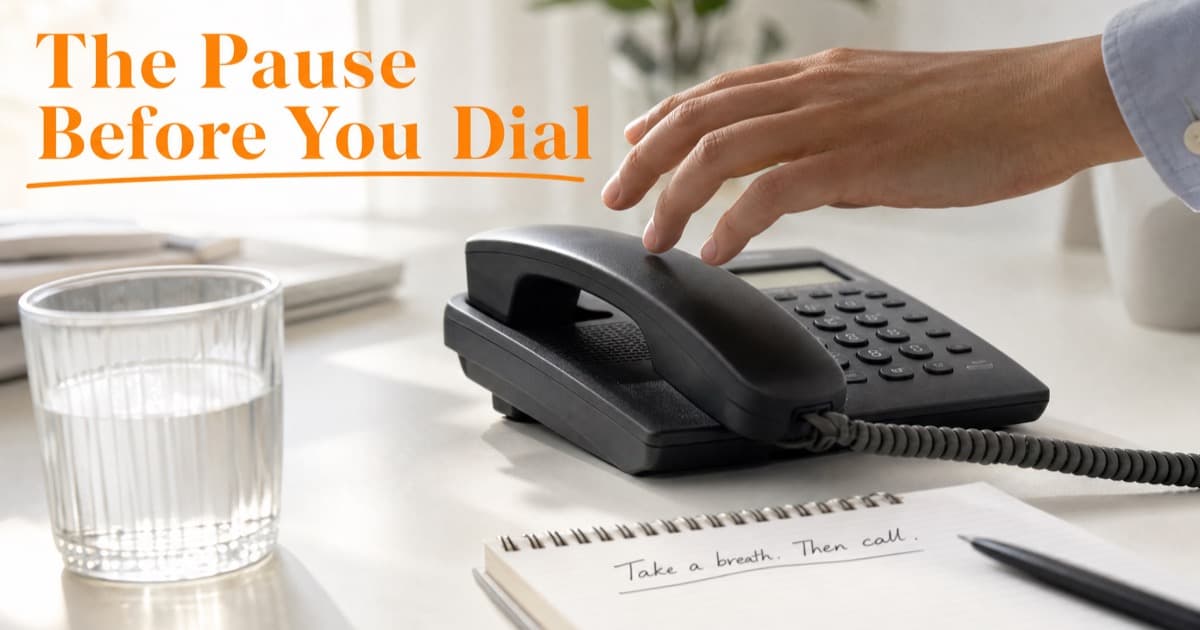
You have the list open. The number is right there. Your hand is on the phone, or hovering over the dial button, and nothing happens. Not because you do not know what to say. You could recite your opener in your sleep. It is the three or four seconds before the first ring that trip you up, over and over, every single day, and no amount of script practice has ever touched it.
That is worth naming precisely, because most advice aims at the wrong target. "Believe in your product." "Visualize success." "Remember they need you more than you need them." None of that reaches the part of you that is actually stalling, because the stall is not a belief problem. It is a body that has decided, correctly or not, that the next four seconds contain a threat, and it wants you to not do the thing.
People call this cold call anxiety, and most of them describe it as a fear of cold calling in general. It is narrower than that. The fear of cold calling is almost never about the whole call, it is about a specific three-second window, and that is a much smaller thing to fix.
The fix is not more confidence. It is a routine that gets your body out of the way so your mouth can do what it already knows how to do.
Why doesn't dialing more calls fix the fear of cold calling?
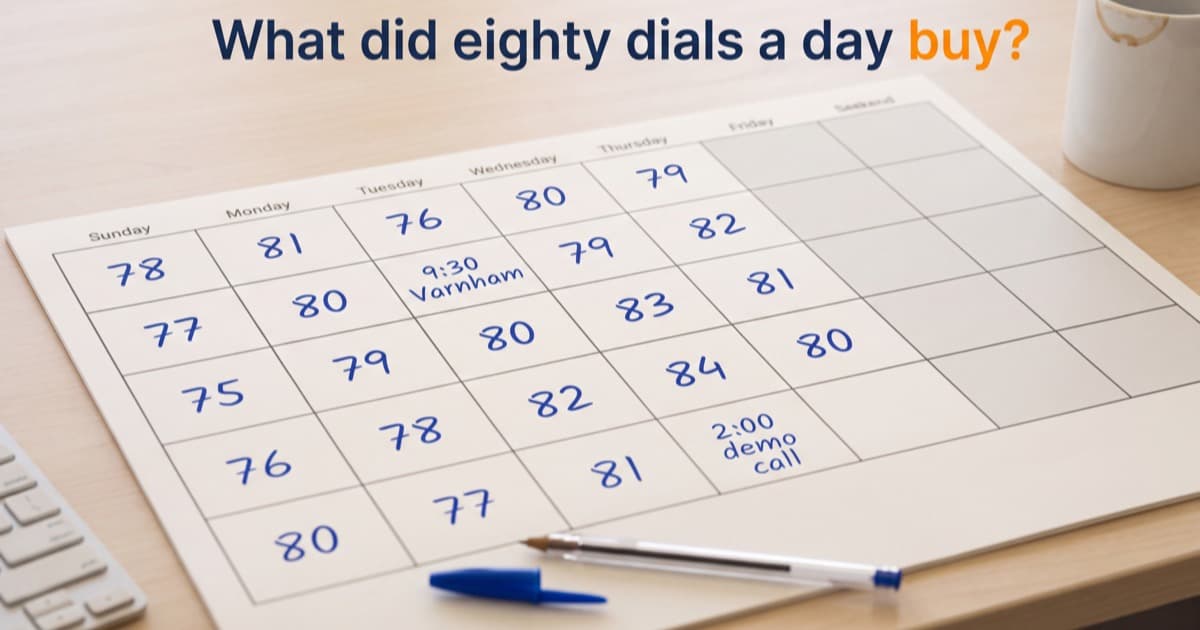
The standard advice is exposure: dial enough times and the fear fades. It is not wrong, exactly. Exposure does work, eventually, for most people. But it has a failure mode nobody mentions: if every one of those exposures is also a spike of the same unmanaged anxiety, you are not desensitizing yourself. You are rehearsing the spike. A hundred reps of "freeze, force it out, feel bad" trains the freeze just as effectively as it trains the calling.
The reps that actually shrink the anxiety are the ones where something is different about the moment right before you dial. Not the pitch. Not the number of calls. The three seconds.
There is also a second reason volume alone underperforms: most reps' anxiety is not really about rejection, even though that is what it presents as. It is about the ambiguity of the silence after you say your first sentence and before the prospect reacts. You do not know if the next sound is going to be a question, a hang-up, or "who is this." Your brain treats an unresolved threat as worse than a confirmed bad outcome, which is why the dial itself, not the actual rejection, is where the dread concentrates. Once you understand that the anxiety is aimed at ambiguity, not at the prospect, you can build a routine that resolves the ambiguity early instead of a routine that tries to talk yourself into feeling brave.
The routine: name it, breathe it out, commit to the first line only
This takes under a minute and it works because it changes what your body is bracing for.
Name it out loud, quietly. Before you dial, say to yourself: "My chest is tight, that's normal, I'm about to make a call." Naming a physical sensation, specifically, moves activity out of the part of your brain that is spiraling and into the part that can plan. This is not a mindset trick. It is a documented effect of putting feeling into words, and it takes four seconds.
Exhale longer than you inhale. One slow breath, four counts in, six counts out. A longer exhale is the fastest lever you have on your nervous system's alarm state; it works in one breath because it is a direct physiological signal, not a thought you have to believe.
Commit to one line, not the whole call. Do not think about the pitch, the objections, or how the call ends. Decide only what your first sentence is, say it in your head once, and dial. The call cannot go badly in the first sentence. It can only go badly after, and after has not happened yet. Shrinking your commitment to "I will say this one sentence" is what actually gets your thumb to press dial, because you are no longer agreeing to survive an entire unpredictable conversation. You are agreeing to say eight words you have already chosen.
Do this before every call for two weeks and the stall gets shorter each time, because you are training the moment before the dial, which is the part that was actually broken.
What it sounds like when the routine is skipped versus used
Same rep, same list, two consecutive calls twenty minutes apart. The prospect is a fictional facilities manager at a mid-size property management company.
Skipped the routine:
(Rep stares at the number for eleven seconds, exhales sharply, dials fast to "get it over with")
Rep: Hi, um, is this Priya? Hey, this is, uh, this is Marcus calling from Fieldline, sorry to bother you, do you have like two minutes, I know this is probably a bad time...
Priya: Kind of, what's this about?
Rep: Right, so, we help property management companies with their maintenance scheduling, and I was just calling to see if that's something you might be interested in learning more about?
Priya: We're all set, thanks. (click)
What went wrong: everything before "Fieldline" is the sound of a nervous system that never got resolved, not a scripting problem. "Sorry to bother you" and "probably a bad time" are apologies for existing, and they told Priya, before any pitch, that this call was not worth her attention. The rep dialed fast specifically to escape the discomfort of waiting, and that same urgency leaked into the pacing of everything that followed.
Used the routine:
(Rep names the tight chest, one slow exhale, commits to the opener: "name it, this is a cold call, ask permission")
Rep: Priya, it's Marcus from Fieldline. You don't know me and this is a cold call. I'll be quick if you give me the go-ahead, want me to?
Priya: ...sure, go ahead.
Rep: I talk to facilities managers who are still building their maintenance schedule in spreadsheets, and most of them tell me a missed inspection is the thing that actually costs them, not the scheduling itself. Does that sound familiar?
Priya: Honestly, yeah. We had one slip through last quarter and it was a whole thing.
What changed: the opener is almost the same information, but nothing in it is apologizing. Naming the call for what it is, then asking a direct yes-or-no question, replaces four seconds of dread with four seconds of structure. Priya answers a specific question instead of deciding whether to keep listening to a monologue. None of this required Marcus to feel confident. It required him to have already decided, before the ring, exactly what his first sentence was going to be.
Where getting over the fear goes wrong
Trying to "feel ready" before dialing. Waiting for the anxiety to go away before you call is waiting for a weather forecast that never clears. The routine is not designed to make the feeling disappear. It is designed to let you dial while the feeling is still there.
Over-preparing the whole call instead of just the opener. Rehearsing every possible branch of the conversation multiplies the number of things your brain can worry about in those three seconds. Commit to the first line only; the rest of the call is a response to a real human, not a script you can pre-load anyway.
Treating one bad call as proof the routine doesn't work. A hang-up after a well-run opener is not evidence of failure. It is a normal outcome of cold calling that has nothing to do with whether your three seconds before the dial were handled well.
Skipping the routine on "easy" calls. The anxiety does not check your list for warm leads before it shows up. Run the routine every time, including on calls you expect to go fine, until it is automatic rather than something you remember to do only when you are already spiraling.
The fear of cold calling does not go away because you got braver. It goes away because the three seconds before you dial stopped being unmanaged, one call at a time.
The dial is only the first of five moments where cold calls die. The other four are in the cold calling guide.