"How many cold calls should I be doing a day?"
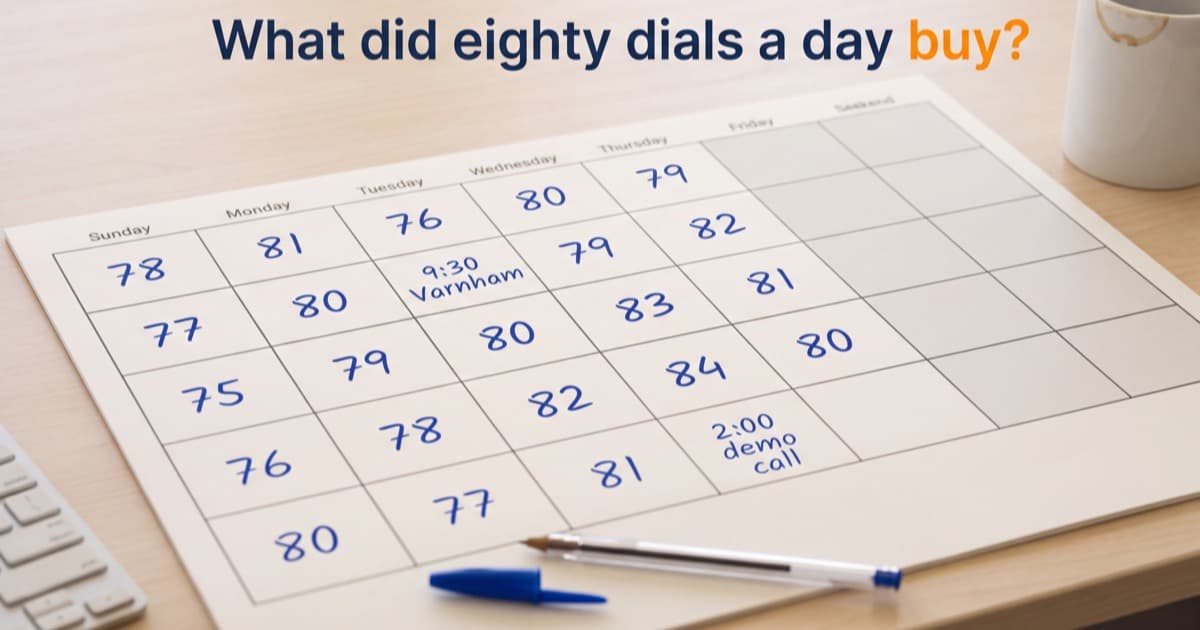
Wesley asked it in his second week and got the answer most reps get: a number. Eighty. He hit eighty for a month, by working the list in the order it was built, by leaving fourteen voicemails between 2:00 and 3:00 because a voicemail moves the counter as fast as anything else, and by getting off two promising calls early so the afternoon block would still clear. At the end of the month he had a perfect activity dashboard and two meetings.
The number was not the problem. The number being the only thing anyone looked at was the problem.
So here is the short answer. For most business-to-business SDRs working a researched list, sixty to eighty dials is a heavy day and forty to sixty is an ordinary one, but the dial count is an output of how you build the day, not a target you should be setting. The number worth setting is conversations: roughly four to eight real ones, depending on who you call and how hard they are to reach. Set that, build two or three blocks capable of producing it, and let the dial count land where it lands.
Where the hundred-dials-a-day rule came from
The hundred-dial day is inherited, not calculated. It comes from a period when a business number rang a phone on a desk, an unknown caller ID was mildly interesting rather than presumed hostile, and nothing labeled you as spam before the second ring. Connect rates ran high enough that volume was a fair proxy for conversations, and a manager who set a hundred dials was really setting eight or ten conversations without saying so.
Most of that is gone. Mobile numbers carry screening by default, carrier labeling flags high-volume lines, and a large share of the people you want now answer nothing they cannot place. The arithmetic moved with it. At a five percent conversation rate, a hundred dials returns five conversations. At two percent, which is normal for a cold mobile list into a guarded role, the same hundred dials returns two.
The rule survives anyway because it is easy to manage. Dials are countable in the CRM by lunchtime and they let a manager coach effort without listening to a single call. That is an honest reason to track them and a bad reason to make them the target, because every metric that is easy to move gets moved, and the cheapest way to move a dial count is to make each dial worth less.
Your day produces four numbers, and dials is the least useful one
A calling day produces four numbers and they are not interchangeable. Watch only the first one and you optimize the part of the job that costs nothing to fake.
| Number | What it rewards | How it fails you |
|---|---|---|
| Dials placed | Sitting down and starting | Rises fastest when you stop researching, stop waiting out rings, and hang up early |
| Connects | Calling at hours your buyer is reachable | Counts gatekeepers, wrong numbers and the word "no" as a win |
| Conversations past sixty seconds | An opener that earns a second sentence | Slow to accumulate, so a bad morning feels like a bad career |
| Next steps agreed | The whole call, end to end | Too rare to steer a single day by; it reads weekly, not hourly |
The practical split is this. Set your target on conversations, read connects to decide when you call, and treat dials as a diagnostic. A dial count that climbs while conversations stay flat is telling you the list has gone stale or the opener has stopped working. A dial count that falls while conversations hold is usually good news: you found better hours, or you cut the accounts that were never going to answer. Next steps stay on the weekly review, because judging a single Tuesday on them is how a fine calling day gets recorded as a failure.
How many cold calls per day can you make before the quality drops?
Most reps hold their standard for about ninety minutes of continuous calling, or roughly thirty to fifty dials, and then start shedding the parts of the call that take effort. The tell is not tone. It is that you stop reading the account before the line rings, you stop pausing after your first sentence, and you recite the value line you have said forty times instead of the one built for the company in front of you.
So build the day out of blocks rather than out of a total. Two blocks of ninety minutes, or three of sixty, with a real gap between them, will produce fifty to seventy dials for most people without the second half being worse than the first. Inside each block, budget two to four minutes per account for a reason to call. Sixty researched dials is a genuinely full day, and a hundred is only reachable by skipping the research, which is the same as choosing a lower conversation rate on purpose.
Your list sets a second ceiling, and it is the one most teams hit first. A two-hundred-account territory worked at eighty dials a day is exhausted inside a week, and by day nine you are on your fourth touch of people who have already decided. Dial volume does not create accounts. It only decides how fast you run out of them.
What a worn-out opener sounds like from the other end
Wesley sells a hiring platform for field service technicians. He is calling Sabine, operations manager at Varnham Pest Control, a regional company running nineteen trucks that staffs up hard before termite season.
The 4:38 pass, dial seventy-one of an eighty-dial target, forty minutes left in the block.
Wesley: Hi, is this Sabine? Wesley here, I'll be quick. We work with field service companies on technician hiring, we help you fill tech roles faster and cut your time to hire. Is hiring something you're working on right now?
Sabine: We use a recruiter.
Wesley: Got it, got it. A lot of the companies we work with use recruiters too and they still find value in what we do, would it make sense to get fifteen minutes on the calendar so I can walk you through it?
Sabine: Send me something. I'm walking into a thing.
Wesley: Sure, what's the best email?
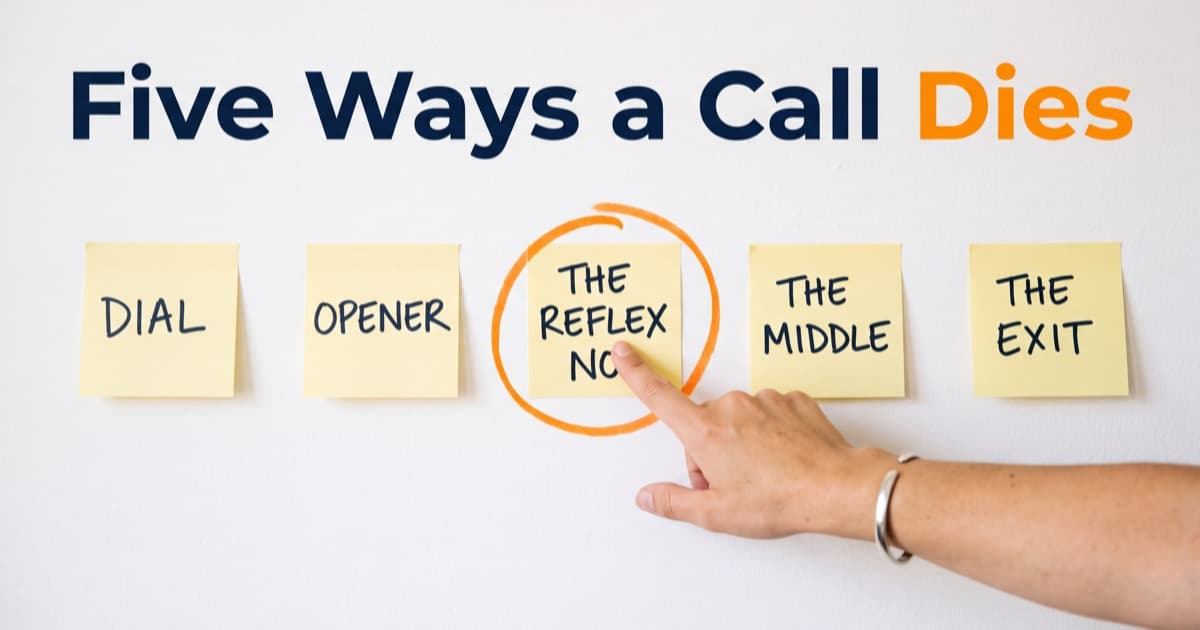
He got the email, a dial, a connect, and something the dashboard will record as a conversation. What he did not get is a single fact about Varnham. Notice the shape of it: the opener names a category rather than a company, the first objection is answered with a sentence about other customers, and the ask is for time rather than for an answer. Each of those shortcuts saves about twenty seconds, and seventy-one dials in, twenty seconds is the currency he is spending.
The 9:20 pass, the next morning, dial twelve, after four minutes on Varnham's careers page.
Wesley: Sabine, it's Wesley, I'm calling cold, you can tell me to go away. You've had a tech role posted since the start of June and I noticed you're running with nineteen trucks. Are you going into termite season a body or two short?
Sabine: How do you know how many trucks we run?
Wesley: It's on your service area page. I count trucks before I call, it's a strange hobby.
Sabine: We're two short. Three if I'm honest, because one of them is leaving.
Wesley: That's the part I wanted to ask about. When a route is short in April, what actually gives? Do you push jobs out, or does somebody run a double route?
Sabine: Double routes. Which is how I lose the next one.
Wesley: That's the pattern we usually get called about, and it is worth a proper conversation rather than me pitching at you now. Are you at your desk Thursday morning?
The difference is not enthusiasm and it is not a better script. Two specific facts, the posting date and the truck count, bought him the right to ask a real question, and the question got him the thing no pitch would have: Sabine saying out loud that short routes cost her the next technician. Admitting he was calling cold cost him nothing and removed the only thing she was suspicious about. That call took eleven minutes including research, and it was worth more than the other seventy.
Four ways a dial target damages the list you have
It reorders the list by ease. You call the accounts with a direct line first because they are fastest, not because they are best. The switchboard accounts drift to the end of the day, then to tomorrow, then to never.
It turns voicemail into production. Voicemails are the fastest way to move a counter, so a rep behind on dials at 3:00 will leave eleven of them. That is defensible when the message is built for that person, and waste when it exists to make the number.
It makes you end good calls early. A buyer who is talking is costing you dials. Nothing in a dial target separates the eight-minute call that just told you who signs off from the eight-minute call that went nowhere, so both feel like a problem at 4:15.
It burns your best accounts on your worst hours. If the top twenty accounts sit in the block where you are tired, they get the tired version. Fixing that costs nothing: call the accounts you cannot afford to waste inside your first thirty dials, and use the best time to make cold calls to find which hours those are on your own list rather than a published average.
Some days you genuinely should push volume: a brand new list, an event follow-up week, a stretch where you need data on a new opener fast. Volume is a fine tool. It is a poor identity.
Pick tomorrow's number before you sit down
Tomorrow, set one number and let it be conversations. Five is a reasonable place to start for most business-to-business lists. Write it on paper, sit down for a ninety-minute block, and end the block when the time runs out rather than when a dial count does. Count your dials afterward, once, and write that down too. In two weeks those two columns give you your real conversation rate, and every other question here becomes arithmetic.
One more constraint: the account you most want a meeting with gets called inside your first ten dials, fully researched, before anything has worn down. If that makes you want to move it to the afternoon, that is a separate problem with its own fix, covered in the fear of cold calling. The rest of the method, block by block, is in our cold calling guide.