
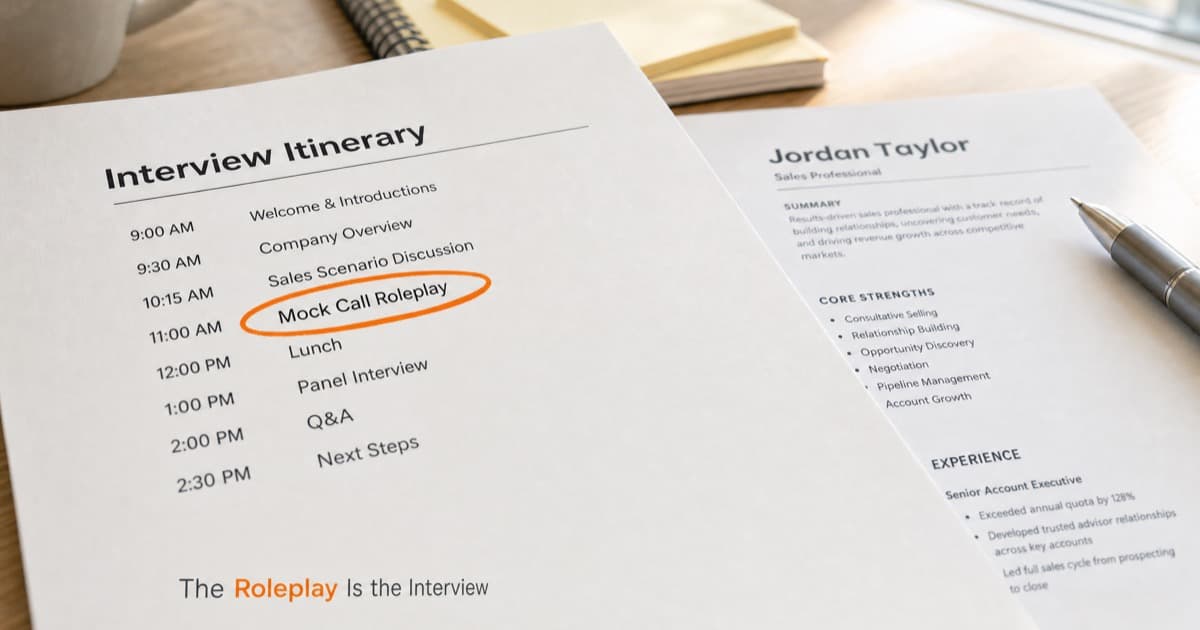
You get the callback for round two, and the recruiter mentions it almost in passing: "This round is a mock call. You'll be pitching one of our products to Bogdan, who'll play the prospect." You hang up and realize you've spent the last week preparing answers to "tell me about a time you handled an objection," and none of that prepares you to actually handle one, live, in front of the person deciding whether to hire you.
That gap is the whole problem. A behavioral question rewards a good story about a past call. A mock call rewards the call itself, produced in real time, with someone pushing back on what you say instead of just listening to what you claim you'd say. Most candidates walk in having rehearsed the story and never having rehearsed the moment, and it shows in the first thirty seconds.
What is a mock sales call interview actually scoring?
Hiring managers who run this exercise aren't grading you against a script they have in their head. They're watching for a small set of things that a resume and a behavioral answer can't show them.
Whether you listen before you pitch. A candidate who opens with a rehearsed value prop and never adjusts it after the "prospect" says something specific is showing exactly how they'll sell on day one: at the customer, not with them.
How you handle the first real pushback. Almost every mock call includes a planted objection, budget, timing, an existing vendor, because the interviewer needs to see what happens when the conversation stops going your way. A rep who freezes, over-apologizes, or reads from memory here is showing the interviewer their ceiling under real pressure.
Whether you ask before you assume. Discovery inside a thirty-second pitch is hard to fake. Interviewers notice the difference between a candidate who asks one sharp question and adjusts, and one who runs the same pitch regardless of the answer.
Composure, not performance. The exercise isn't measuring how polished you sound. It's measuring whether you can keep a conversation moving when it gets uncomfortable, which is the actual job.
None of that shows up if you spend your prep time memorizing a pitch paragraph. It shows up if you spend your prep time practicing the conversation, including the part where it doesn't go according to plan.
The play: prepare the shape, not the script
The candidates who do well in this exercise aren't the ones with the smoothest opening line. They're the ones who prepared a structure they can run under pressure and left the words themselves flexible enough to respond to whatever the interviewer actually says.
That structure is small: a short opener that states why you're calling, one open question that lets the other person tell you what matters to them, and a response plan for the two or three objections that show up in almost every mock call (this isn't a priority right now, we already use something for this, send me information instead). Memorize the shape. Never memorize the sentence, because the first thing that breaks a scripted answer is a prospect who doesn't say the line you rehearsed against.
A mock sales call interview example, scored line by line
Two candidates are given the identical prompt for an SDR role at a fictional project-management software company: cold-call Ellis, an operations manager at a 40-person logistics company, and pitch the product. The interviewer, Bogdan, plays Ellis.
Candidate one, scripted:
Soren: Hi Ellis, this is Soren calling from Thurlow Ops. We help operations teams cut project delays by up to 30% with automated task tracking. Do you have two minutes?
Bogdan (as Ellis): We actually just rolled out a new PM tool three months ago.
Soren: Totally understand. A lot of teams feel that way at first, but once they see what we offer, they usually find room to switch. Can I walk you through a few features?
Soren never engages with what Ellis actually said. "A lot of teams feel that way at first" is a stock line that ignores the specific fact he was just handed: a three-month-old rollout, which means there's a real switching cost and probably a recent, still-fresh decision behind it. He's running the pitch he prepared regardless of the answer he got, and Bogdan can tell within one exchange that he isn't listening.
Candidate two, adaptive:
Noor: Hi Ellis, this is Noor from Thurlow Ops. I'll be quick. We work with operations teams on project delays. Is now an okay time, or should I catch you later?
Bogdan (as Ellis): We actually just rolled out a new PM tool three months ago.
Noor: Got it, that's pretty recent. What made the team pick that one over what you had before?
Bogdan (as Ellis): Mostly better task visibility across teams.
Noor: Makes sense. We usually come in on the reporting side, once a tool's in place, most teams still end up building manual status reports for leadership on top of it. Is that something you're dealing with, or has the new tool solved that too?
Noor doesn't fight the objection or try to talk past it. She treats "we just rolled out a new tool" as information and asks a question that could genuinely go either way, if Ellis says the new tool already solved the reporting problem, she has nothing left to sell and would need to close gracefully. That's the difference Bogdan is actually scoring: not a smoother recovery line, but a candidate willing to let the prospect's answer change what happens next.
Common mistakes candidates make preparing for this
Treating it like a monologue to memorize. The interviewer is going to respond like a real prospect, not read along with your script. A memorized paragraph has no branch for "what if they push back here," and that's exactly where it breaks.
Preparing only the pitch and skipping the objection. Almost every mock call includes at least one planted objection. If your prep stops at the opener, you're unprepared for the part of the exercise that actually matters most.
Over-explaining after a good answer. Once you've handled the pushback, stop. Candidates under interview pressure often keep talking past the point where they've made their case, which reads as nerves, not confidence.
Practicing out loud alone instead of against pushback. Rehearsing your pitch in the mirror tells you whether you can say the words. It doesn't tell you what happens the first time someone interrupts you with an objection you didn't expect, which is the actual test.
Forgetting this is a conversation, not a performance review. The candidates who come across best treat Bogdan like an actual person on the other end of the call, not a judge to impress. That shift alone changes how naturally the questions land.
The mock call is a strange kind of interview question: there's no story to tell about it in advance, because the only way to prepare for it is to actually run it, more than once, against something that pushes back the way a real prospect would. Rehearsing the shape of the call, and letting the words stay flexible, is what separates a candidate who sounds ready from one who actually is.
For the call itself rather than the interview version of it, the cold calling guide covers the five moments an interviewer is usually testing you against.