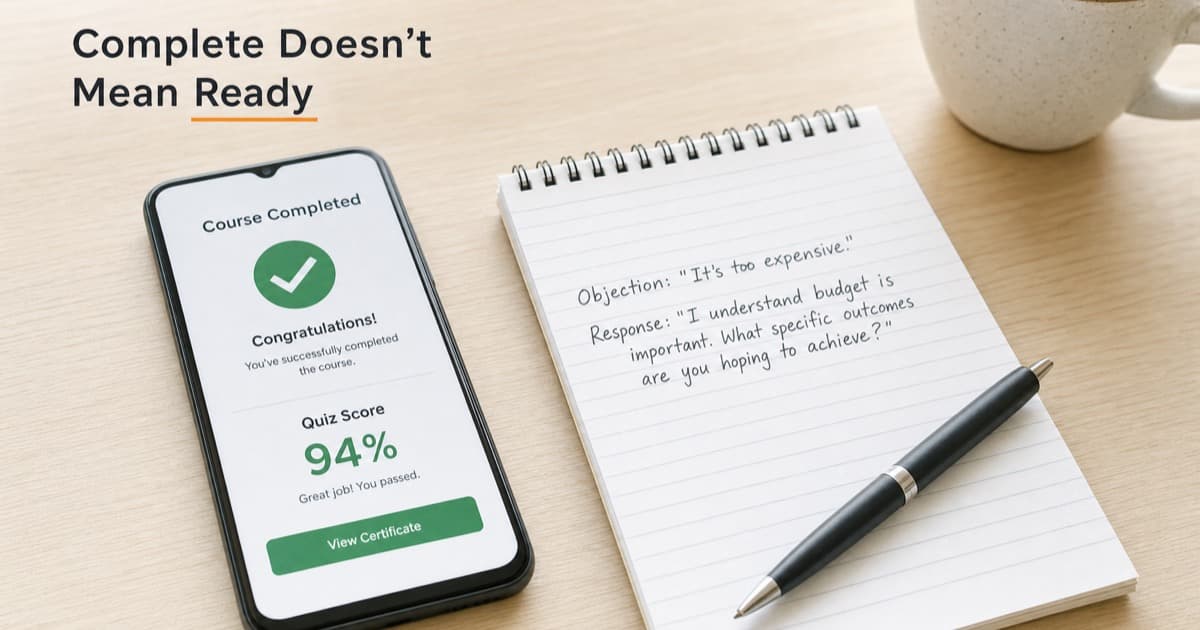
You finish the module. Green checkmark, 94% on the quiz, "Handling Price Objections" marked complete. Then a prospect tells you their budget is frozen until next quarter, and none of it comes back. Not because you didn't pay attention, but because reading four bullet points about reframing a price objection and actually reframing one out loud, in real time, while someone pushes back, are two different skills, and the app only ever tested the first one.
That's the gap most people hit with a sales training app before they can name it. The app isn't lying about what it teaches. It's just measuring the wrong thing: whether you can recognize the right answer on a quiz, not whether you can produce it under pressure. A rep can pass every module in a course and still freeze on the exact objection the course covered, because recognizing "reframe around ROI" in a multiple-choice list and generating that reframe live, mid-sentence, with a stranger waiting on the other end, don't draw on the same muscle.
The gap stays invisible for a while because everything about the app feels like progress. The streak counter goes up, the completion percentage climbs, the quiz scores look good enough to screenshot. None of that is fake, exactly, it just isn't measuring the thing you actually need on a call, which is whether you can hold your own when someone pushes back on what you just said. That only shows up once you're tested against a moving target instead of a fixed answer key, and most apps in this category never build that test in.
What separates a training app from a video library?
A sales training app earns the word "training" when it does three things a video course structurally cannot.
It requires an unscripted response, not a selected one. Multiple choice and fill-in-the-blank test recognition. The only way to test whether you can actually handle an objection is to make you respond to one out loud, in your own words, with no menu of pre-written options to pick from. If the app never puts you in that position, it's a content library with a completion tracker.
It reacts to what you actually say, not to which button you pressed. A real prospect doesn't grade your answer against a rubric and move to the next slide. They push back on what was weak in it. A tool worth calling training does the same: if your reframe was vague, the persona presses for specifics instead of rewarding you with a green checkmark for effort.
It lets you fail somewhere that doesn't cost you a deal. The entire value of a practice app over a real call is that freezing, fumbling, or going blank on an objection is free. If the app only ever shows you good answers instead of letting you generate a bad one and feel it land badly, it's protecting you from the exact discomfort that builds the skill.
Get those three right and twenty minutes in the app does more for a rep's actual call performance than two hours of video. Get them wrong and you have a well-produced course that happens to live on a phone.
Recognizing an answer versus producing one
Emeka sells onboarding software to mid-market retailers. She's three weeks into ramp and just finished a module on the "we're already using a competitor" objection.
Content-app version, multiple choice:
App: A prospect says: "We already have a system for this, we're not looking to switch." What's your best response?
A) "Totally understand, I'll follow up in six months." B) "What would need to be true for switching to be worth the disruption?" C) "Our platform is actually rated higher than what you're using."
Emeka selects B. Correct! Asking about switching conditions uncovers whether the pain is real.
Emeka got the concept right. She could not tell you, five minutes later, what she'd actually say if a prospect said this to her, because she never had to produce the sentence. She recognized someone else's good answer among three options.
Practice-app version, live persona:
AI buyer: We already have a system for this. We're not looking to switch.
Emeka: Totally understand. A lot of teams we work with felt the same way before they saw the gap.
AI buyer: What gap? We haven't had any complaints.
Emeka: [pause] I mean, there's usually something that comes up eventually.
AI buyer: That's pretty vague. Is there a specific problem you think we have?
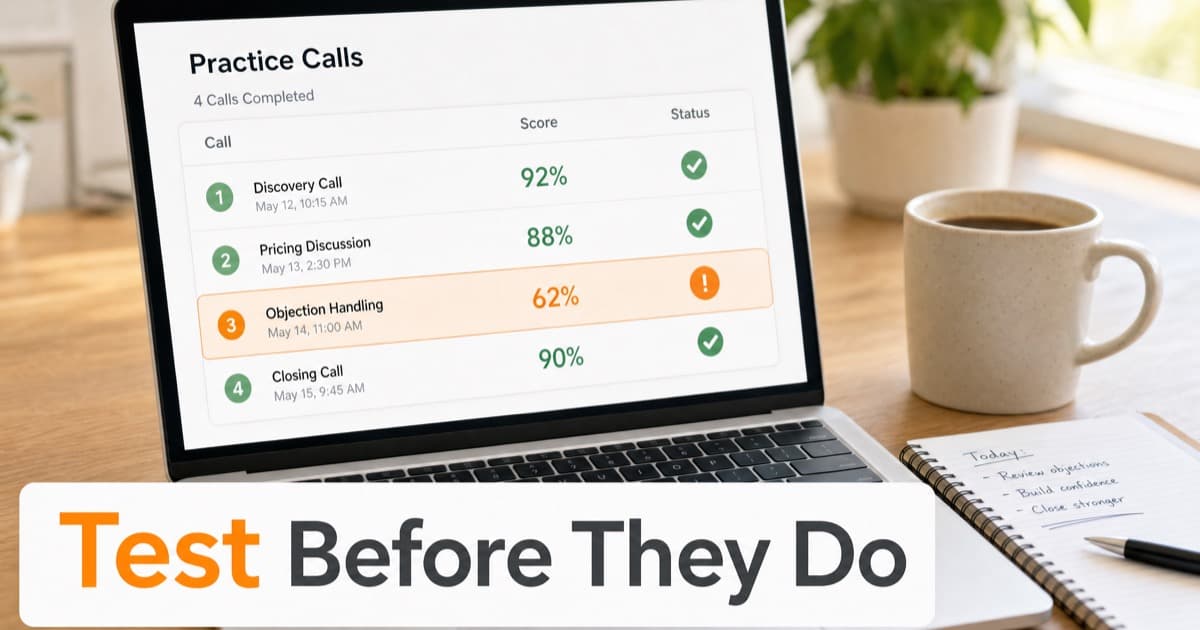
The persona didn't accept a vague answer, and Emeka heard, in real time, that "there's usually something that comes up eventually" is not an argument. That's a correction no quiz can deliver, because a quiz never puts her in the position of having to generate the sentence and watch it fail to land. She tries again the next round, this time naming an actual gap instead of gesturing at one, and the difference between those two attempts is the entire reason the app exists.
What to check before you trust an app with your ramp time
Ask what happens when you give a weak answer. If the app moves you forward regardless, or only shows you the "right" answer after you pick wrong, it isn't built to develop the skill of recovering from a bad first attempt, which is most of what a real call requires.
Check whether the difficulty changes as you improve. A rep in week one and the same rep in week eight shouldn't face an identical, static objection. If the app can't escalate resistance, you plateau against the app's ceiling instead of against an actual market.
Look for scoring on specifics, not a completion percentage. "87% complete" tells you nothing about whether you held your position under pressure. Useful scoring names the moment, held the opener, asked a follow-up instead of pivoting to script, folded on the price question, so you know exactly what to fix.
Don't confuse volume of content with volume of practice. An app with two hundred video lessons and one roleplay mode is still, functionally, a video library. Count how many times you're actually forced to speak, not how many lessons exist to watch.
Watch for a persona that just agrees. If the AI buyer says yes to everything after one line of pitch, every session ends in a fake win. The persona needs to hold out, the same way a real prospect who's heard your pitch category before actually does.
Weigh whether it fits into the ten minutes you actually have. The advantage of an app over a training room is that it should work in the gap before a shift starts or between two back-to-back calls. If a real practice session requires scheduling a slot and logging into a desktop tool, you've recreated the training room's scheduling problem inside your phone.
A sales training app that only tests what you recognize will always leave the same gap between the module and the real call: the gap between choosing the right answer and being able to say it, unscripted, while someone pushes back. Close that gap by practicing the conversation itself, not by getting better at multiple choice. Ten real, unscripted attempts at an objection will change how you handle it on a call faster than fifty more slides about it ever will.
For what to actually practice once you have found an app that makes you talk, the cold calling guide walks the call moment by moment.