Ask a sales floor whether reps should use a script and you get an argument that never resolves. One half says scripts make you sound like a robot reading a card. The other half points out that the newest rep on the team books more meetings than the veteran who improvises, and the newest rep is holding a script. Both sides have watched this happen. Neither is describing what actually made the difference.
The argument is stuck because the two words get used for the same object. A script and a talk track are not two levels of preparation, one rigid and one relaxed. They are different answers to what you do when the buyer says something you did not plan for, which on a cold call is roughly the fourth thing that happens.
What is the difference between a script and a talk track?
Cold calls follow a predictable shape for about three exchanges. You say who you are. The buyer says something short and unhelpful. You say your reason for calling. Up to here, a script and a talk track look identical, and a rep using either will sound fine.
Then the buyer does something off-plan. They ask what your company does. They say they already use a competitor. They ask how you got this number. They answer a question you have not asked yet. A script has one behavior available at that point: return to the next line. A talk track has a different one: register where you are and pick the next move that fits.
That is the whole distinction, and it is mechanical rather than stylistic. A script is an ordered list of sentences. A talk track is a small map with a handful of fixed sentences pinned to specific places on it. Reps who "sound scripted" are not suffering from formal language. They are suffering from having only one available next line regardless of what just happened, and a buyer hears that instantly, because the reply they receive does not refer to the thing they said.
It also explains the veteran who improvises badly. Total improvisation is a map with nothing pinned to it, so every call reinvents the reason for calling and the ask, and both depend on the rep's mood at 3pm on a Thursday. That failure is quiet. Nobody hangs up on a rambling call in any obvious way, and the rep books nothing and cannot say why.
Fix the sentences a buyer cannot move, and only those
The practical version of this is not "write a talk track instead of a script." It is deciding, sentence by sentence, which parts of your call earn the right to be fixed word for word.
Three categories belong in the script column, permanently.
The reason for the call. One sentence, memorized, delivered the same way every time. This is the highest-leverage sentence you will say, you will say it hundreds of times, and it should not be recomposed live. Fix it, test it, change it deliberately.
Any number or claim you cite. "Teams your size usually run four to six emergency callouts a week" is a factual assertion. Improvised numbers drift upward call by call until you are saying something you cannot support, and the first buyer who asks where the figure comes from ends the conversation. Write the number down. Say only that number.
The ask. The specific next step you want, phrased as a concrete request with a time attached. Reps who improvise the close reliably soften it, because softening feels safer in the moment. A fixed ask removes that choice.
Everything else is track. The transitions, the follow-up questions, the acknowledgements, the order you cover things in, the decision to skip a point because the buyer already made it. Their whole job is to respond to what was just said, so written out as lines they get read on the wrong call, and that is the exact sound people mean by "scripted."
A working call plan is therefore short: three or four fixed sentences, the checkpoints you want to hit in no particular order, and the objections you actually hear with a first move for each. If your call plan is a page of dialogue, it is a script pretending to be preparation.
The same call, read and then run
Rafael is an SDR at Orlin, a fictional contact center quality monitoring tool. The prospect is Bram Bell, director of support operations at Danforth Insurance, a fictional mid-size regional insurer. Same rep, same product, same buyer, same first thirty seconds. What differs is what happens after Bram interrupts.
Reading the script:
Rafael: Hi Bram, Rafael from Orlin. I'll be quick about why I'm calling. Support teams around your size are usually reviewing a couple of percent of their calls by hand, and the ones that go wrong are almost never in the sample.
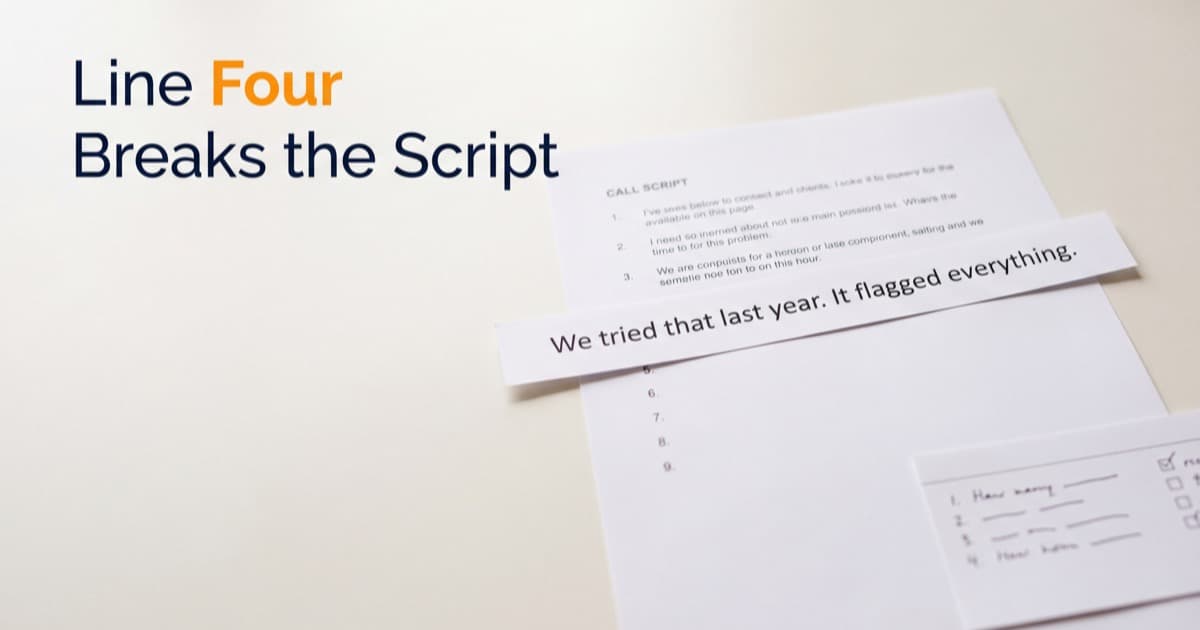
Bram: Hang on, are you the people who do the AI scoring thing? We looked at something like that last year and it flagged everything.
Rafael: Right, so what we do is automatically review one hundred percent of your support conversations and surface the ones that need a human to look at them, which typically saves QA managers about six hours a week.
Bram: Yeah, that's the same pitch we heard last year.
Rafael: Totally. And would you be open to a fifteen minute call next week to walk through how it works?
Bram: I don't think so. Send me something and I'll look at it.
Rafael's lines are individually fine. The problem is that Bram handed her the single most valuable thing on the call, an actual prior experience with a competing product that failed in a specific way, and she stepped over it to reach line three. Her answer describes her product to someone who has already told her they understand the category. By the time she asks for the meeting, she is asking Bram to re-run an evaluation that disappointed him, and she has given him no reason to expect a different result. The "send me something" is not a brush-off. It is the accurate response to what she offered.
Running the track:
Rafael: Hi Bram, Rafael from Orlin. I'll be quick about why I'm calling. Support teams around your size are usually reviewing a couple of percent of their calls by hand, and the ones that go wrong are almost never in the sample.
Bram: Hang on, are you the people who do the AI scoring thing? We looked at something like that last year and it flagged everything.
Rafael: Then you already know the failure mode better than most people I call. What was it flagging that wasn't worth flagging?
Bram: Everything, basically. Any call over about nine minutes, any time a customer raised their voice. Our QA lead spent two weeks clearing the queue and then just turned the alerts off.
Rafael: So it cost her more time than the manual sampling did.
Bram: Pretty much. She's back to pulling twenty calls a week at random.
Rafael: That's the part I'd want to be honest with you about, because a tool that flags on call length and volume will do exactly what you just described. The thing I'd want to show you is what the review queue looks like on a normal week, and specifically how many items land in it. If it's forty, we're wasting your time. Can I take twenty minutes on Thursday and show you a real one?
Bram: Thursday afternoon could work. Send me a time.
Notice what stayed identical. The opening is the same fixed sentence, delivered the same way, because it is a script line. The ask at the end is fixed too, with a real duration and a real day.
Everything between those two points is track. Bram's interruption was not an objection to handle, it was a checkpoint arriving early, so Rafael went there instead of continuing. "What was it flagging that wasn't worth flagging" is not a memorized line, it is the obvious next question given what he said. His answer then supplied the ask: he is not skeptical of the category, he is skeptical of alert volume, so the demo on offer is about alert volume. A script cannot produce that offer, because it depends on a sentence Bram had not said yet when the call started. The concession that a tool flagging on call length will do exactly what he described is available for the same reason: she is not defending a position written in advance.
Where the talk track quietly fails
It becomes an excuse for not preparing. The most common way this goes wrong is a rep who declares themselves a talk track person and then has nothing written down at all. If you cannot say your reason for calling out loud right now, word for word, you do not have a talk track. You have improvisation with better branding.
New reps get handed it too early. Someone in week two does not yet have the pattern library that a track relies on, and telling them to be responsive produces long, unfocused calls. The sequence that works is script first until the fixed sentences are automatic, then loosen the middle deliberately. That transition usually needs prompting, because reps rarely give up a script on their own once it is comfortable.
The checkpoints stop being checkpoints. A track is only useful if you actually know whether you hit its points. Ending a call unsure whether you ever named a specific problem, or whether you asked for anything concrete, means the map exists on paper and not in your head. Three checkpoints you can recite from memory beat nine you have to look up.
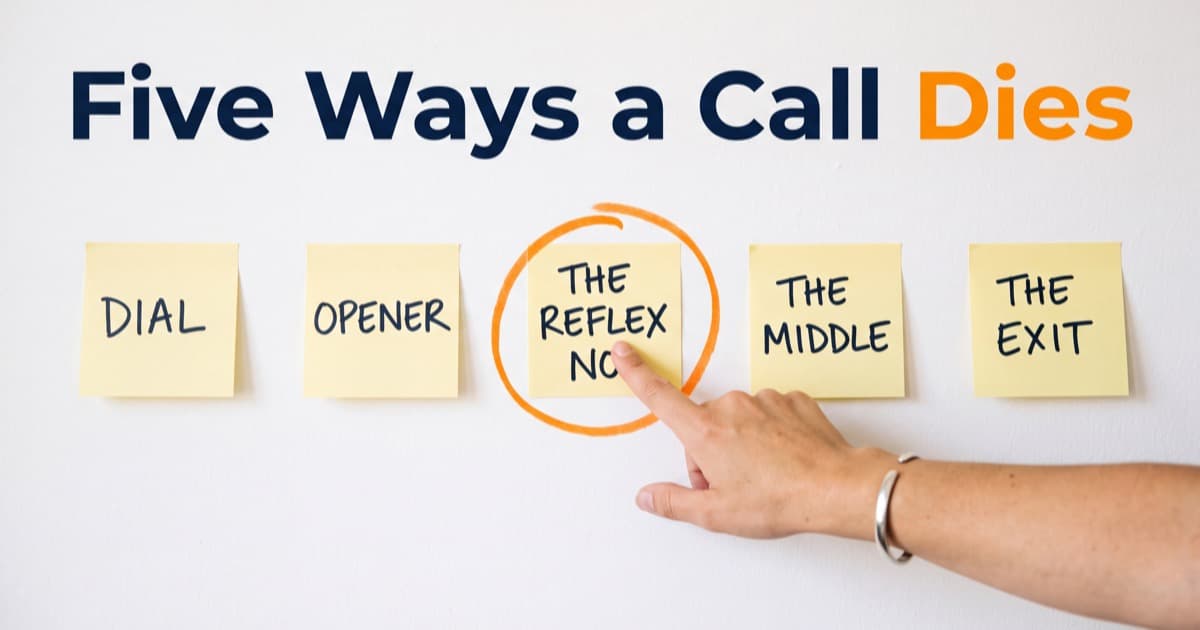
Practice happens only on live calls. A script can be rehearsed by reading it, which is why script-heavy teams practice more. A track can only be rehearsed against something that interrupts you and goes somewhere you did not plan, and a colleague who knows your product is a poor substitute because they cooperate. That gap is why the middle of the call stays weak long after the opener is polished. The wider map of where cold calls break down, opener through exit, is in the cold calling guide.
Take your current script and mark it up in two colors. The sentences that must survive contact unchanged stay as written. Everything else becomes a checkpoint, phrased as what you are trying to learn rather than as a line to deliver. Most reps end up with four fixed sentences and about six checkpoints, which fits on an index card and holds up when the buyer stops cooperating.