There is a version of this problem every rep has lived through. You find a list of openers that supposedly book meetings, you pick the one that sounds most like something you could say without cringing, and you use it on eleven calls. Two people are polite. Nine are gone before you finish the second sentence. The line was not obviously bad. It just did not do anything.
The reason is almost always the same, and it has nothing to do with wording. Opening lines get chosen by how they sound to the person saying them. They get judged by the person hearing them, and that judgment happens in the shape of a single reply. Whatever you say first, the buyer has to say something second, and most openers quietly make "no thanks" the easiest thing available. Fix that one property and the same script starts working. Ignore it and you can rewrite the words forever.
How do you tell if a cold call opening line works?
Here is a test that takes ten seconds and kills most of the openers in circulation. Say your line out loud, then say the three easiest replies to it. Not the reply you hope for. The three that require the least effort from a distracted person holding a phone they did not want to answer.
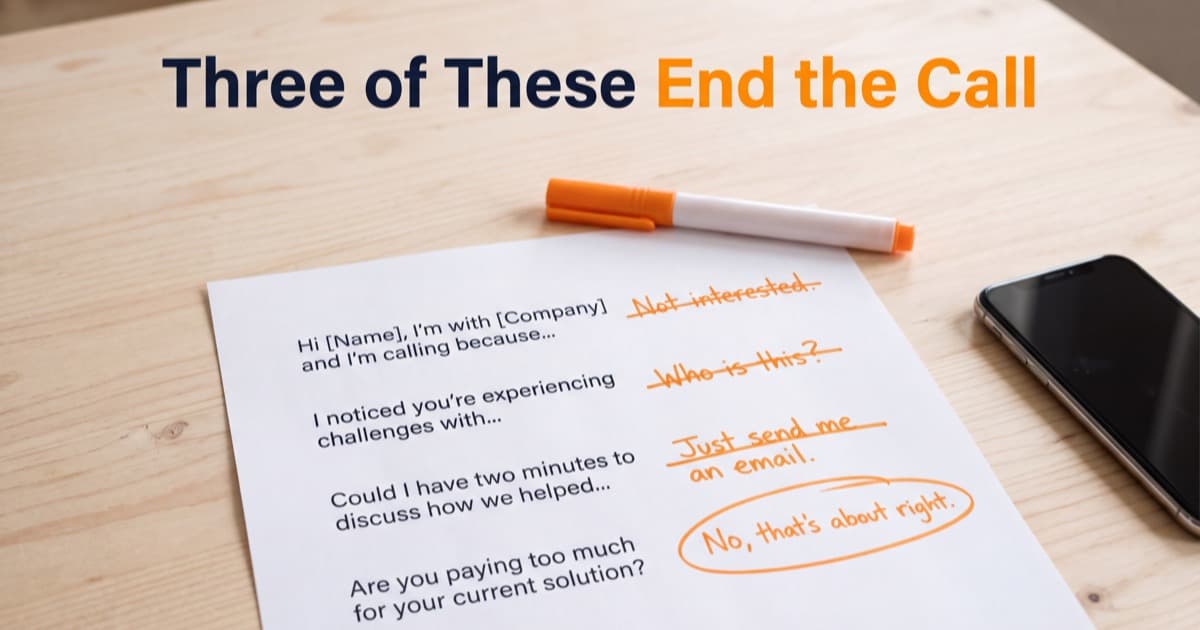
Try it on "Hi, is now a bad time?" The three cheapest replies are "yes," "yeah, kind of," and "who is this?" Two of those end the call and the third puts you on the back foot. The line is polite, it feels considerate, and it hands the buyer a ready-made exit as the path of least resistance.
Now try it on a line that states one specific, checkable observation about their world and then stops. The cheapest replies become "yes that's right," "no, actually it's the other way," or "why do you ask?" All three keep you on the phone, and two of them hand you information. Same call, same rep, same eight seconds. The difference is entirely in what the buyer's mouth has to do next.
That is the whole standard. An opening line works when answering it honestly is easier than ending the call. Everything below is an application of that one rule.
The four openers, graded on what they hand the buyer
The permission ask. "Do you have twenty-seven seconds?" and its cousins. This one splits hard depending on the variant. Asking whether you caught them at a bad time invites the word you least want, because "yes" is true for almost everyone almost always. Asking for a specific small slice of time is better, because refusing a named twenty seconds feels disproportionate, but it still spends your first sentence on a procedural question rather than a reason. If you use a permission ask, attach the reason to it in the same breath: "Can I take thirty seconds to tell you why I called, and you can tell me if it is nonsense?" That version gives the buyer a job that is not just yes or no.
The name-drop. "I was speaking with Dana on your operations team" or "we work with two other regional facilities groups." A reference only helps when it is specific and checkable. A vague one triggers suspicion, and a suspicious buyer's cheapest reply is a question you cannot answer well, which is a bad place to spend your first fifteen seconds. If the name is real and the person will vouch, lead with it. If it is a logo you are stretching, it costs more than it earns.
The pattern interrupt. "I'll be honest, this is a cold call, you can hang up on me if you want." Naming the call for what it is genuinely does buy you a few seconds of attention, because it breaks the script the buyer was preparing to run. The catch is that it buys seconds, not interest. Reps who love this line often stop there, and the buyer's cheapest reply to a standalone interrupt is a chuckle followed by a hang-up. It has to be immediately followed by a reason worth staying for, and the reason is the hard part, not the interrupt.
The problem-first observation. One sentence naming something specific and likely true about their situation, then silence. "Most facilities teams your size are still scheduling emergency callouts by phone tree after hours, and it usually shows up as overtime nobody approved." This one grades highest for a mechanical reason. It hands the buyer a true-or-false question, and true-or-false is the cheapest correct reply in any conversation. It also fails loudly and usefully: if the observation is wrong, they will tell you it is wrong, and you have learned more in eight seconds than a permission ask gives you in a minute.
Two openers, graded by what Tom says next
Nadia is an account executive at Certal, a fictional field service scheduling tool. She is calling Tom Vasquez, operations director at Brightwell Facilities, a fictional regional building maintenance company. Same rep, same prospect, same product. Only the first fifteen seconds differ.
The opener that hands over an exit:
Nadia: Hi Tom, this is Nadia calling from Certal. How are you doing today?
Tom: Fine.
Nadia: Great. I know you're busy, so is now a bad time to chat for a few minutes about your scheduling process?
Tom: Yeah, it's not a great time honestly.
Nadia: No problem, when would be better?
Tom: Just send me an email. (click)
Three sentences, two of which asked Tom to make a decision about the call instead of engaging with anything in his own world. "How are you doing today" signals a script before she has said anything of substance. Then "is now a bad time" offers him a door and he takes it, which is not rudeness, it is the cheapest available reply. Nadia never got to say what Certal does, so Tom's "send me an email" is not a brush-off from a considered position. He is declining an unspecified thing.
The opener that requires an answer:
Nadia: Tom, this is Nadia at Certal. You don't know me, so I'll be quick about why I called.
Tom: Okay.
Nadia: Most maintenance teams around your size are still handling after-hours emergency callouts by phone tree, and it tends to surface as overtime nobody signed off on. Is that roughly what happens at Brightwell, or have you already got that solved?
Tom: No, that's about right. We've got an on-call rotation but the dispatcher still ends up calling three people to find someone awake.
Nadia: That's the part I'd want to understand. How often is that happening in a normal week?
The interrupt and the reason arrive together, so the seconds Nadia bought get spent on something. The observation is specific enough to be wrong, which is what makes it worth answering. And the question at the end deliberately offers Tom an easy out that is not hanging up: "or have you already got that solved" lets him say no without ending the call, and most people would rather correct a stranger than dismiss one. By his second reply, Tom has described his own process in his own words, which is a better position than any pitch could have created.
Where a good opening line still goes wrong
Claiming something specific you cannot support. The problem-first opener only works if the observation holds up when they push back. If Tom had said "why do you think that," Nadia needs a real answer about where the pattern comes from. A confident guess that collapses under one question is worse than a generic line.
Stacking two openers. A pattern interrupt, then a permission ask, then a name-drop is three sentences of throat-clearing before any content. Pick one, attach the reason, stop.
Rehearsing it into flatness. The same line delivered for the four hundredth time develops a recognizable cadence, and buyers hear the cadence, not the words. If your opener sounds memorized, its content stops mattering. Vary the phrasing between calls even when the substance stays fixed.
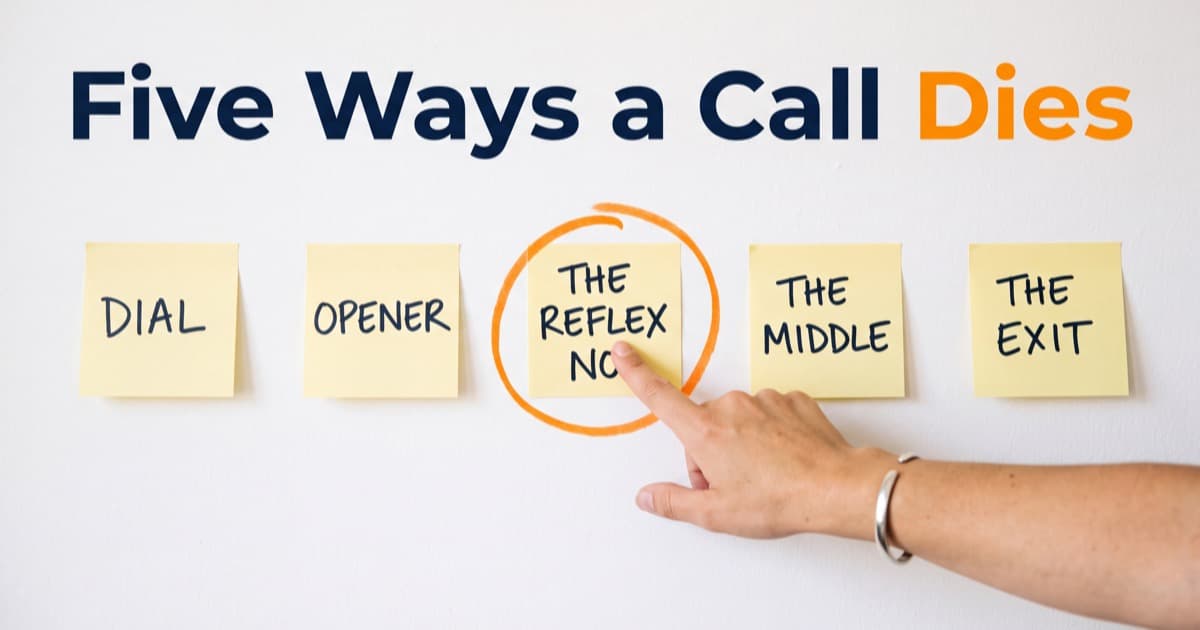
Treating the opener as the whole problem. Getting past the first fifteen seconds is one of several places a call dies, and reps who fix only this one often lose the deal ninety seconds later instead. The full map of where calls actually fall apart is in the cold calling guide.
The opener is the only part of a cold call you fully control before the other person exists in the conversation, which is exactly why it deserves rehearsal instead of collection. Take your current first sentence, say the three cheapest replies to it, and if two of them end the call, you already know what to change. That takes a minute. Finding another list of openers takes an afternoon and changes nothing.