
The meeting is on the calendar. Nobody canceled, nobody is late, the buyer joins with their camera on. Then the rep says "thanks so much for taking the time, before we dive in, do you mind telling me a bit about yourself and your role?" and the call quietly decides what it is going to be.
What comes back is a job description. Twenty seconds of org chart, in the flat voice people use for questions they have answered a hundred times. The rep says "amazing," asks what prompted the call, gets a shrug, and fills the gap with a product overview. Forty minutes later the notes hold nothing that could not have been read off a company page.
The call did not fail at minute thirty. It failed in the first ninety seconds, because the opener told the buyer what kind of conversation this was, and they adjusted what they were willing to say to match.
What does the opening of a discovery call decide?
Reps treat the top of a discovery call as a warm-up: some pleasantry, some agenda, then the real call starts. Buyers treat it as an assessment. In those first two minutes they settle three questions, and their answers govern everything you get afterward.
Is this person going to sell at me? If the opener contains a company overview, a slide, or "let me tell you a little about what we do," the answer is yes, and the buyer switches into evaluation mode. Evaluation mode is polite, brief, and useless to you. They stop volunteering problems, because a volunteered problem invites a pitch.
Does this person already know something? A rep who names a specific, checkable reason for the meeting gets treated like someone worth briefing. A rep who opens with "so tell me about your business" has to be briefed instead, and briefing a stranger is work. People do the minimum required.
Is this going somewhere? An opener with no stated endpoint reads as open-ended, and open-ended calls get managed. The buyer steers toward the exit early, usually with a product question they do not care about, because a product answer is a clock they can watch.
None of this is about charisma. People answer the question you asked. Ask someone to describe their role and they will describe their role, and the call rarely regains the altitude it lost there.
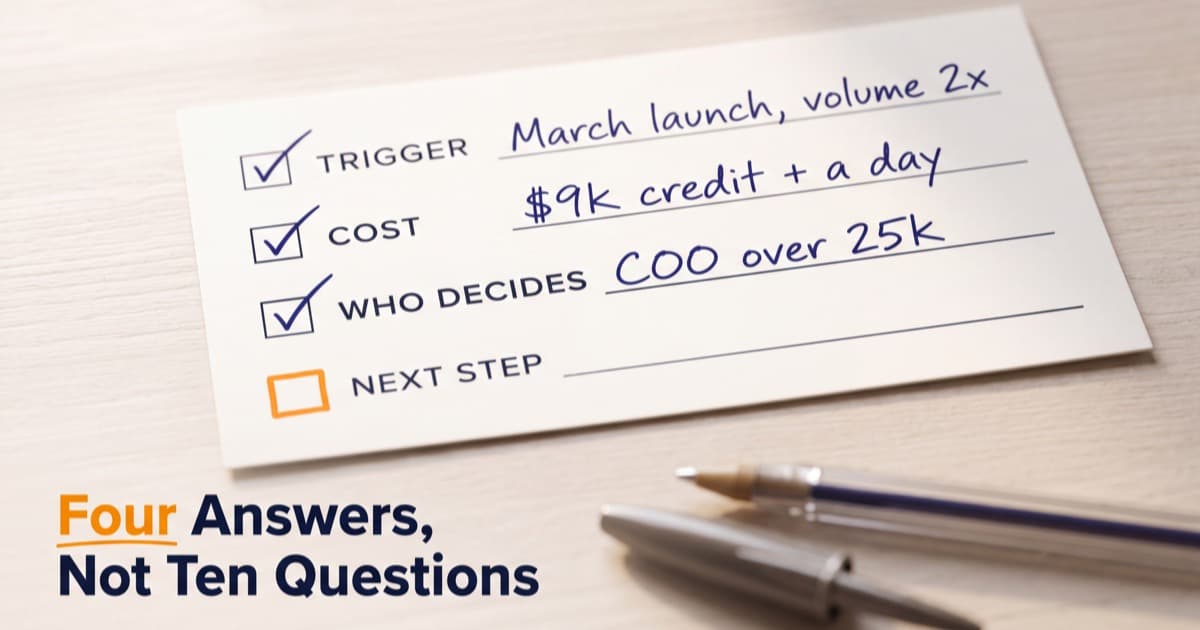
Four beats, ninety seconds, all of them written down
A working opener has four beats, one or two sentences each, all four fixed language you can write on a card. That matters because this is the only stretch of the call you can prepare word for word. Everything after it depends on what the buyer just said.
Beat one: the reason, in their words. Name the specific thing that produced this meeting, and hand the buyer the chance to correct it. "Your team asked for this after the second depot came online, and the note said routing was being rebuilt by hand every morning." If your beat one could be pasted into any other prospect's call unchanged, it is filler, and a generic reason tells the buyer you are working a list.
Beat two: what you will cover, and what you will not. The second half is load-bearing. "I'm not going to demo anything today unless you ask me to" costs you nothing and changes the buyer's posture immediately, because you just removed the thing they were bracing for. Fold the time check in here rather than making it its own ceremony: "I've got you until half past, still good?"
Beat three: the end state. Say what both of you will know when the call ends, including the version where the answer is no. "By the end I'd like us both to know whether this is a routing problem or a staffing problem, and if it's staffing we're the wrong call." Reps skip this because naming a disqualification out loud feels like giving away leverage. It does the opposite: it is the fastest way to stop reading as someone who will say anything to get a second meeting.
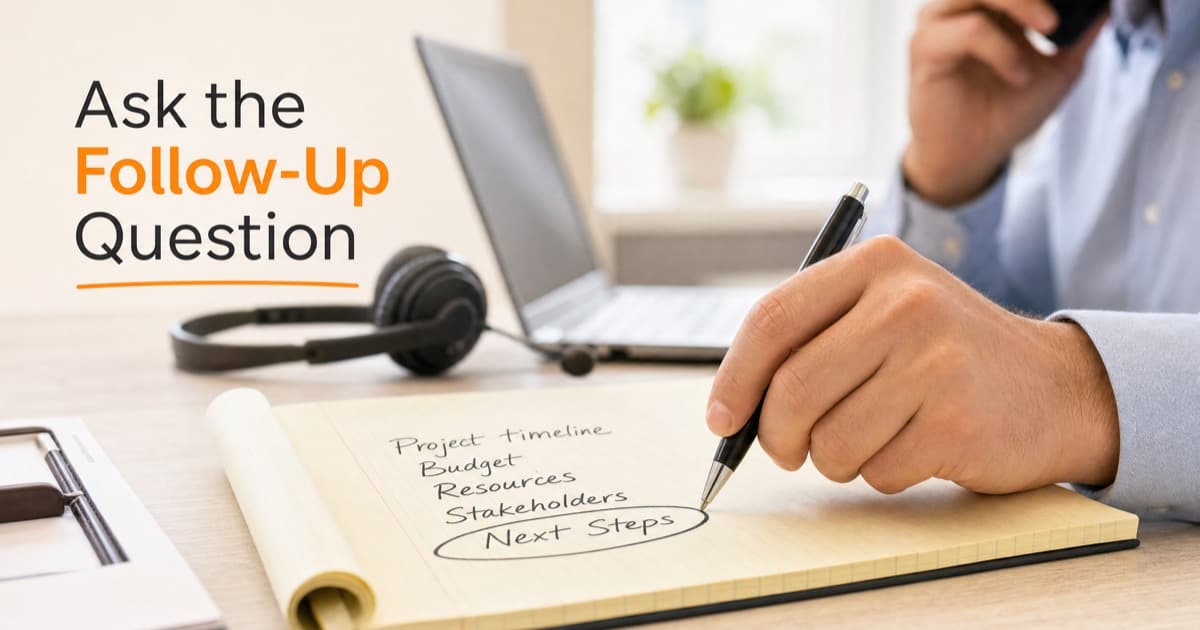
Beat four: your first question, phrased so it can be redirected. Do not ask "where would you like to start." That hands the buyer a planning task and they hand it back as "why don't you tell me about the product." Name your starting point and offer the override: "I want to start with how the morning actually runs. Is that the right place, or is something else more urgent?"
Ninety seconds, before and after the four beats
Dani Okoro sells for Verlune, a fictional delivery route planning tool. The buyer is Ellen Prasad, VP of operations at Gallowmere Produce, a fictional regional food distributor, and the meeting came in through Ellen's team after Gallowmere opened a second depot. Same rep, same buyer, same thirty minutes.
The warm-up opener:
Dani: Hi Ellen, thanks so much for making the time. Before we jump in, do you mind telling me a bit about yourself and your role at Gallowmere?
Ellen: Sure. I run operations. Distribution centers, drivers, routing, about two hundred people all in.
Dani: Amazing. And what made you want to take the call today?
Ellen: Honestly, someone on my team forwarded it to me.
Dani: Got it. So let me give you a quick overview of what Verlune does, and then we can figure out where it might fit.
Ellen: Sure, go ahead.
Nothing here is rude or wrong, which is why it survives on so many teams. The damage is structural. Dani's first question asked Ellen to recite an org chart, so Ellen recited an org chart. Her second asked Ellen to justify a meeting Ellen did not book, and the honest answer made the call sound low intent, which pushed Dani into an overview. And because Dani never said why she was there, Ellen had nothing to correct. The most valuable thing a buyer can do in minute one is tell you your premise is slightly off, and that only happens if you state one.
The four-beat opener:
Dani: Hi Ellen. I'll tell you why I asked for this and you can tell me how wrong I've got it. Your team put this in after the Cranbury depot came online in May, and the note said routing was getting rebuilt by hand every morning. That's honestly all I know.
Ellen: That's about right. It's two people and a whiteboard, and nothing moves until nine.
Dani: Okay. I've got you until half past, and I want to spend most of that on how the morning actually runs, because that's the part I can't guess from the outside. I'm not going to demo anything today unless you ask me to. By the end I'd like us both to know whether the nine o'clock thing is a routing problem or a staffing problem, because if it's staffing we're the wrong call and I'd rather say so today than in three weeks.
Ellen: Fair enough.
Dani: So, the morning. Who's at the whiteboard, and what are they looking at when they start?
Ellen: Sanjay and whichever shift lead is on. Yesterday's delivery exceptions, anything that came in overnight from the sales side, and the driver availability sheet. The exceptions list is what blows it up, because half of those need a phone call before anyone can plan around them.
Dani: So the planning can't start until the phone calls are done.
Ellen: Right. And nobody wants to make those calls at six in the morning, so they happen at seven thirty, and by then we're already behind.
Ninety seconds in, Dani has something the warm-up version never reached: the bottleneck is not the routing math, it is that planning sits blocked behind overnight exceptions that need a human phone call. That is a sentence you can build a deal around, and it arrived unprompted.
Look at what produced it. Beat one gave Ellen a premise to confirm rather than a form to fill in, and her correction ("nothing moves until nine") added a number Dani did not have. Beat two removed the demo, so Ellen was not conserving airtime for it. Beat three named the outcome where Dani walks away, and the tone changed at "fair enough." Beat four named a starting point instead of making Ellen pick one.
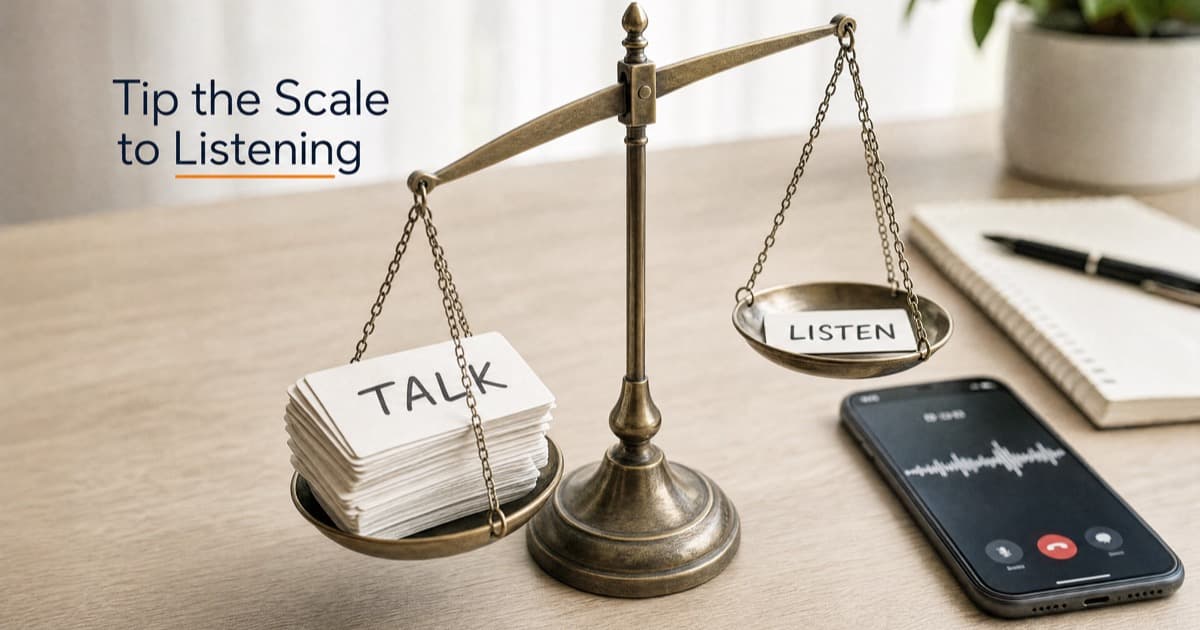
One more line is worth copying. Dani's reply to Ellen's long answer is not a new question, it is a one-sentence summary of what she just heard, and it is what pulled out the seven thirty detail. Proving you listened keeps a buyer talking better than moving to the next item does, which is the subject of talking too much on discovery calls.
Where a good opener still falls apart
The trigger is invented. Beat one only works if the reason is real and checkable. "I saw you're growing quickly" is a guess dressed up as research, and buyers spot it instantly. If you do not know why the meeting exists, say so: "This came in through your team and I don't know the backstory, so I'd rather ask."
You promise no demo, then demo anyway. A rep who says "I'm not going to demo today" and shares a screen at minute eight has taught the buyer the rest of the opener was negotiable too. If you cannot hold the promise, do not make it. Say instead that you will show something at the end if it turns out to be relevant.
Beat three becomes a mission statement. The end state should be one decision in plain language. Grown into "align on your priorities and explore how we can partner," it stops working, because nobody can tell whether it was reached. If the sentence contains nothing that could turn out to be no, rewrite it.
Inbound meetings need a different beat one. When the buyer booked the call themselves, your reason is their reason, and stating your version first wastes the advantage. Invert it: "You booked this, so I'd rather hear your version before I assume anything. What made you pick this week?" Beats two through four hold.
You rehearse it by reading it. An opener looks finished on the page and falls apart the first time a buyer cuts into beat two with "sorry, how much does this cost?" There is no version of that moment you can practice silently, and a colleague playing the buyer cooperates because they know what you are doing. The full map of what discovery calls get judged on is in the discovery call guide.
Write your four beats out tonight, full sentences, one card. Then read beat one and ask whether you could send it unchanged to any other prospect on your list. If you could, you have written an introduction rather than an opener, and the buyer will answer it as carefully as it deserves.