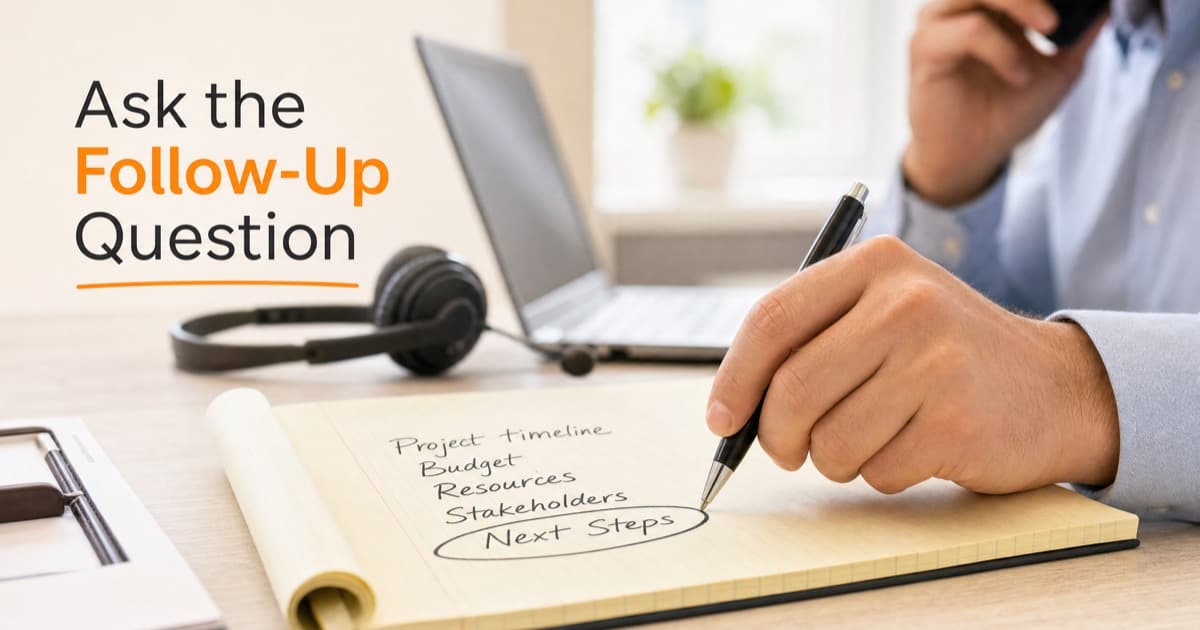
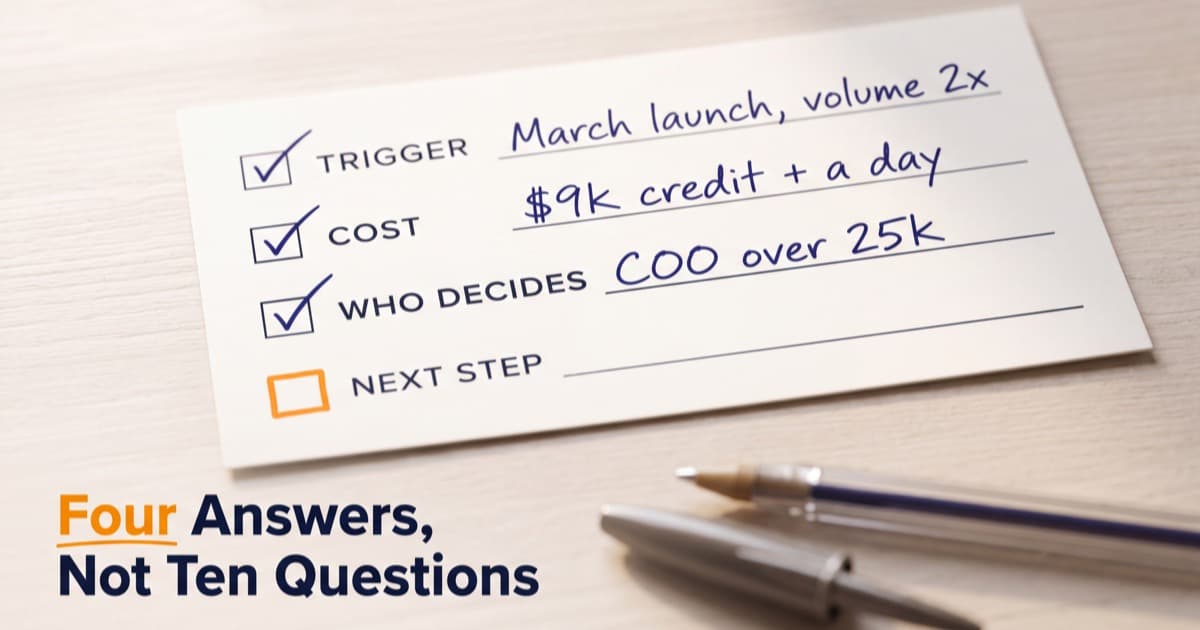
Here is a test you can run on your last discovery call, and it takes about forty seconds.
Open a blank note. Write down, from memory, four things: what changed in that company recently that made them take your call, what the problem costs them in a number they said out loud, who else has to agree before money moves, and what specifically happens next with a date attached. No paraphrasing your own pitch, no "they seemed interested," no "budget is probably there." Only things the buyer actually said.
Most reps cannot fill in more than two, and the call felt great. That gap is the whole problem with how discovery gets taught. The advice is almost always a question list, and a question list is a plan for what leaves your mouth. It says nothing about what has to arrive in your notes by the end, which is the only thing the call is actually for.
This guide is organized around those four answers rather than around a set of questions to ask. Each one gets a section: what the answer looks like when it is real, the language that gets it, and the version reps usually settle for instead. At the end there is a full call run twice, once badly and once well, with commentary on the exact lines where the two versions split.
What should a discovery call actually produce?
A discovery call is not an interview and it is not a demo. It is a joint investigation with a very specific output. When it works, both people leave knowing something they did not know at the start, and you leave able to write down four things.
One: the trigger. Not the problem, the change. Problems are permanent and nobody buys because of one. Something happened recently, a launch, a hire, a churned account, a board question, a system that broke under load, and that event is what turned a background annoyance into a thing someone is now responsible for fixing.
Two: the cost. What the problem is worth in hours, dollars, headcount, missed revenue, or risk, stated by them, ideally with a number. Not your ROI slide. Their arithmetic.
Three: the decision path. Who signs, who can veto, what the process actually looks like at this company, and what each of those people cares about. This is the answer most reps trade away because asking feels presumptuous eighteen minutes into a first conversation.
Four: the next step. A specific action, with a date, confirmed out loud by both people, that moves the deal rather than just continuing the relationship.
Miss the trigger and you will forecast a deal that has no reason to close this quarter. Miss the cost and you will get outsold by whoever put a number in front of the CFO. Miss the decision path and you will find out in week six that a director you never met has to approve it. Miss the next step and you get the most common outcome in software sales, which is a friendly call followed by silence.
Everything below is in service of those four. If a question you were going to ask does not move one of them forward, it is filler, and filler is expensive because you only get about thirty minutes.
| The answer | What it looks like when it is real | What reps settle for |
|---|---|---|
| The trigger | A dated event: "after the March launch, volume doubled" | "Visibility is a challenge for us" |
| The cost | A number they said, in their units | Your ROI slide, or "it's a huge time sink" |
| The decision path | Who signs, who vetoes, what each cares about | "It goes to the leadership team" |
| The next step | An action, a date, agreed out loud by both | "I'll send some materials over" |
Answer one: what changed, and why they took the call now
Start here, because the trigger explains everything else. It sets the urgency, it usually names the internal sponsor, and it tells you which of your capabilities matters in this deal.
The question reps ask is "so what challenges are you facing with X?" The answer they get back is a generic complaint the buyer has told six vendors, delivered in vendor-safe language: "visibility is a challenge for us," "we want to be more proactive." That is not a trigger. That is a brochure sentence.
Ask about the event instead of the state:
- "What made this land on your plate in the last month or two?"
- "Was there a specific thing that happened, or has it been building?"
- "What were you doing about this before you booked this call?"
The last one is quietly the best question in discovery. It is concrete, it is easy to answer honestly, and the answer tells you what they have already tried, what failed, and how much internal energy has already been spent. A buyer who says "nothing really, we just started looking" is in a very different deal from one who says "we built a spreadsheet in March, it broke in May, and my analyst quit in June."
When you get a trigger, do not move on. Stay on it for at least two follow-ups. The first answer is the version they have already rehearsed. The second and third are where the specifics live.
The tell that you actually have the trigger: you can say it back as a dated sentence. "After the March launch, ticket volume roughly doubled and your first-response times slipped past the SLA you publish, and that showed up in the QBR." That sentence is worth more than an hour of feature discussion, because everything you do afterward can be aimed at it.
Answer two: what it costs them, in their own numbers
Reps skip cost because asking about money feels like the vulgar part of the conversation. So they infer it, put their own estimate in the deck, and then wonder why procurement grinds them down on price. A number you invented is a number the buyer is free to dispute. A number they said is one they have to defend.
You do not have to ask "what is your budget" to get to cost. Most of the time that question is premature anyway, and on a first call it often gets an honest "I don't know yet." Go at it from the operational side instead, where people know their own business cold:
- "How much time does that eat in a week, roughly?"
- "When it goes wrong, what actually happens next?"
- "Who ends up absorbing that, and what are they not doing while they do it?"
- "Has anyone put a number on it internally, or is this a feel thing so far?"
That last question does something useful: it gives them permission to say the number does not exist yet, which is common and which you need to know. If no one has quantified it, the deal has a hidden task in it, and that task is now part of your next step.
Then do the arithmetic together, out loud, and let them correct you. "So two people, most of a day a week each, that is roughly eighty hours a month before you count the escalations. Am I in the right neighborhood or is that high?" Buyers love correcting numbers. They rarely volunteer them. Use that.
The version to avoid is the one where you supply both the problem and the math. "Companies like yours typically lose thirty percent to this" is a claim about a category, and the buyer will nod politely at it because there is nothing to push against. The point of this section is not to impress them with an insight. It is to end up with a sentence in your notes that has a number in it and their name on it.
Answer three: who else has to say yes, and what they care about
This is where most first calls quietly fail, and the reason is social. Twenty minutes in, the conversation is going well, the person is friendly, and asking "so are you actually the decision maker here" feels like an insult. So the rep does not ask, writes "champion" in the CRM, and inherits a deal with unknown geometry.
The fix is to stop asking about authority and start asking about process, which is a question anyone can answer without losing face:
- "If you decided this was worth doing, what does the path look like from there?"
- "Who else would want a say, even informally?"
- "Has your team bought something like this before? What did that take?"
- "Is there a security or procurement review involved, and when does that usually kick in?"
Notice that none of those ask a person to rank themselves. They ask about the company's plumbing, and people are usually happy to describe plumbing. The information you get is better anyway, because "authority" is rarely one person. It is a signer, one or two people who can veto, and a quiet influencer whose objection nobody will tell you about.
For each name that comes up, get the thing they care about. "What would the CFO's first question be?" is a genuinely great line, because your buyer knows the answer, and now you are both preparing for the same meeting instead of you preparing for a fantasy version of it.
Two more things belong in this answer. First, timing that is anchored to something real: a contract renewal, a fiscal year, a launch date, an audit. "Sometime next quarter" is not timing, it is politeness. Second, the alternative. "If this doesn't happen, what do you do instead?" The most common competitor is nothing, and knowing whether nothing is a comfortable option changes how you run the rest of the deal.
Answer four: the next step, agreed out loud
A discovery call that ends with "this was great, I'll send over some materials and we'll go from there" has produced nothing, no matter how warm it felt. That is not a next step. It is the sound of a rep who did not want to risk the ask after a nice conversation.
A real next step has three properties. It is specific about what happens, it has a date and a time, and both people say yes to it while still on the call.
Tie the ask to what they told you, so it does not read as your process being imposed on them:
"Based on the first-response numbers you just described, the useful next thing is thirty minutes where I walk through how two other support teams handled the post-launch spike, and I'd want your QA lead on it since she's the one who would live in this. Tuesday at 2, or is Thursday morning better?"
Then stop talking. The silence after a specific ask is uncomfortable for about three seconds and it is the most productive silence in the call.
If they will not commit to the meeting, get something smaller and real rather than something large and vague. A named document sent by a named date plus a confirmed time to reconnect is a next step. "I'll follow up next week" is not. And if the honest answer is that this is not a priority this quarter, that is a fine outcome to leave with, as long as you leave with the date when it becomes one.
The opening two minutes decide how honest the rest of the call is
Everything above assumes the buyer is telling you real things. Whether they do is mostly determined before the first question, by how you open.
The failure mode is the warm-up plus company overview: two minutes of weather, five minutes of "let me tell you a bit about us," and then a pivot to questions. By then you have taught the buyer that this is a vendor presentation with an interrogation attached, and they respond in the register you set, which is the polite one.
A better opening takes about forty seconds and does four things: confirm the time you have, say what you want to get out of it, say what they should get out of it, and hand them the agenda pen.
"I've got you until half past, is that still right? My plan was to spend most of it understanding how your team is handling the post-launch volume, and then if it looks like a fit I'll show you the two or three things that are actually relevant rather than a tour. What would make this worth your time?"
That last question is the one that changes calls. It gets an agenda item you did not know about, and it converts the buyer from someone being asked questions into someone with a stake in the outcome.
One deliberate omission: no company overview. If they need context they will ask, and a single sentence covers it. The full version, before you know what matters to them, is the most reliable way to spend your best minutes on the least useful content.
Thirty minutes, scored against the four answers
Fictional but ordinary. Sunita is an account executive at Northwind Analytics, which sells support-quality software. Ximena Whitcomb runs customer support at Larkfield Instruments, a mid-size medical device company. Ximena booked the call after clicking an ad. Same rep, same buyer, thirty minutes, two versions.
The weak version:
Sunita: Hi Ximena, thanks so much for taking the time. How's your week going?
Ximena: Busy, but fine.
Sunita: I hear that a lot. So before I dive into questions, let me give you a quick overview of Northwind. We're a support quality platform, we work with about four hundred companies, mostly in regulated industries, and what we do is give support leaders visibility into ticket quality and agent performance in one place. Does that make sense so far?
Ximena: Sure.
Sunita: Great. So what challenges are you seeing on the support side right now?
Ximena: I mean, the usual. We'd like better visibility. Volume's been up, so quality is something we're watching.
Sunita: Totally. Visibility is the number one thing we hear. And are you doing any kind of QA scoring today?
Ximena: Sort of. My team leads listen to a few calls a month.
Sunita: Got it. So that's exactly the gap we close. Most teams are sampling maybe two percent manually, and we score a hundred percent automatically, so you catch the coaching moments you're currently missing. I can show you what that looks like. Do you have budget allocated for this?
Ximena: Not specifically, no. We'd have to look at it.
Sunita: Understood. Well, let me send you a deck and a case study from a med device customer, and maybe we can find some time in a couple of weeks once you've had a look?
Ximena: Yeah, send it over. Thanks Sunita.
Score that against the four answers and it is zero for four. There is no trigger, because "volume's been up" is a state, not an event, and Sunita never asked what changed. There is no cost, because the only number in the call was Sunita's own "two percent" statistic about other companies. There is no decision path, because "do you have budget" was asked once, got a soft no, and was dropped rather than turned into a process question. And there is no next step, because "send you a deck and maybe find some time" is two vague things stapled together.
Look at where it actually broke. The overview came first, which set the vendor frame. "What challenges are you seeing" invited a rehearsed answer and got one. Then, at the single most important moment in the call, Ximena said something specific, that team leads listen to a few calls a month, and Sunita answered it with a product claim instead of a follow-up question. That was the fork. Everything after it is downhill with good manners.
The strong version:
Sunita: Ximena, I've got you until half past, still good? My plan is to spend most of it on how your team is handling things right now, and if it's relevant I'll show you the two or three pieces that actually apply instead of a full tour. Anything you want to make sure we cover?
Ximena: Mainly I want to know what this takes to run. I don't have people sitting around.
Sunita: Noted, we'll cover that specifically. Can I start with what made you click on this? You've presumably had this problem for a while.
Ximena: Honestly, the last board review. We launched the new pump line in March, ticket volume roughly doubled, and our first response time went from four hours to about eleven. We publish four hours.
Sunita: Eleven against a published four. Is that still where you are today, or has it come down?
Ximena: It's around eight now. Better, not fine.
Sunita: What did you do to get it from eleven to eight?
Ximena: Pulled two people off the enterprise queue and stopped doing call reviews entirely. Which is not a great trade.
Sunita: That's the part I'd want to understand. What happens because you stopped the reviews?
Ximena: We're finding out. Two escalations last month that a review would have caught early. One of them went to the customer's VP before I heard about it.
Sunita: What does an escalation like that cost you, once it's at their VP level?
Ximena: A day of my time, at least. Usually a credit. The last one was about nine thousand.
Sunita: So call it a day of yours plus something in the mid four figures, a couple of times a month, and the reviews that would catch them are the thing you cut to hold response times. Is that fair or am I overstating it?
Ximena: No, that's about right. That's why I clicked.
Sunita: If you decided this was worth doing, what does the path look like from there?
Ximena: I'd need to make the case to our COO. Anything over about twenty-five thousand goes through him, and security reviews anything that touches ticket content.
Sunita: What's the COO's first question going to be?
Ximena: Whether it reduces headcount or adds work. He's heard "this will save time" before.
Sunita: Then that's what the next conversation should answer, not a feature tour. Thirty minutes, me and you and whoever your strongest team lead is, and I'll walk through what the first four weeks actually looked like at two support teams your size, including the setup time, since you said that's your real question. Tuesday at 2, or Thursday morning?
Ximena: Thursday. Make it nine.
Ximena: And send me something I can forward to security in the meantime.
Sunita: I'll send the security overview today and the invite in the next ten minutes. Thursday at 9.
Four for four, and Sunita never described her product.
The specific lines that did the work: "what made you click on this" got a dated event instead of a complaint. "What did you do to get it from eleven to eight" turned a metric into a trade-off, and the trade-off is the actual deal. "What happens because you stopped the reviews" pushed one layer past the answer most reps would have accepted, and that push produced the escalations. Then one money question, asked about a concrete incident rather than about budget in the abstract, produced nine thousand dollars, said by the buyer.
The process question came after the value was established, not before, which is why it landed as collaboration instead of qualification. And "what's the COO's first question" turned the next meeting from a demo into a specific piece of work, which is why Ximena picked a time instead of asking for a deck.
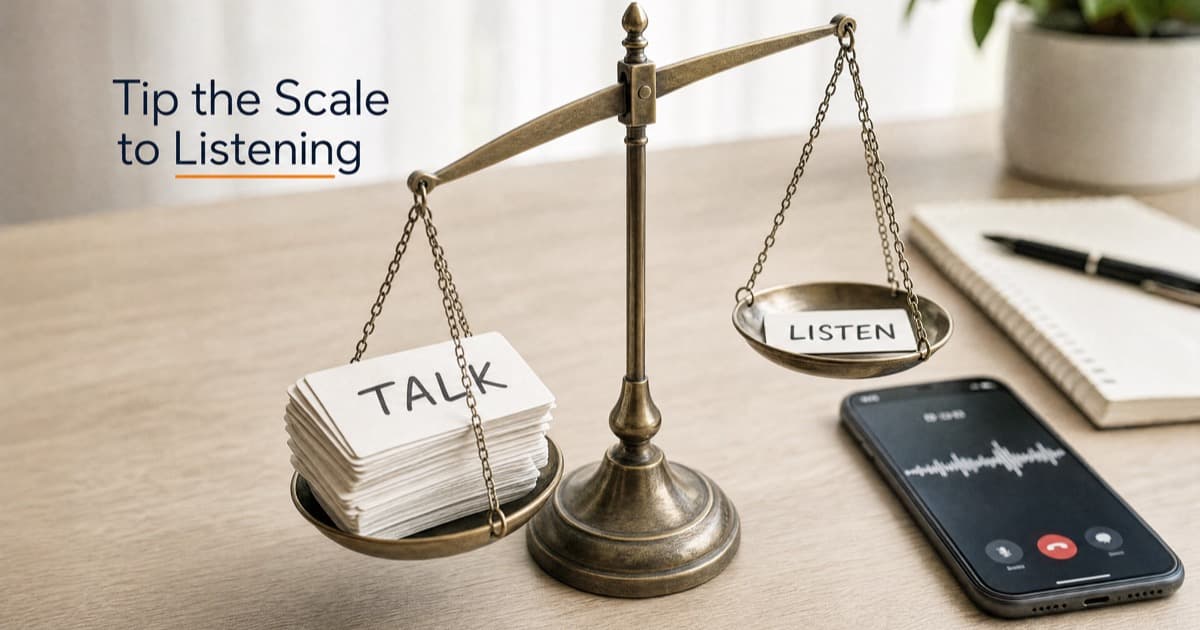
Count the words in each version, too. In the weak call Sunita says roughly twice what Ximena does. In the strong one it is close to the reverse, and none of it required her to be clever. It required her to ask a follow-up to the answer she just got rather than moving to her next prepared question. That single habit is most of the difference between the two calls, and it has its own longer treatment in you are probably talking too much on discovery calls.
Where discovery calls go wrong
Running the list instead of the thread. Ten prepared questions asked once each will always lose to three questions asked three layers deep. The first answer is public relations. The third answer is the business. If you are worried about getting through your list, you are not listening to the answer in front of you.
Treating a soft answer as an answer. "Visibility is a challenge," "we'd like to be more proactive," "budget is tight right now." These feel like information and are not. Each one needs one more turn: what does that look like this week, what did it cost you last time, tight compared to what.
Demoing on discovery. The moment a screen gets shared, discovery is over, because the conversation becomes about your product rather than their situation. If a demo genuinely belongs in the call, put it at the end, keep it to the two or three things they told you matter, and get the next step before you share your screen, not after.
Confusing rapport with progress. Friendly calls that produce no answers are the most dangerous outcome in the pipeline, because they feel like wins and they forecast like wins. The four-answer test exists precisely to catch a call your gut liked.
Skipping the process question because it feels rude. It is not rude. It becomes rude when you ask it as a challenge to the person's importance. Ask about the company's path, not about their rank, and it is a normal thing that two adults discuss.
Taking a brush-off at face value inside the call. "We're happy with what we have" ten minutes into discovery is usually a reflex, not a position, and the difference matters enormously. That distinction is worth its own read in brush-off versus real objection.
Ending on the calendar instead of on the call. "I'll send some times" is where deals go to die quietly. Book it live, on the phone, with a reason attached.
Rehearsing the part that actually decides it
Read this guide back and notice how little of it is knowledge. Almost every line is a decision made in about one second, under mild social pressure, while someone is talking to you. Knowing that you should follow up on "we stopped doing call reviews" is trivial. Doing it, in the moment, when the buyer has just handed you an opening to pitch into and pitching feels like progress, is the skill.
That gap is why reps who can explain good discovery still run bad discovery calls. The knowledge lives in one system, the performance lives in another, and only the second one shows up on the call.
So rehearse the moment, not the framework. Pick one thing: the forty-second opening, the second follow-up, the money question, the process question, the close. Run it out loud against a buyer who gives you the vague answer first, until the follow-up arrives without a search. Twenty repetitions of the money question is a better use of an hour than reading five more articles about discovery. The practical version of that, including what to do when you have nobody to run it with, is in discovery call practice, and the full-length version, a complete call from opening to next step, is in the mock discovery call scenario.
The first ninety seconds have their own rules in how to open a discovery call, and the five ways a call can feel excellent while producing nothing are in the discovery call mistakes that feel like a good call.
Then go back to the forty-second test. After your next real call, write down the trigger, the cost, the decision path, and the next step. Whichever line is blank is the one to rehearse this week.