
The call runs seven minutes long because neither of you wants to stop. The buyer laughs twice, says "yes, exactly" three times, and volunteers that this has bugged them for a year. You hang up and tell your manager it went really well.
Then you open the CRM and try to write down what you learned. Pain: they want better visibility. Impact: significant. Decision process: it goes to the leadership team. Next step: circling back in a couple of weeks.
Nothing in that record could forecast a deal, build a business case, or produce a follow-up the buyer would answer. The call was pleasant and it was empty, and those two things are not in tension. They tend to arrive together.
Why do bad discovery calls feel like good ones?
Most advice here assumes you will notice. It describes reps who talk over buyers, read a script, or pitch in minute two. Those calls feel wrong while they happen, and you leave knowing you lost.
The expensive mistakes are quieter. They happen on calls with good rapport, where the buyer is engaged and generous and you are being warm and curious back. Rapport is what hides them: when the conversation is flowing, a vague answer feels like it was answered and a soft next step feels like momentum rather than a decline you did not hear.
The one reliable test is not how the call felt. It is whether the notes hold specifics a stranger could act on: a number, a date, a name, a consequence. Vague notes are not a writing problem. They are a record of vague answers you accepted because pushing would have broken the mood.
Five mistakes, and the sentence that fixes each one
Taking the first pain as the real one. You ask what the challenge is, they name something, you start working on that something. But the first answer is the rehearsed one, the tidy version people give vendors, and it usually sits a layer or two above whatever actually generates the cost. The fix is one follow-up before you move on: "How long has that been the case?" A problem that has survived three years unfixed is not urgent, and learning that in minute six beats a fifty-minute call about it.
Collecting impact as an adjective. "It's a huge time sink" tells you the buyer is frustrated. It does not tell you what the problem costs, and nobody signs off on frustration. You need a quantity in the buyer's voice, not your estimate. Ask for the unit before the total: "Roughly how many hours a week does that eat, and who is doing them?" If they do not know, that is useful too: a cost nobody has measured is a cost nobody has been asked to approve.
Letting the question list drive. This one looks the most like professionalism. You have ten good questions, you ask them in order, and you never chase the loose thread the buyer dropped in question four. The tell is audible: they say something surprising and you say "great, and next I wanted to ask about..." Anything worth calling discovery lives one level beneath a prepared question.
Accepting a decision process instead of a decision history. Ask how decisions get made and you get a civics lesson: it goes to the leadership team, procurement reviews it, we align as a group. Accurate, useless, and a description of what is supposed to happen. Ask about the last one instead: "What was the most recent tool your team bought, and what happened between deciding you wanted it and getting it signed?" That version surfaces the person who blocked it for six weeks and the budget cycle that governs your timeline.
Ending on interest instead of a commitment. "This has been really helpful, let me take it to the team and circle back" is a decline delivered warmly, and the most common way a good call becomes a dead one. The close is not "does that sound good," it is a specific proposal with a name and a date on it, made while you are still on the phone. Interest costs a buyer nothing. Calendar time costs them something, which is why it tells the truth.
Four short follow-ups the pleasant version skipped
Nkechi Ilori sells for Fernbrook, a fictional expense management platform. The buyer is Piotr Raman, head of finance operations at Latterly Health, a fictional group of eighteen dental clinics. Same rep, same buyer, same facts sitting there to be found.
The pleasant version:
Piotr: The main thing is visibility. I never really know what we've spent until the month closes.
Nkechi: That's such a common one. And I imagine that makes planning hard?
Piotr: Very. We're always looking backwards.
Nkechi: Totally. And is it painful across all the clinics, or worse in some?
Piotr: Worse in the newer ones, I'd say.
Nkechi: Makes sense. Okay, and if you were to fix this, how would a decision like that get made on your side?
Piotr: It'd go to me and then to our CFO for sign-off.
Nkechi: Perfect. Well, this has been super helpful. Why don't I put together some information and follow up next week?
Piotr: That sounds great. Thanks Nkechi.
Read the transcript cold and there is not one fact in it. "Visibility," "very," "worse in the newer ones," "it'd go to the CFO." Nkechi did nothing Piotr would call wrong, and she has no reason to take his follow-up call, because she was never asked to say out loud that anything mattered.
The version that gets something:
Piotr: The main thing is visibility. I never really know what we've spent until the month closes.
Nkechi: How long has it been like that?
Piotr: Honestly, always. It got noticeable when we went past a dozen clinics.
Nkechi: So it survived twelve clinics without anyone fixing it. What changed recently that made you take this call?
Piotr: We got surprised in March. Two of the practices had been ordering supplies on their own cards and we found out at close. It was about forty thousand over budget for the quarter.
Nkechi: Forty thousand, discovered at close. What happened after you found it?
Piotr: I had to explain it to the CFO in the quarterly review, which is not a conversation I want again. Now my team pulls card statements manually every Friday so we can catch it earlier.
Nkechi: Who does the Friday pull, and how long does it take them?
Piotr: Two analysts, most of a morning each. So call it eight hours a week that exists purely because we got burned once.
Nkechi: That helps a lot. You mentioned the CFO. When your team last bought something like this, what happened between wanting it and having it?
Piotr: We bought a scheduling system last year. I thought it was approved in June and it went live in October, because it sat with our security reviewer for most of the summer and nobody told me that was a step.
Nkechi: So the real gate was security, not the CFO. Is that same reviewer still in place?
Piotr: Same person, yes.
Nkechi: Then here is what I'd suggest. Rather than me sending information, give me forty-five minutes next week with you and whoever owns that Friday pull, and I'll show how the March surprise would have surfaced and what your security reviewer will ask us for. Does Thursday afternoon work, or is Tuesday better?
Piotr: Thursday. Let me get Dev on it too, he runs the analysts.
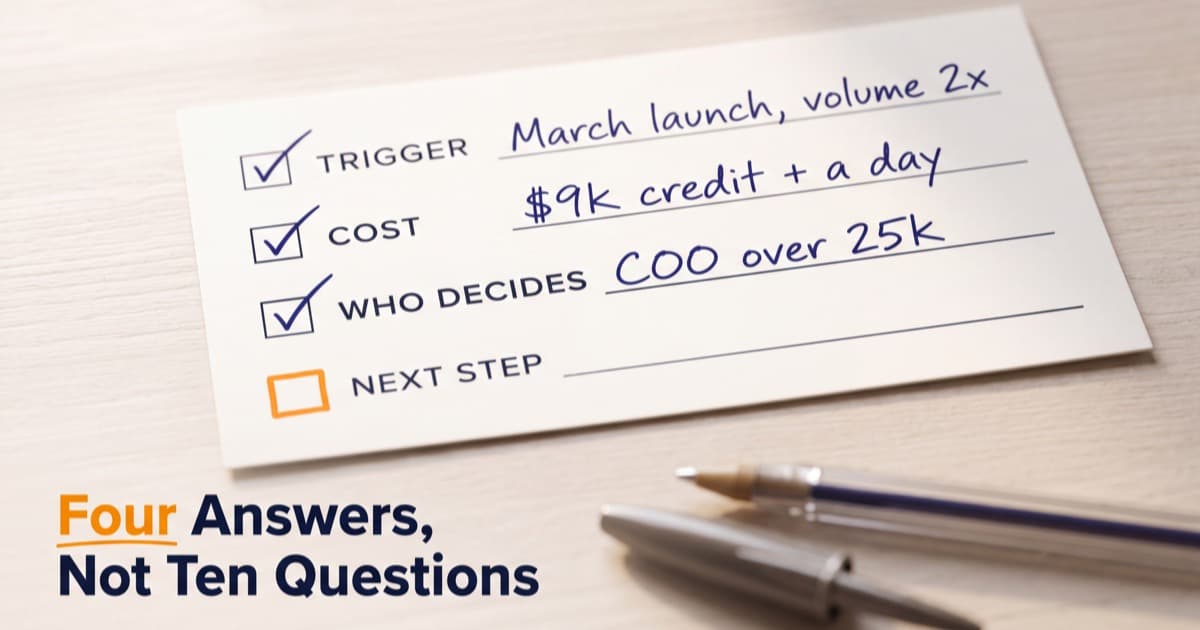
Count what the second version holds that the first does not: forty thousand dollars, a specific month, eight hours a week, two named analysts, a security review that added four months to the last purchase, that reviewer still being in post, and a meeting on Thursday with an attendee the buyer added herself.
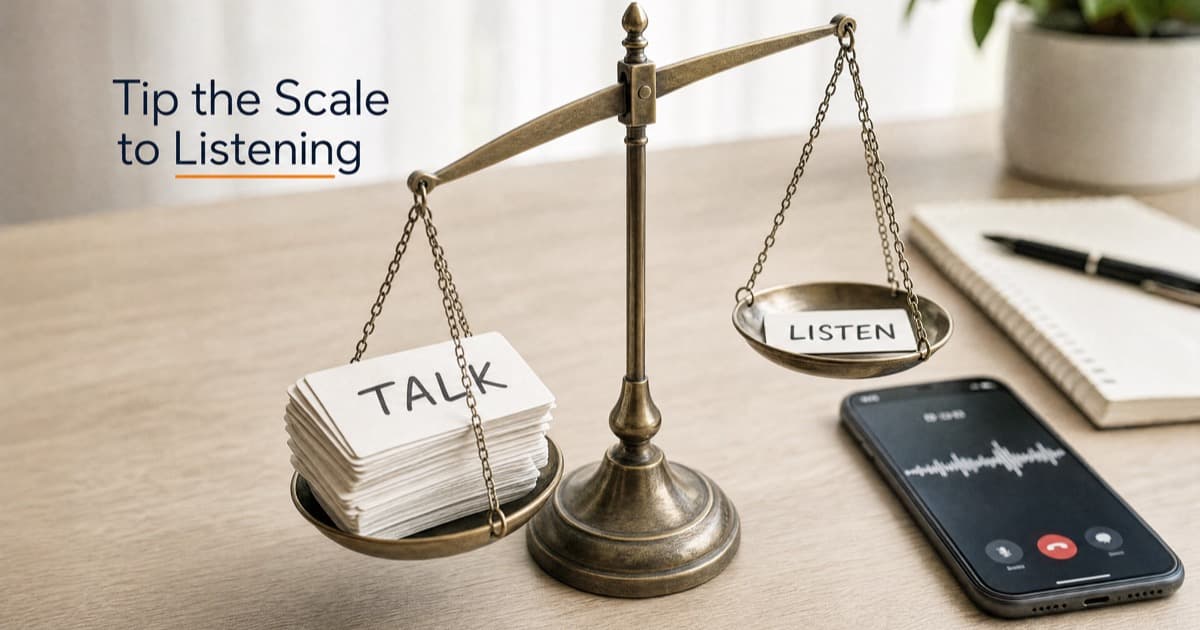
Nkechi did not get that by being tougher. He asked four short follow-ups the pleasant version skipped: how long, what changed, who does it and how long does it take, and what happened last time. None of them break rapport. Notice too that he reflects answers back before moving ("Forty thousand, discovered at close") instead of jumping topics, which is what keeps a buyer expanding rather than closing down. That habit is the subject of talking too much on discovery calls.
Where this gets harder than it reads
The buyer is warm and you do not want to cool it. This is the real reason reps skip follow-ups, so say it plainly: asking "how long has that been the case" cools nothing. What cools a call is a question that sounds like an audit, and the difference is tone, not content. Curious lands fine. Prosecutorial does not.
You already know the answer, so you answer it yourself. After a hundred calls, the moment a buyer says "visibility" you can finish the sentence. Finishing it is the mistake. A cost the buyer states is a cost they own. A cost you state for them is a claim they will politely let stand and never repeat internally.
The call was inbound, so everyone relaxes. A booked demo request feels like qualification already happened. It did not. Inbound tells you someone had a reason to click, and nothing about budget, timeline, or who blocks purchases in the summer.
There is genuinely no time. On a twenty-minute call you cannot run all five. Choose two: how long has it been this way, and what happened the last time you bought something like this. Those two produce more forecast-grade information per minute than the rest.
Reading this changes nothing by itself. Every rep who fumbles these knows the questions. They lose them live, because the follow-up you meant to ask evaporates the second a buyer says something interesting. The only fix is repetition somewhere the stakes are fake, against a buyer who gives you the tidy first answer and makes you dig for the second. The wider map of what a discovery call is judged on sits in the discovery call guide, and the first ninety seconds have their own rules in how to open a discovery call.
One diagnostic for your next call. Before you write anything up, say out loud what the problem costs the buyer, in a number they gave you, and what happens next, with a date. If either sentence will not come, the call felt better than it was, and you know which question you skipped.