
You learned one in onboarding. Four letters on a slide, a worksheet, a roleplay with the colleague next to you reading buyer lines off a printout. It made sense in the room.
Then the buyer says the thing. You are two steps in, acknowledging, about to explore, and they cut across you with "so is it going to work with our system or not." The framework had no step for that. So you answer the question, the answer is a feature list, and the call ends in a follow-up email nobody replies to.
The frameworks are not the problem. What onboarding rarely tells you is that they are four versions of the same idea, they differ in exactly two places, and only one of those differences matters once a real buyer is talking over you.
Are LAER, LAARC and Feel-Felt-Found different?
LAER: listen, acknowledge, explore, respond.
LAARC: listen, acknowledge, assess, respond, confirm.
Feel-Felt-Found: I understand how you feel, others felt the same, here is what they found.
The reverse: instead of answering, hand the objection back as a question, and answer whatever comes back.
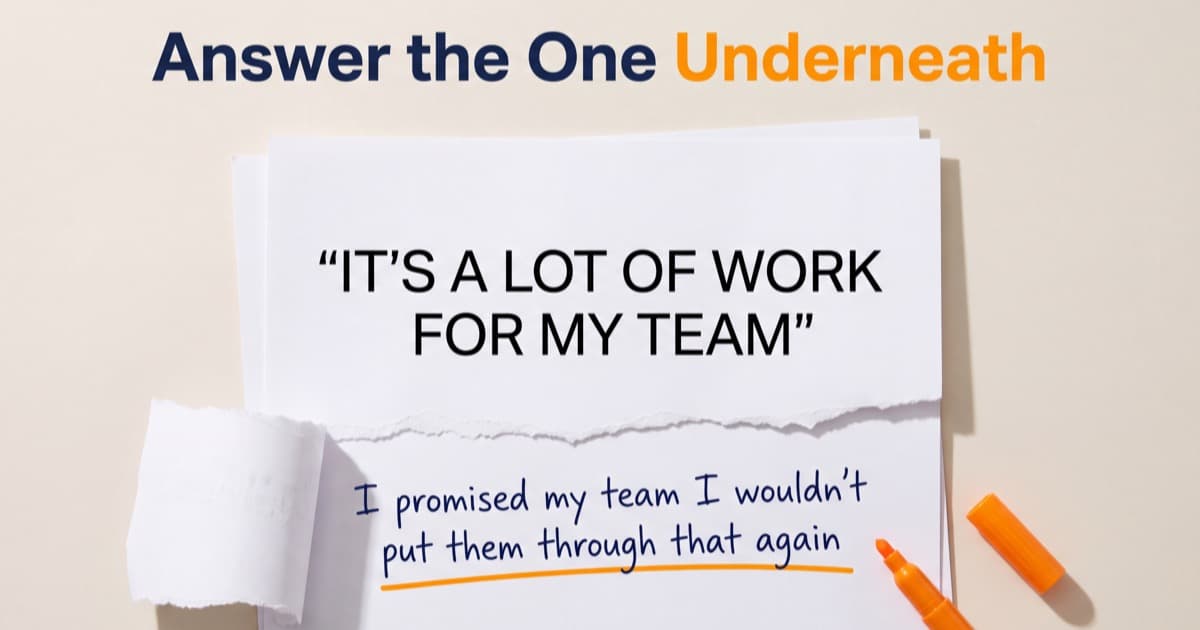
Every one exists to stop you doing the thing you would otherwise do, which is answer immediately. A rep who hears "this looks like a lot of work for my team" and starts describing onboarding has already lost, because they answered the sentence rather than the thing underneath it.
So the shared value is a delay. What separates the four is what you are supposed to do with the delay, and whether anything happens after you answer.
On the first axis, LAER and LAARC send you to learn something. Feel-Felt-Found sends you to reassure. The reverse sends you to ask. On the second axis, only LAARC has a step after the answer at all, and that step is the one most reps drop first.
What each one buys you, and where it breaks
LAER buys you a habit. It is the easiest of the four to remember under pressure, and "explore before you respond" is the single most valuable instruction in any of them. Where it breaks is that explore is not a question, it is a category. New reps hear it and produce "can you tell me more about that," which the buyer answers with a longer version of the same sentence. LAER tells you to dig and does not tell you where.
LAARC buys you the two steps the others skip: assess, which forces you to decide what kind of objection this is before you answer, and confirm, which forces you to check whether your answer landed. It is the most complete of the four and the least used, because five steps is one more than anyone holds live. Where it breaks is speed. Run it in full on a thirty second brush-off and the buyer feels processed. It earns its length on real objections late in a deal, not on a reflex no in the first minute.
Feel-Felt-Found buys you a tone. When a buyer is genuinely worried, "other teams have had that same concern" is disarming and true. Where it breaks is that it is the only one of the four with no learning step at all. You go from their sentence straight to your evidence, which means you are answering a guess. It is also the most recognizable script in sales. Buyers who have been sold to before hear "I understand how you feel" as a rep reaching for a technique, and you spend the next minute recovering credibility.
The reverse buys you information at the lowest cost. One question, no claims, no risk of answering the wrong thing. Where it breaks is repetition and tone. Answer two objections in a row with a question and the buyer notices they are doing all the work. Reverse a direct commercial question ("what does it cost?") and it reads as evasion, which is expensive. It is a scalpel, not a policy.
Put plainly: LAER is the one to learn first, LAARC is the one that holds up on deals that matter, Feel-Felt-Found is a tone to borrow rather than a sequence to run, and the reverse is a single move you deploy once or twice per call.
| Framework | What the delay is for | Step after the answer? | Best used on |
|---|---|---|---|
| LAER | Learning, but it does not say where to dig | No | Everyday pushback, first framework to learn |
| LAARC | Learning, plus deciding which objection this is | Yes, confirm | Real objections late in a deal |
| Feel-Felt-Found | Reassuring; no learning step at all | No | Borrow the tone, not the sequence |
| The reverse | Asking, at the lowest cost | No | Once or twice a call, never on a direct price question |
One objection, two frameworks, same rep
Rowan Adeyemi sells for Calder Grid, a fictional shift scheduling platform. The buyer is Aisha Whitlock, operations director at Brightmoor Logistics, a fictional regional freight company with eleven depots. Second call, and the objection arrives halfway through a sentence about something else.
Run with Feel-Felt-Found:
Aisha: It looks good. My worry is honestly the rollout. This looks like a lot of work for my team and they are already stretched.
Rowan: I completely understand how you feel. A lot of the ops leaders we work with felt exactly the same way before they started.
Aisha: Right.
Rowan: What they found is that once the depot data is in, it actually saves their schedulers time within the first month. Most teams are up and running in about three weeks.
Aisha: Three weeks of my people's time, though.
Rowan: It is much lighter than it sounds. We handle the import, and there is a dedicated onboarding manager the whole way through.
Aisha: Okay. Let me talk to the depot managers and see what they think.
Nothing here is rude or obviously wrong, and the deal is now in trouble. Rowan answered a worry he never defined. Aisha said "a lot of work for my team," and there are at least four different problems hiding in that phrase: hours, the wrong people doing them, a bad experience with the last rollout, or a promise she made her staff after the last one. He picked one at random, defended it, and handed her a reason to go ask other people whether his answer was true.
Watch the last line. "Let me talk to the depot managers" is not progress. It is Aisha leaving to re-litigate the objection in a room Rowan is not in, which is where most of these are actually decided.
Run with LAARC:
Aisha: It looks good. My worry is honestly the rollout. This looks like a lot of work for my team and they are already stretched.
Rowan: That is fair. When you say a lot of work, is it the hours, or is it who ends up doing them?
Aisha: Who does them. It lands on my two schedulers, and they are the same two people who did the telematics rollout last year.
Rowan: How did that one go?
Aisha: Badly. It was sold as two weeks, it ran most of a quarter, and my schedulers were doing data cleanup on Saturdays. I told them I would not put them through that again.
Rowan: So the real question is not whether this takes three weeks. It is whether I am about to make you break a promise you made your team.
Aisha: That is exactly it.
Rowan: Then let me answer that specifically. The import is on us, not your schedulers. What we do need from them is one ninety minute session to confirm depot rules, and one hour in week three to check the first live roster. That is two and a half hours each, total, and I will put those two sessions in writing before you sign anything.
Aisha: Two and a half hours I can defend.
Rowan: Say that back to me the way you would say it to your schedulers, so I know it holds up when I am not in the room.
Aisha: Ninety minutes to set the rules, an hour to check the first roster, and cleanup is not ours this time.
Rowan: That is right. Should we get those two sessions on the calendar now, provisionally, so they can see the size of it before they hear the price?
Same rep, same objection, ninety extra seconds. The assess step turned "a lot of work" into a promise Aisha made after a bad telematics rollout, which is a completely different objection with a completely different answer. The respond step then got to be specific, because it had something specific to be about: two sessions, two and a half hours, in writing.
The confirm step is the one worth stealing even if you take nothing else from this. Asking Aisha to say it back is not a trust exercise. It is how Rowan finds out whether his answer is portable, which is the only property that matters when the objection gets raised again by someone who has never met him. That test is the spine of the objection handling guide.
The parts no framework covers
The buyer will not wait for your steps. Aisha could easily have cut in during step two. When that happens, do not restart the sequence. Answer the interrupt in one sentence, then go back for the assess question. The order is a default, not a contract.
Explore is only worth running on a real objection. Running four steps on "just send me something" is how a two second brush-off becomes an awkward interrogation. Sort the reflex from the real thing first, which is a separate skill covered in brush-off vs real objection.
The acknowledgment line is where the tell lives. "That is fair" and "makes sense, tell me which part" do the job without announcing themselves.
Assess is two questions, maximum. You are finding which version of the objection you are in, not doing discovery you should have done last call. On question three, the objection is not the problem, the earlier call was.
Mixing them is fine. Switching mid-objection is not. Borrowing the Feel-Felt-Found tone for your acknowledgment and then running LAARC works well. Starting with a reverse, getting a flat answer, and then restarting with empathy reads as fishing.
None of this survives first contact untested. Every rep who fumbles an objection can recite the framework afterward. It comes apart live because the buyer interrupts, the room goes quiet, and you reach for the fastest thing you know rather than the best one. The only fix is running the same objection enough times that the assess question arrives before the reflex does, which is what objection handling practice is for.
Pick one framework for the next two weeks and judge it with one question after every call where an objection came up: could the buyer repeat my answer to someone who was not on the call? If not, you skipped the step that would have told you.