
You have had this call. The buyer raised three concerns and you had something for all three. Price, timing, the tool they already pay for. Each time you said your piece, each time they nodded or said "okay, that makes sense," and the call ended warm. You wrote "handled objections, strong call" in the CRM.
Then it died. Not with a no, which would at least be information. It died in a thread you were never on, when your champion tried to explain your product to a finance lead in about eleven seconds and could not do it.
That is the part almost every objection handling guide leaves out. The advice is nearly always about the exchange itself: what to say when they say the price is too high, which framework to run, how to reframe, how to reverse. All of that assumes the conversation you are in is where the decision gets made. On any deal with more than one person in it, that assumption is wrong. The objection is raised in front of you and resolved without you.
So this guide is built around a different test than "did they stop pushing back." It is built around whether your answer can travel. That single change reorders everything: what a good answer sounds like, how long it should be, what you do immediately after giving one, and what is actually worth rehearsing.
The test that matters is whether the answer survives the retelling
Your buyer is not going to relay your answer well. They are not a seller, they were half listening, and by the time it matters they are typing a reply between two other meetings. Whatever you said gets compressed to one sentence, in their words, to someone who has different priorities and no context.
An answer that survives that compression has four properties.
It is short. Not because attention spans are short, but because compression happens whether you like it or not. If you give ninety seconds, the buyer chooses which eight words survive, and they will choose badly. Give them two sentences and you choose.
It is specific and checkable. "We deliver a strong return" does not survive contact with a finance lead. "It replaces about six hours a week of manual reconciliation for two people" does, because it can be argued with, and things that can be argued with sound true.
It is in their units, not yours. Hours, headcount, renewal dates, error rates, the thing their boss asks them about on Mondays. The moment your answer is denominated in your feature names, it stops being repeatable, because nobody relays a feature name they cannot define.
It does not need your enthusiasm to work. This is the one reps miss. A lot of answers are carried by tone, by momentum, by the fact that you are likeable and clearly believe it. Strip the delivery and read the transcript flat. If it collapses without your voice behind it, it will collapse in the retelling, because in the retelling your voice is not there.
Held against that bar, most of what passes for good objection handling is not handling. It is ending the conversation about the objection, which feels identical in the moment and produces the exact call described at the top of this page.
What kind of objection are you actually holding?
The second habit that separates reps is diagnosis. Two sentences that sound the same need opposite responses, and the cost of guessing is high in both directions.
There are roughly four things a buyer can hand you.
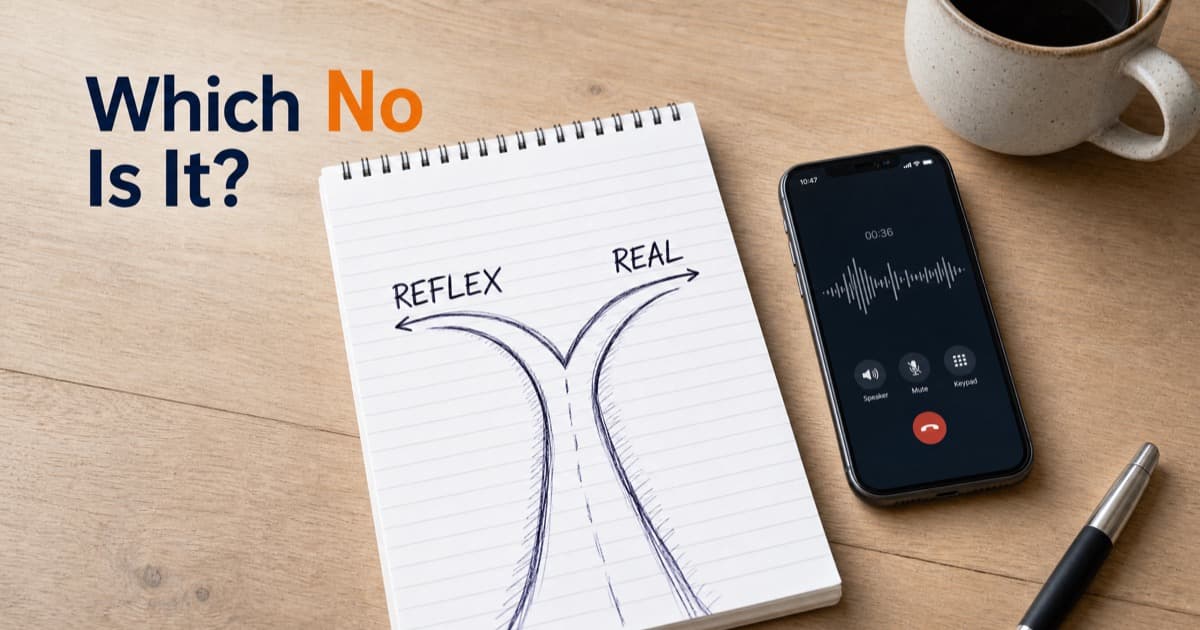
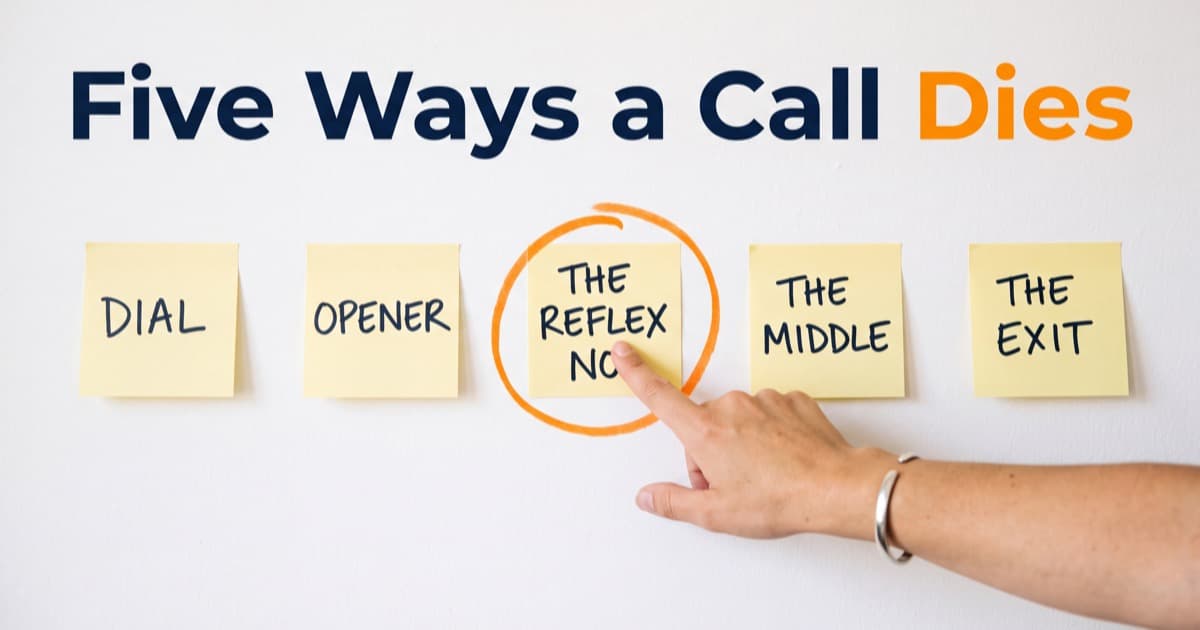
A reflex. A scripted deflection aimed at your category, fired before they have processed anything you said. "We're all set," "not interested," "send me something." These arrive early and they arrive fast, usually in under ten seconds. They contain no information about your offer because there has not been time for any. Answering a reflex as though it were a considered position is the most common unforced error in sales, and it is worth its own read in brush-offs versus real objections.
A real concern. A considered position about your offer, from someone who has understood enough to disagree. "Your implementation is six weeks and our fiscal year closes in four." This is the good kind. It means they modelled it.
A constraint. Something structurally true that no language changes. A contract with fourteen months left, a hiring freeze, a compliance requirement you do not meet. The right response is to believe it, find out when it changes, and stop selling into it.
A relay. The objection is not theirs. They are carrying someone else's, often badly. "My CFO will say we already pay for something like this." Everything in this guide points at this case, because a relay is the objection made visible: you are being told, out loud, that your answer has to work in a room you are not in.
The diagnosis is usually cheap. It takes one question and about four seconds of restraint. What makes it hard is that the reflex to answer is faster than the reflex to ask, so under time pressure most reps produce a fluent answer to an objection nobody actually made.
| What you heard | What it actually is | What it needs from you |
|---|---|---|
| "We're all set", "not interested", "send me something" | A reflex, fired before they processed anything | Acknowledge, swap the abstraction for something concrete |
| "Your implementation is six weeks and our year closes in four" | A real concern from someone who modelled it | One clarifying question, then one short answer |
| "We signed a two-year contract in March" | A constraint no language changes | Believe it, get the renewal date, stop selling |
| "My CFO will say we already pay for this" | A relay you are being handed | Write the sentence your champion has to repeat |
What a good answer is shaped like
Whatever the objection is, the sequence is close to the same, and it is shorter than most reps expect.
Pause. A full beat, not a filler word. The pause does two things: it signals that you are considering rather than retrieving, and it frequently gets the buyer to keep talking. The second half of an objection is usually more honest than the first half, and reps who answer instantly never hear it.
Acknowledge without agreeing. "That is a fair thing to check" is acknowledgment. "Totally, price is always a factor" is a concession dressed as empathy, and you just told them the number is soft. One clause is enough. Anything longer reads as bracing for impact.
Ask one question. One, not three. The purpose is to find out what the sentence is standing on. "When you say it is above budget, is that above what is approved for this, or above what you expected it to cost?" Those are different problems with different answers, and you cannot tell them apart from the outside.
Answer once. Two sentences, in their units, and then stop talking. Answering a second time because the silence felt long is how a solid answer gets diluted into a nervous one. The most expensive four seconds in sales is the gap where a rep decides their good answer needed reinforcement.
Check that it can travel. This is the step that almost nobody runs, and it is the highest-leverage line in this entire guide. Ask them to say it back: "If your CFO asks why this is not just a line item in the system you already have, what would you tell them?"
Then listen to what comes out of their mouth. What comes back is the version that will actually be relayed. If it is thin, you found out now, while you can still fix it, rather than four weeks later when the thread went quiet. If it is good, you have just watched your champion rehearse the argument they are going to have without you, which is worth more than any additional feature you could have described.
Advance. Tie the resolution to the next concrete action, with a date. An objection that resolves into "great, I'll follow up next week" did not resolve.
The four objections you will actually get
Most of what you will hear is one of four things wearing different clothes. Each needs something different from you.
"It is too expensive." Price objections are almost never about the number in isolation. They are about the number relative to a comparison the buyer has in their head and has not said out loud. Find the comparison first. Against a competitor, against doing nothing, against last year's spend on the same problem, against what they told their boss it would cost. Discounting before you know which one you are facing is how reps give margin away to solve a problem that was never about price. The live version is worked through in answering "your price is too high", and the adjacent case where the money genuinely is not allocated is in "no budget" is usually a priority problem.
"Not right now." Timing objections are priority objections in a polite coat. Nothing is ever the right time for a project nobody has been made responsible for. The useful move is to find what would have to happen for it to become urgent, and whether that thing is on a calendar. If the answer is a real date, you have a real deal with a later start. If there is no date, there is no priority, and you should know that now. See "now is not a good time".
"We already use someone else." The instinct is to attack the incumbent, which forces your buyer to defend a decision they made and turns your call into a referendum on their judgment. The alternative is narrower and much more effective: find the one thing the incumbent does not cover, confirm it costs them something, and let the rest of the relationship stand. Worked through in "we already have a vendor".
"I need to run it past someone." Treat this as the relay it is. The deal is now being sold by an amateur, in a room you cannot enter, and the only lever you have left is how well equipped they are. Ask who, ask what that person will care about, ask what they usually push back on, and hand your champion one sentence they can actually repeat. See "I need to talk to my boss".
Notice that none of the four are solved by a better rebuttal. Three of them are solved by finding out what the sentence is standing on, and the fourth is solved by writing a sentence for somebody else to say.
Watch the relay test produce Alina's own sentence
Fictional but ordinary. Tomas sells contract review software at Kettleview. Alina Sorensen is the VP of legal operations at Harborlight Insurance, six weeks into a deal, and she has just come back from a budget conversation.
The weak version:
Alina: So I took this to finance and honestly the pricing is a problem. It is roughly triple what we expected, and the pushback I got was that we already pay for a document platform that does some of this.
Tomas: Right, and I hear that a lot. The thing is, those document platforms are really storage tools with some templating on top. They are not doing clause level extraction, they do not have the obligation tracking, and there is no audit trail that would hold up in a regulatory review. So it is a bit of an apples to oranges comparison. When you factor in that our customers typically see a fifty to sixty percent reduction in review cycle time, and you consider the risk exposure side of it, the total cost of ownership case is actually very strong. We also have a lot of flexibility on how we structure the commercial side if that helps.
Alina: Okay. Yeah, that makes sense.
Tomas: Does that address the concern?
Alina: I think so. Let me take it back to them.
Tomas: Perfect. I will send over a one pager with the ROI breakdown and some of the compliance detail, and let me know how it lands.
Alina: Sounds good. Thanks Tomas.
Everything Tomas said was true, and the call ended pleasantly, and the deal is now in serious trouble.
Look at what he actually did. He answered a question about money with a lecture about product categories, which put Alina in the position of defending a platform her own company chose. He never found out which comparison "triple what we expected" was against, so his entire answer was aimed at a target he guessed. "Fifty to sixty percent" is a range, and ranges do not survive retelling because the listener always takes the bottom of the range and then discounts it. He offered commercial flexibility unprompted, which tells a buyer the price has give in it before they ever asked. And then he did the most damaging thing available: he handed the whole problem to a one pager. A document is not an answer. It gets forwarded unread, and the sentence that actually decides this deal will be spoken by Alina, from memory, in a meeting that starts before she opens the attachment.
Notice also what "that makes sense" meant. It meant she had stopped listening. Reps hear that phrase as agreement. It is almost always punctuation.
The strong version:
Alina: So I took this to finance and honestly the pricing is a problem. It is roughly triple what we expected, and the pushback I got was that we already pay for a document platform that does some of this.
Tomas: That is fair to push on. (pause) When you say triple what you expected, is that against the document platform's line item, or against a number you had in your head going in?
Alina: Against the platform. We pay about forty thousand for it and this came in near one twenty.
Tomas: Got it, that is a real gap. Was the forty thousand covering the review work your team is doing today, or is that a separate cost sitting somewhere else?
Alina: Separate, I suppose. The review is us. It is two paralegals and about a day and a half of my week.
Tomas: Then here is the only comparison I would want finance to see. Today the platform stores the contracts and two paralegals plus a day and a half of your week reads them. The change we are proposing does not replace the platform, it takes the reading. If your CFO asks you why this is not just a feature of what you already own, what would you say?
Alina: I guess that the platform holds the documents but nobody is checking what is in them until something goes wrong.
Tomas: That is the sentence. I would use exactly that, and add the number: two paralegals and a day and a half of legal ops leadership, every week. Is that number defensible if she asks where it came from?
Alina: It is roughly right. I could get the actual hours from the last quarter.
Tomas: Do that before Thursday and it stops being an estimate. Are you presenting it, or is it going in a deck she reads?
Alina: I present it Thursday at nine.
Tomas: Then let us do fifteen minutes Wednesday and run it out loud once, so the version she hears is the version you have already said. Wednesday at four?
Alina: Yes, that would help. Four works.
Trace what changed, because it is not charisma and it is not product knowledge.
He asked which comparison before answering, and the answer relocated the entire deal. It was never a price objection. It was a category error, and one clarifying question surfaced it before he had spent any credibility defending a number.
He then asked a second question that did the real work: whether the forty thousand covered the labor. It did not. That question is what produced "two paralegals and about a day and a half of my week," a cost Alina said out loud in her own units. Nothing Tomas asserted could have done that. Buyers do not believe your arithmetic, they believe theirs.
He never argued with the incumbent platform. "It does not replace the platform, it takes the reading" leaves her earlier decision intact, which means she can repeat it without admitting she bought the wrong thing. Answers that require your champion to look wrong do not get repeated.
Then the relay test, and look at what it produced. Alina's own sentence, "the platform holds the documents but nobody is checking what is in them until something goes wrong," is better than anything in Tomas's pitch deck, and it is the one that will be spoken on Thursday because it is already hers. He did not improve it. He confirmed it, attached the number, and pressure tested where the number came from.
And he closed on the room he is not in. Not a one pager, a rehearsal, before the meeting that decides it.
One more thing worth noticing. In the weak version Tomas speaks roughly four times as many words as Alina. In the strong version it is close to reversed, and everything the deal now rests on came out of her mouth.
Where objection handling breaks
Collecting rebuttals. A rebuttal library feels like preparation and behaves like a liability, because it trains you to pattern match on the first six words and start talking. The rep with twenty memorized responses is usually slower to understand the objection than the rep with none, and speed of understanding is the whole game.
Answering the first version. The first sentence out of a buyer is rarely the real concern, especially when the real concern is political, personal, or embarrassing. "It is a budget issue" is easier to say than "I do not think I can get my team to change how they work." Answer the first version and you will win an argument that was never load bearing.
Winning. You can beat a buyer in an exchange and lose the deal in the same minute. Every point you score has to be defended by them later, to a colleague, without you. Make your answer easy to agree with rather than hard to refute.
Discounting to end the discomfort. Most unnecessary discounts are not commercial decisions, they are the fastest available way to stop an uncomfortable silence. If you find yourself reaching for terms within ten seconds of an objection, the pause step is not optional for you, it is the entire fix. The mechanics of that particular failure are worth their own study.
Treating a constraint as a reflex. Running technique at somebody who just told you they are in a hiring freeze until January is how you become the rep whose calls get avoided. Believe it, date it, leave.
Answering three times. One good answer, then stop. The second answer weakens the first and the third tells them you are not sure.
Rehearsing in your head. Every move here is a mouth skill executed under about one second of pressure. Reading it produces recognition, not capability, and recognition collapses the moment a real person interrupts you.
How to rehearse this so it holds up live
Pick one objection. Not objection handling in general, one sentence you actually get, in the actual words your buyers use, including the annoying version rather than the tidy one.
Then run it out loud, repeatedly, against something that pushes back. The bar is not that you can produce a good answer. It is that you can produce the pause, the one question, and the relay check without hunting for them, because on a live call you have about a second before the silence starts to cost you.
Two specific reps are worth more than the rest. First, the diagnosis rep: hear the objection and ask the clarifying question rather than answering, twenty times, until the question arrives before the answer does. Second, the relay rep: after your answer, ask the buyer to say it back, then listen to what they produce and fix the weak version on the spot. Almost nobody practices the second one, and it is the one that decides deals with more than one person in them.
ConvoSparr exists for exactly this. You talk to an AI counterpart out loud, in real time, and it pushes back the way a real buyer does, including going quiet, restating the objection in a worse way, and refusing to accept an answer that only works with your enthusiasm behind it. Afterwards you get a scored breakdown of the call, so you can see where you answered before you understood and where the conversation actually turned.
The practical structure for those sessions, including how to build one around a single objection instead of a whole call, is in objection handling practice. The diagnostic half of this guide has a longer treatment in brush-offs versus real objections. And if the objections you keep losing arrive in the first ten seconds of a cold call rather than in week six of a deal, that is a different problem with a different fix, covered in the cold calling guide.
If you were handed a framework in onboarding and want to know where it gives out live, the frameworks compared runs four of them through the same call. And price is the objection reps fumble most reliably even when they can recite the answer, which has its own diagnosis in why reps fumble price objections.
The deal you lost last quarter was probably not lost because your answer was wrong. It was lost because your answer never made it out of the call.