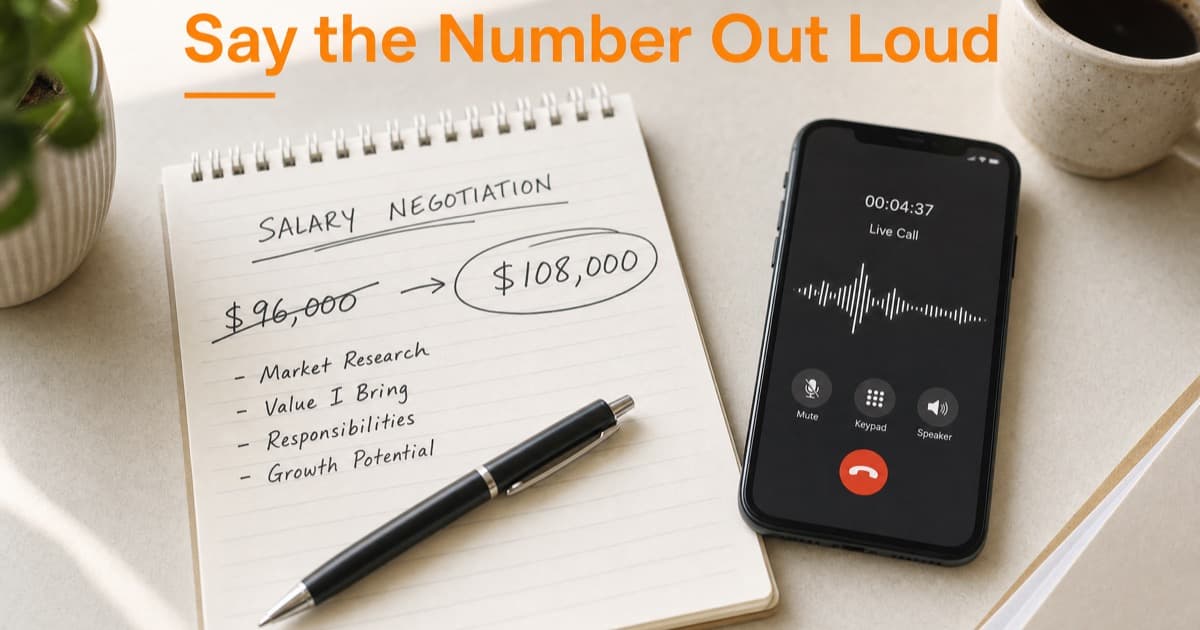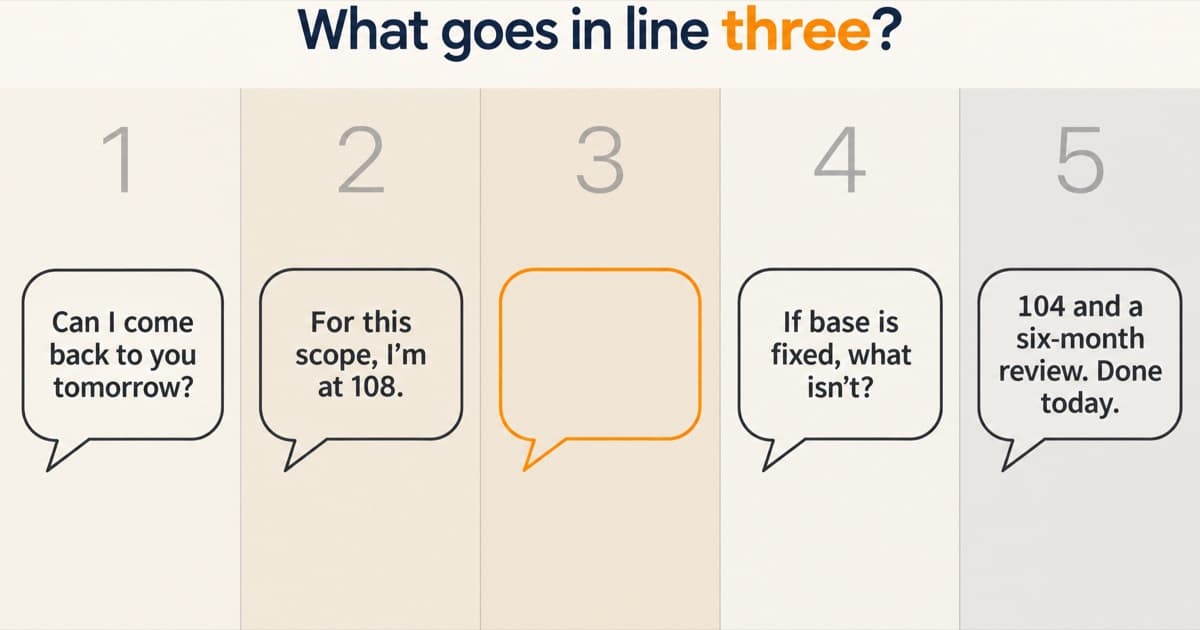

You have an offer call in three days and a number in your head you are supposed to say out loud at some point during it. You have read the advice: know your range, anchor high, don't speak first after the offer lands. You believe all of it. The problem is not knowledge. The problem is that you have never once said your counter-number to another person and watched them not immediately agree with you, and you are not sure what your voice is going to do when that happens for real.
A friend can roleplay this with you, but a friend also knows you, likes you, and will probably fold the moment you sound uncomfortable, because that is what friends do. An AI negotiation partner has no reason to make you feel better. That is the entire pitch: something that will actually hold a number against you, the way a recruiter with a budget will, so the first time you face real resistance isn't during the real call.
Can an AI actually hold a number against you?
A script tells you what to say. It cannot tell you what to do when the other person doesn't follow it, and in a real negotiation, they never do. The recruiter doesn't say "okay, we can go to $130,000" the moment you ask. They push back, they go quiet, they say "let me see what I can do" and then come back with almost nothing. Practicing against a script trains you to deliver lines. Practicing against something that resists trains you to hold a position while someone pushes on it, which is the actual skill.
For a synthetic negotiation to be worth the time, it needs to do three specific things a script never will:
Hold its number instead of caving on request. If you can get an AI persona to agree to your ask just by asking twice, it has taught you nothing except that asking twice works, which is false in real life and will cost you the second you try it on an actual recruiter.
Make you sit in the silence after you counter. The three seconds after you state a number and stop talking are where most people lose ground, filling the gap with a nervous "but I'm flexible, obviously." A useful session forces you to survive that silence instead of narrating around it, because the recruiter on the real call will let it sit exactly as long as it takes for you to blink first.
React to what you actually said, not to a keyword. If you soften a strong counter with an apologetic tone and the AI responds the same way it would to a confident one, it isn't listening to you, it's just running a branch of a decision tree. The response should change based on how you actually delivered the ask, tone included, not just whether you said a number in the right range.
None of that replaces homework. An AI partner cannot tell you whether $135,000 is a reasonable ask for your role in your market, because it does not know your market. It can only give you somewhere to say the number out loud, under resistance, until saying it stops feeling like the hardest part of the call.
The same offer, rehearsed the wrong way and the right way
Milos is a senior product manager who has just been given a verbal offer of $128,000 by Melissa, a recruiter at a fictional healthtech company called Sablecrest Health. His research puts the market rate for the role closer to $148,000. He runs the same scenario twice, four days apart, against an AI persona playing Melissa.
First attempt, reading his prepared counter almost word for word:
Melissa: So the number we landed on is $128,000 base, plus the standard equity grant. How does that feel?
Milos: Um, thank you, I appreciate that. So based on my research, comparable roles are actually closer to, um, $145,000 to $150,000, so I was hoping we could look at something in that range?
Melissa: I hear you, but that's pretty far from where we are. Our budget for this role is fairly fixed at this stage.
Milos: No, totally, I understand, budgets are tight everywhere right now. Would there be any flexibility at all, even a little?
Melissa: I can check, but I wouldn't get your hopes up. Let's plan on where we are for now.
What went wrong: Milos's counter arrived buried in hedges ("um," "I was hoping," "even a little"), which told Melissa before she said a word that he wasn't confident in the number. The moment she pushed back, he immediately validated her constraint ("budgets are tight everywhere") instead of holding his own, and closed by asking permission for "any flexibility at all," which handed the entire negotiation back to her. He never restated his number after the pushback. He said it once, softly, and let it die there.
Second attempt, four days later, after two more rehearsal rounds against the same resistance:
Melissa: So the number we landed on is $128,000 base, plus the standard equity grant. How does that feel?
Milos: I appreciate the offer. Based on comparable PM roles at this level in this market, I'm looking at $148,000 base. That's the number that reflects what I'd be bringing in.
Melissa: I hear you, but that's pretty far from where we are. Our budget for this role is fairly fixed at this stage.
(pause)
Milos: I understand there are constraints on your end. $148,000 is still the number I need to see for this to work for me. Is there a version of the offer that gets closer to that, whether that's base or a mix with equity?
Melissa: Let me talk to the hiring manager and see what's possible. I can't promise $148,000, but I might be able to move some.
What changed: Milos stated his number once, flat, with a reason attached, and did not soften it. When Melissa pushed back, he let the pause sit instead of filling it, then repeated his number instead of retreating from it, which is a different move from repeating a request for flexibility. He acknowledged her constraint without adopting it as his own problem to solve. The line "is there a version of the offer that gets closer to that" kept the pressure on her to move, rather than asking whether she was willing to consider moving at all. Nothing about his research changed between the two calls. What changed was that the number now came out of his mouth the same way on a bad day as on a good one, because he had said it under pushback enough times that it stopped requiring courage.
Where practicing with AI stops helping
Treating the session as a test of the AI, not of yourself. The point isn't to "win" against the persona by finding a prompt that makes it cave. If you're hunting for the phrasing that gets an easy yes, you're optimizing for the wrong outcome. Optimize for whether you can hold your number under real pushback, even when the persona doesn't budge.
Skipping the research and expecting the practice to cover for it. No amount of rehearsal fixes a counter-offer that isn't grounded in an actual market number. If you don't know what the role pays elsewhere, the AI session will just help you deliver a bad number more confidently, which is worse than delivering it badly.
Running the same offer amount every time. If you only ever rehearse against a lowball, you'll be unprepared the one time the initial number is closer to fair and you have to decide whether to counter at all. Vary the opening offer across sessions so you're practicing the decision, not just the delivery.
Stopping after the first clean run. The first time a rehearsal goes well feels like proof you're ready. It usually just means you've learned that specific persona's pattern on that specific try. Run it again a few days later, cold, the way the real call will actually happen.
Never rehearsing the moment after you get a yes. Reps and negotiators alike over-index on the pushback and forget that agreeing too fast when the recruiter finally moves can also cost money. A good session includes what to say when the offer improves but still isn't quite there.
The number you're asking for on the real call was never the hard part. Writing it down took five minutes. Saying it out loud, holding it while someone pushes back, and not filling the silence that follows: that's the part that needs reps, and it's the part a synthetic negotiation that actually resists you can give you before the real one starts.
The research the practice cannot do for you, your walk-away, your target and your ask, is in the salary negotiation guide.