Type "salary negotiation simulator" into a search bar and most of what comes back is a quiz. Pick an answer from four options, get a score, read a tip, move to the next slide. It feels like practice because there's a scenario and a scorecard attached to it. It isn't practice, because nothing about picking option B trains what actually happens on the call: your own voice, live, with no multiple choice menu to fall back on when the recruiter says a number you didn't expect.
That gap matters because the negotiation itself is not a knowledge test. You already know the advice: anchor high, don't speak first, ask for a range. A simulator that quizzes you on that advice is testing something you've already passed. What it needs to test is whether you can say the counter number out loud, at normal speed, without your voice cracking or your sentence trailing into "but I'm flexible, obviously." That's a spoken skill, and a spoken skill can only be built by speaking, against something that talks back unpredictably.
What separates a salary negotiation simulator from a quiz?
It has to respond to what you actually say, not to which button you pressed. A branching quiz has a finite tree: three or four pre-written recruiter replies per node. A live counterpart has to parse your actual sentence, including the ones you didn't plan, and answer in character. That's the difference between rehearsing a flowchart and rehearsing a conversation.
It has to hold its position instead of folding on schedule. Most quiz-style tools are built to teach, so they reward the "right" choice by having the recruiter cave shortly after. A real negotiation doesn't work that way. A useful simulator plays a recruiter who defends their number, pushes back on a weak counter, and only moves when you give them something to move on, the same as a real one would.
It has to force you to actually say the number. Typing "$135,000" into a text box and clicking submit trains nothing that transfers to a phone call. Saying "$135,000" out loud, at the pace a real conversation moves, with a stranger's voice waiting on the other end, is the entire skill. If the tool never makes you produce spoken language under time pressure, it isn't simulating the moment that decides the outcome.
It has to leave you with more than a score. A number out of ten tells you that something went wrong. A transcript of the actual call tells you where: the sentence where you hedged, the pause you skipped, the counter you rounded down before anyone asked you to.
The same offer, run through both kinds of tool
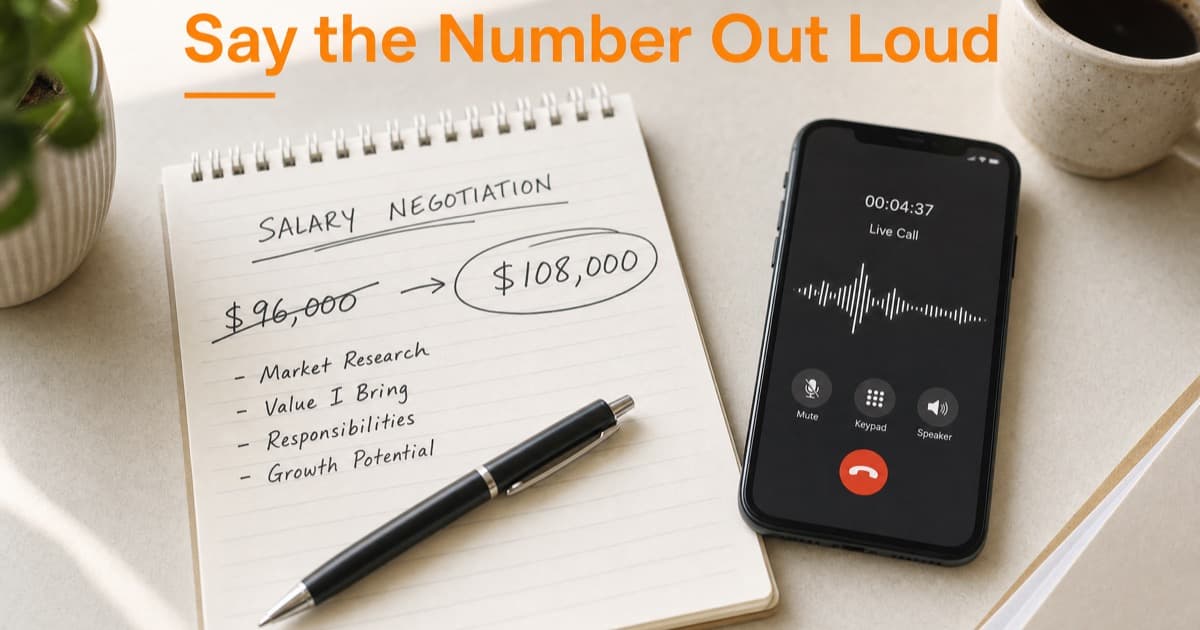
Diego is a fictional senior support engineer with an offer in hand from a company called Brasswood Logistics: $96,000 base against a market rate closer to $108,000 for his profile in his region.
Run through a branching-quiz simulator:
Prompt: "The recruiter offers you $96,000. What do you say?" A) "I accept." B) "Can we discuss the number?" C) "I was expecting something closer to market rate. Can we look at $108,000?" D) "That's too low."
Diego picks C. The screen shows a green checkmark and a paragraph explaining that anchoring above your target is a strong move.
Diego now knows the right multiple-choice answer. He has never once said the sentence "I was expecting something closer to market rate" out loud, at a natural pace, to another voice that might immediately ask him a question back. The quiz confirmed he understands the theory. It told him nothing about whether he can execute it live, and understanding the theory was never the part he was missing.
Run through a live voice counterpart:
Recruiter (AI): We're excited to have you. We'd like to offer $96,000 base, plus standard benefits.
Diego: Thank you, I appreciate that. Can I take a second to think it through?
(pause)
Diego: Based on what I'm seeing for senior support engineers with my background in this market, I was expecting closer to $108,000. Is there room to move toward that?
Recruiter (AI): That's a meaningful jump from where we are. I could probably get approval for $101,000. That's close to the top of what this role's band allows.
Diego: I hear you on the band. If we can land at $104,000, I'm ready to accept this week.
Recruiter (AI): Let me take that back to the hiring manager and get you an answer by tomorrow.
Nothing in that exchange was on a menu. Diego had to generate the anchor sentence himself, hear a counter he hadn't scripted for ($101,000, not $96,000 and not $108,000), and produce a real-time response to a number that didn't exist five seconds earlier. That's the actual shape of a negotiation call, and it's the only version of practice that tells Diego, before the real call, whether he can do this outside a controlled quiz environment.
What to check before you trust a tool with your real negotiation
Does it require a spoken answer, or a clicked one? If the entire session can be completed with a mouse, it isn't rehearsing the skill a phone call requires.
Does the counterpart ever say a number you didn't plan for? If every session ends at the same predictable figure, you're memorizing an outcome, not building the ability to handle whichever number actually shows up.
Can it be caught off guard by an unscripted response? Ask something the tool's designers probably didn't anticipate, a clarifying question about the bonus structure, a request to think it over out loud, and see whether it stays in character. A rigid tool breaks immediately; a real one adapts.
Does it give you a transcript, or just a grade? A score tells you that something was off. Only your own words, written back to you, show you which sentence it was.
Does it let you fail the negotiation? If every path in the tool eventually leads to a win, it isn't teaching you to recover from the version of the call where the recruiter holds firm and you have to decide, live, whether to push again or accept.
None of this means the quiz-style tools are worthless. Reading the theory once, so you know what an anchor is and why the pause matters, is a reasonable first step and it's fast. The mistake is stopping there and treating that fluency with the concepts as if it were fluency with the call. The two feel similar from the inside, because both leave you with the sense that you "know what to do." Only one of them has tested whether you can actually do it while a stranger is waiting on the other end of the line for your answer.
A useful way to tell them apart before you commit real preparation time: try to derail the tool. Ask a question that isn't on any obvious script, push for a number the recruiter already rejected, or go quiet for five seconds and see what happens next. A quiz has nowhere to go and either loops back to the same options or breaks character. A live counterpart improvises, the same way an actual recruiter would, and that reaction, more than any feature list, tells you whether the practice you're about to do will transfer to the call that actually matters.
A salary negotiation simulator is worth the name only if it makes you do, out loud and under a little pressure, the exact thing the real call will ask of you. Everything short of that is a study guide wearing a scenario as a costume, and a study guide has never once talked anyone through the three seconds after a lowball offer lands.
What to rehearse once you have found a tool worth using is in the salary negotiation guide.