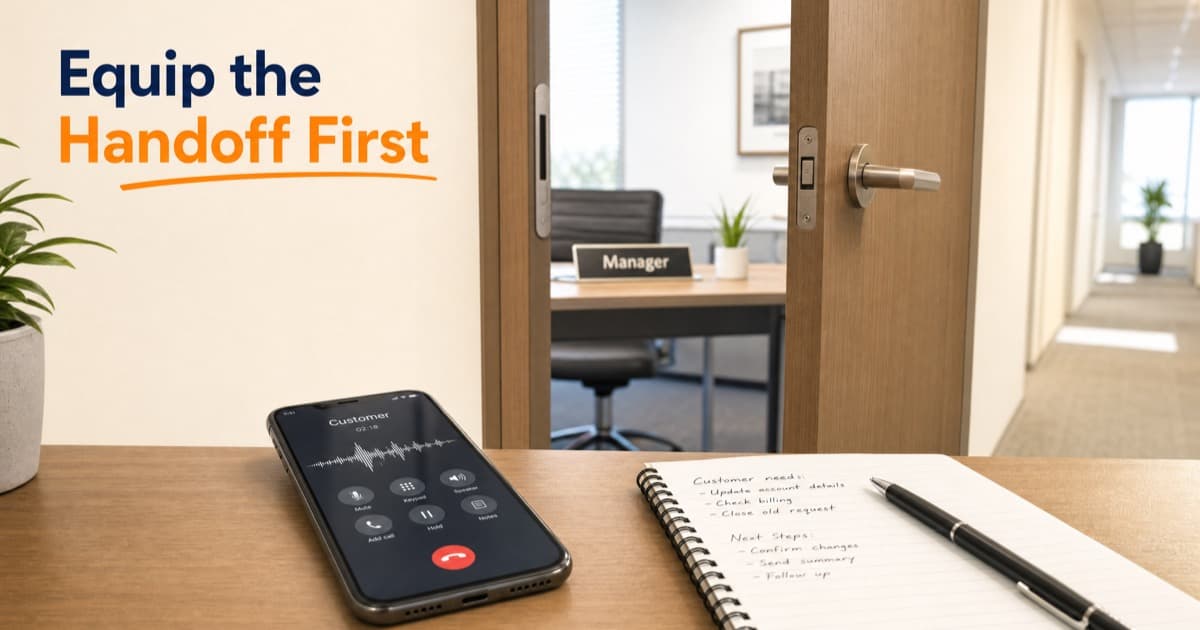

A committee buying decision is not a meeting you get invited to. It is a fifteen minute agenda item, argued from a summary someone else wrote, in a room where your best answer is only as good as your contact's memory of it. So the call you are actually on is not a pitch. It is a briefing for a person who has to sell this without you, to people who will never hear you say a word.
Where the committee forms without anyone announcing it
Nobody says "you are now in a committee sale." What happens is smaller. Halfway through a good second call, your contact starts using a different pronoun. "We would need to look at how this fits." "We have a review cycle for anything touching member data." The deal did not change shape there. You just found out what shape it had been all along.
By the end of that call you get the sentence: "Let me take it to the group." It sounds like progress, and it is, but it is also the last moment you have any control over what the group hears. From here the deal moves by relay: three or four lines typed into a thread, a question asked in a hallway, a decision made or deferred on material you never saw.
This is not the 'I need to talk to my boss' objection, where one named person says yes or no and you can usually get to them. That has a door you can knock on. A committee has four, and at least one belongs to someone whose main relationship with your category is a bad experience from three years ago.
Losing on a summary you never got to write
Treating the group as a scheduling problem. The reflex is to ask when they meet and put a follow-up in the calendar. That answers logistics and nothing else. What gets said, by whom, against which objection, stays entirely unspecified, and the follow-up call opens with "so, any thoughts from the team?"
Giving your contact a deck instead of a sentence. A deck is built for a live conversation with a supportive person. Nobody forwards nineteen slides into a committee thread. What gets forwarded is one paragraph your contact types from memory at 6pm, and that paragraph is the entire pitch now.
Preparing for the enthusiast and not the skeptic. Every question you rehearsed came from the person who wanted it to work. The committee contains at least one person whose job is to find the reason to wait, and that objection is the one your contact will face alone, holding your paragraph.
Reading silence afterward as rejection. Sometimes it is. Often the item got bumped, because the group spent forty minutes on something else and yours was item six. A wounded follow-up burns the one ally who was still arguing for you.
What is everyone else in the room actually weighing?
They are not weighing your product. They are weighing what it costs them personally if it goes wrong, and that number is different for every seat. The champion spends credibility. Finance spends budget already allocated somewhere else. Risk spends the assumption that nothing new breaks on their watch. Operations spends their team's quarter on an implementation nobody asked them about.
So one message cannot work on all of them, and what your champion carries has to be splittable: not four pitches, but one line per seat that survives being repeated by someone who is not you.
| Seat at the table | What they are actually weighing | The line that has to survive relay |
|---|---|---|
| Your champion | Whether backing this makes them look sharp or naive in six months | "Two places our size did this last year, and here is who to call." |
| Finance | What this displaces, not what it costs | "It replaces a line we already pay, and the delta is $14k a year." |
| Risk or security | Whether it creates a new thing that can fail on their watch | "Nothing new touches member data, and the review packet is already written." |
| Operations | How many hours of their team's quarter this eats | "Setup is one afternoon with two people, not a project." |
Arming a champion who has to sell it without you
The rep sells Wexler, a digital account opening platform for credit unions and community banks. Lorena is Director of Member Experience at Harkness Valley Credit Union, eleven branches, and she has been on two calls and likes what she has seen. Her leadership team meets Thursday. Wendell, the Chief Risk Officer, has vetoed two vendor projects in the last year.
The version that dies in the hallway:
Lorena: This looks like a real improvement on what we do now. Let me take it to the group on Thursday and I will circle back.
Rep: That's great to hear. I'll send over the deck and the one-pager so you have everything, and I'll follow up Friday to see how it went.
Lorena: Perfect, thanks.
Rep: Anything you think they'll push back on?
Lorena: Honestly, I think it should be fine. It's a pretty clear win.
The rep accepted the most optimistic possible read of a meeting they will not attend, from the one person in the building already sold. "Anything you think they'll push back on" is a yes-or-no question asked at the end of a call, so it got the polite answer. The deck goes into a folder. On Thursday, Lorena has forty seconds and no line prepared for Wendell, and the item ends as "Lorena is looking at a vendor, we will revisit."
The version that survives the retelling:
Lorena: This looks like a real improvement on what we do now. Let me take it to the group on Thursday and I will circle back.
Rep: Happy to help you get ready for that. Who's in the room Thursday besides you?
Lorena: Our CFO, our COO, our head of IT, and Wendell, who runs risk.
Rep: Which of them is most likely to say "not this quarter"?
Lorena: Wendell, without question. He killed a core banking add-on last spring over a vendor review that dragged.
Rep: Then let's not make you improvise that one. Two things happened in that add-on review that won't happen here: we don't hold member data, we pass it through to your core, and our SOC 2 packet and the standard risk questionnaire are already filled out. Can I send you both today, so you're forwarding a completed review instead of promising to chase one?
Lorena: That would actually change how I open it.
Rep: Last thing. If Wendell asks a question you don't want to guess at, I'd rather be twenty minutes on a call with him next week than have you carry it. Can I offer that in the room?
Lorena: Yes, and I think he'd take it.
Asking who is in the room turned an abstract group into four named positions, which is the only way to prepare for any of them. Asking which one says "not this quarter" is a forced choice, so it produced a real name and a real story instead of "I think it should be fine." And rather than arguing with the objection, the rep handed Lorena something she could forward whole, which is the difference between defending a claim and presenting a document. The offer to talk to Wendell is not a meeting request. It is permission for Lorena to say "I can get you the answer" instead of stalling.
Running this one live before the deal goes quiet
Set up a discovery call against a buyer who likes you and cannot sign. Do not try to win the call. Try to leave it with material a stranger could argue from. Goals for the run:
- Get the room named. Not "who else is involved," but the seats: who signs, who worries about risk, who owns the work afterward.
- Ask which person is most likely to want to wait, and get the story behind it. A forced choice gets an answer; an open question gets reassurance.
- Turn your strongest claim into one sentence per seat, short enough to be said from memory.
- Send one thing that can be forwarded whole, a completed questionnaire or a reference name, rather than a deck built for you to present.
- Set the next step against the committee's calendar, not yours.
Then run it again against a contact who is friendly and vague, the kind who answers "I think it should be fine" to everything, and see whether you can still leave with names.
One warning worth taking seriously: the most dangerous version of this call is the one that felt excellent. A committee deal rarely goes quiet on Thursday. It goes quiet on the Tuesday before, in the two minutes your champion spent writing the summary alone, with nothing from you in front of them.