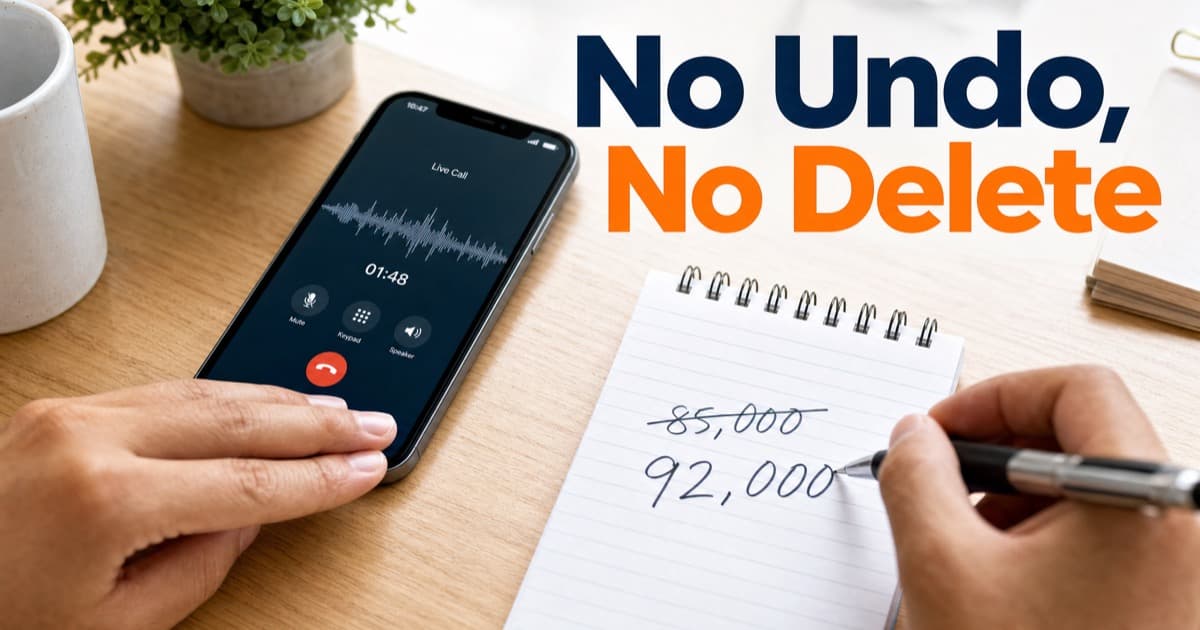
Negotiating a job offer over the phone happens live and unscheduled, so the habit that matters is acknowledging the news without evaluating the number. Ask for the whole package first, say your target as a complete sentence with a reason, then stop talking. Both versions of that call are below.
The call you do not get to schedule
Your phone rings at 2:40 on a Tuesday. You are between meetings, or in a grocery aisle, or halfway through lunch. It is the recruiter, and the first sentence is good news: the team wants to move forward. The second sentence contains a number.
That is negotiating a job offer over the phone, and almost nobody gets to choose when it starts. There is no draft folder, no chance to reread the sentence before it lands, and no written offer in front of you to point at. The recruiter has the full package on a screen. You have whatever you can remember and whatever you can write down in the next few seconds.
The trap is that this call feels like an announcement. It is not. It is the first round of the negotiation, and the tone you set in the first thirty seconds decides whether the number written into the formal offer is the one they opened with or the one you asked for. Treat the call as information delivery and you end up negotiating against a number you have already reacted well to.
Five ways a live offer gets accepted by accident
Reacting before the package is complete. Recruiters usually lead with base salary because it is the cleanest number to say out loud. Bonus target, equity, signing bonus, start date, and review timing come afterward, if they come at all. Candidates who respond to the base before hearing the rest have committed to a reaction to one line of a multi-line offer.
Letting relief sound like acceptance. After weeks of interviews, hearing yes is genuinely a relief, and it comes out as "oh, that's great." On the phone that sentence has no accompanying face to soften it. The recruiter writes down that the candidate responded positively to the number, and that note travels.
Filling the silence. A pause on a call feels much longer than a pause across a table, so candidates rush to fill it. The rushed sentence is almost always a concession, because it is the one thing nobody rehearsed.
Treating the call as the only window. Candidates assume they must respond fully, right now, or look unserious. The opposite is true: asking for the offer in writing and naming a specific time to talk again is standard and costs nothing. What looks unserious is a vague "let me think about it" with no date attached to it.
No number ready to say out loud. Plenty of candidates know their range perfectly well and still cannot produce it under time pressure, because they have never said it in a sentence to another person. A number you have only thought about is not a number you have.
What is the recruiter doing on an offer call?
The recruiter on this call is doing two jobs at once. The first is closing: they want a verbal signal strong enough to report back to the hiring manager. The second is calibration: they are trying to learn how much room the company actually needs to spend to get you.
Everything you say is evidence for the second job. Enthusiasm without a number tells them the opening figure is probably enough. A specific counter with a reason attached tells them it is not, and gives them something concrete to take upstairs. Hesitation with no ask tells them nothing, so they default to assuming the offer stands.
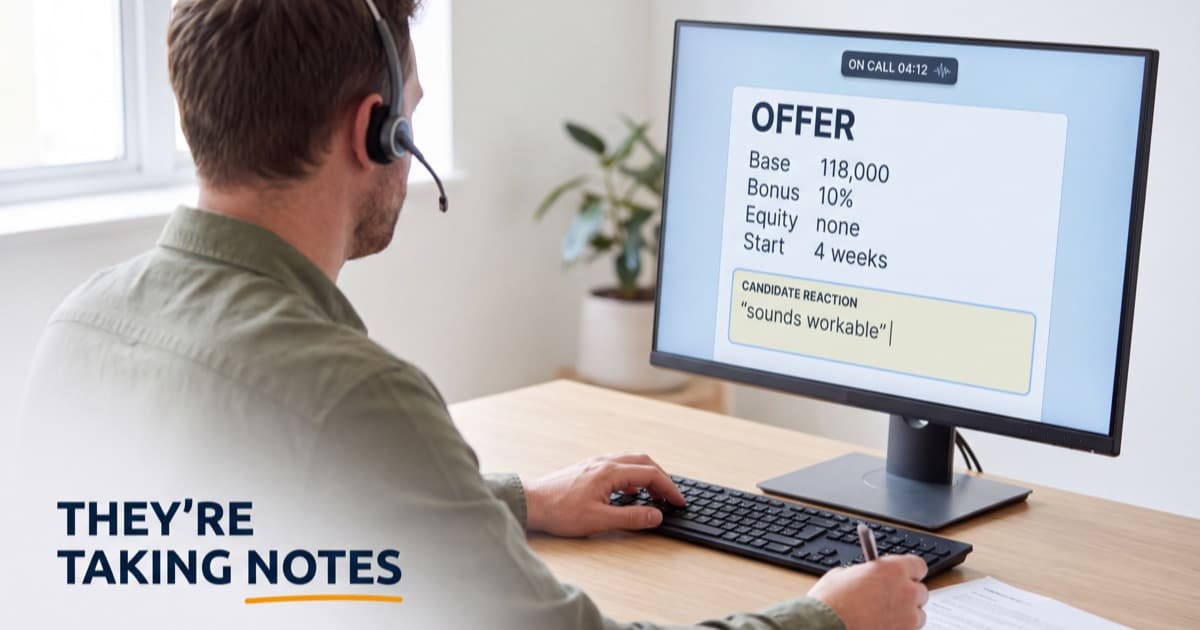
They are also, quite often, taking notes. A number you say casually will be quoted back to you accurately three days later, which cuts in your favor only if it was the number you meant.
What gets conceded before the package is read
Leonie is a fictional operations manager candidate. Cadence Freight, a fictional logistics company, is offering $118,000 base. Leonie's researched target is $130,000. Ruslan is the recruiter, calling without warning on a Tuesday afternoon.
Reacting to the number:
Ruslan: Leonie, good news. The team loved you and we would like to make you an offer. We are looking at $118,000 base to start.
Leonie: Oh wow, that's great news. Thank you so much.
Ruslan: Wonderful. So how does that number feel to you?
Leonie: Yeah, no, that sounds workable. I mean, I was maybe thinking a little higher, but I'm sure we can figure something out.
Ruslan: Great. I will send the paperwork over today and we can go from there.
Leonie: Perfect, thanks again, really excited.
Leonie said "that's great news" before hearing a single other component of the package, so the base is now anchored as acceptable. "Sounds workable" is an acceptance in everything but name, and Ruslan will report it that way. "A little higher" is not a number, so it costs Ruslan nothing to nod at it and move on. Worst of all, Leonie closed with "really excited," which removes any pressure to improve the offer, and then agreed to paperwork, which converts a live negotiation into a document review. The next conversation now starts from a number Leonie already praised.
Taking the whole package first:
Ruslan: Leonie, good news. The team loved you and we would like to make you an offer. We are looking at $118,000 base to start.
Leonie: That is good to hear, thank you. Before I react to anything, can you walk me through the whole package? Base, bonus structure, equity if there is any, and the start date you have in mind.
Ruslan: Sure. $118,000 base, a 10 percent target bonus, no equity at this level, and we were hoping for a start in four weeks.
Leonie: Got it, I am writing that down. I appreciate you calling directly. I do want to be straightforward with you rather than sit on it: based on what this role covers and what I have seen for comparable operations roles in this market, I am targeting $130,000 base.
Ruslan: That is above where we budgeted. I am not sure I can get there.
Leonie: I understand it may take a conversation on your side. Two things that would help me: send the offer in writing with those components spelled out, and let us put fifteen minutes on the calendar Thursday morning to talk through where you can land. If we get to $130,000, I am ready to say yes on that call.
Ruslan: Thursday works. Let me see what I can do before then.
Leonie acknowledged the news without evaluating the number, which is the single most useful habit on this call. Asking for the full package first gets the real offer on the table and buys ten seconds of thinking time that does not look like stalling. "I am writing that down" quietly slows the call and signals that the details will be held to.
The counter is specific, spoken as Leonie's own target rather than a request for whatever is possible, and it arrives with a reason instead of an apology. Leonie then converts Ruslan's open-ended "let me see" into a dated fifteen minutes, which is the phone equivalent of getting something in writing. The final sentence is the one that gets deals closed: it tells Ruslan exactly what a yes costs, so she can go argue for it internally with a clear case rather than guessing.
Note what Leonie never said: no "I'm really excited," no "whatever you can do," no filled silence after Ruslan pushed back. The pause after "I am not sure I can get there" belonged to Ruslan, and Leonie let her keep it.
Rehearsing the unscheduled version
Set up a salary negotiation scenario as the receiving side of an unscheduled offer call. Load in a starting offer meaningfully below your target and let the counterpart open with the number rather than waiting for you to raise it. Aim for these four things in a single run:
- Acknowledge the news without evaluating the number. No "great," no "that works," until the whole package has been described.
- Ask for every component before responding: base, bonus, equity, signing bonus, start date, first review.
- Say your target number as a complete sentence with a reason attached, then stop talking. Practice sitting through the pause that follows.
- Close the call with a specific next step that has a date on it, plus a clear statement of what number earns an immediate yes.
Run it more than once, and change the pressure each time: a recruiter who says the budget is fixed, one who counters halfway, one who asks what other offers you have. The version of this call you are least prepared for is the one where the recruiter is warm, agreeable, and never gives you an opening to counter. Practice that one twice.