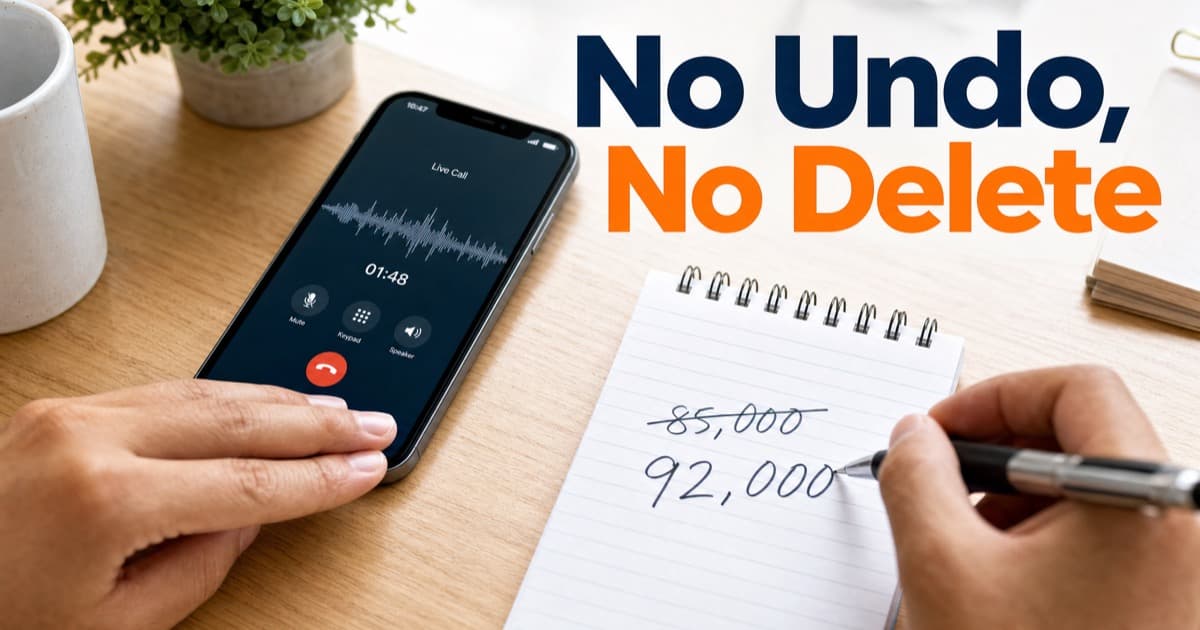
The offer-letter version of this conversation gives you room. The number arrives in writing, you close the laptop, you talk it over with someone you trust, you sleep on it, and you send back a considered reply two days later. The phone version gives you none of that. Halvard, a recruiter at a company called Ferrowatt Systems, says a number out loud and then goes quiet, and the only thing filling that silence in the next four or five seconds is going to be your voice, saying something you cannot draft, cannot revise, and cannot take back.
That real-time constraint is the entire difference between negotiating a salary offer over the phone and negotiating one in writing, and most negotiation advice is written for the email version. It tells you what to say, not what to do with the fact that you have to say it live, with your voice doing half the negotiating whether you intend it to or not. The skill that actually matters on a phone call is not a sharper argument. It is a way to manufacture the four seconds you don't naturally get.
How do you buy time on a live salary call?
A live number lands as a small shock even when you were expecting one, and the instinct under mild shock is to fill the silence, immediately, with whatever reaction is closest to the surface. That reaction is almost never your best answer. It is relief that the process is over, or disappointment that leaks into your tone, or a counter-number you invented on the spot because staying quiet felt unbearable. All three hand the recruiter information you did not mean to give away, before you have done a single second of actual thinking.
The fix is not staying silent, which reads as dead air and makes people repeat themselves nervously. The fix is a short, neutral bridge that buys real time without sounding evasive. You are not refusing to engage. You are declining to react before you have thought, which is a completely different and much more defensible thing to ask for out loud.
The exact language: what to say instead of a number
Three phrases do almost all of the work, and none of them require you to sound uncertain.
Ask for the number again, plainly: "Could you say that number again, just so I've got it exactly right?" This is not a stall. Repeating it back slows the pace of the call by a beat, gives you a second pass at hearing it clearly, and buys a few seconds of processing time under the completely ordinary cover of accuracy.
Name what you're doing instead of hiding it: "I want to actually think that through rather than react to it on the spot." Recruiters hear this constantly and it costs you nothing. Reacting on the spot is what candidates without leverage do; thinking it over is what candidates who have other things going on do, and it signals that even before you've said anything else.
Put a real deadline on the follow-up, not a vague one: "Can I get back to you by Thursday at 3?" A specific time makes the pause feel like a process step instead of an opening for stalling, and it keeps the recruiter from wondering whether you've gone cold on the role.
Buying four seconds on a live call
Below is a fictional candidate, Maya, on a live call with Halvard, a recruiter at Ferrowatt Systems, a fictional industrial software company. Halvard is calling to extend a verbal offer for a Senior Ops Analyst role. Both versions open identically.
Reacting on the spot:
Halvard: We'd love to bring you on as Senior Ops Analyst. The number we're able to offer is ninety-two thousand.
Maya: Oh, wow, okay. That's honestly pretty close to what I was hoping for, so that works for me.
Halvard: Great, I'll get the paperwork started. Anything else you wanted to cover?
Maya: Actually, wait, is there any room to move on that at all? I was thinking more like ninety-six.
Halvard: I mean, I can ask, but you just told me it works for you.
Maya's first sentence gave away the one thing she needed to keep private: how close the number already was to her real number. Once Halvard has heard "that works for me," any counter that follows sounds like second-guessing rather than negotiation, because it is negotiation against her own stated position from fifteen seconds earlier. The problem was not the second ask. It was answering before she had decided what to ask for.
Buying the four seconds:
Halvard: We'd love to bring you on as Senior Ops Analyst. The number we're able to offer is ninety-two thousand.
Maya: Could you say that again, just so I've got it exactly right? Ninety-two.
Halvard: That's right, ninety-two thousand base.
Maya: Got it, thank you. I want to actually think that through rather than react to it on the spot, this is a big decision. Can I get back to you by Thursday at 3?
Halvard: Of course, take the time you need. Talk Thursday.
Maya gave away nothing about how she felt about the number, positive or negative, and she did not need to. The repeat-back bought her a genuine second look at the figure while it was still fresh instead of half-remembered an hour later. Naming the delay out loud, rather than going quiet and hoping Halvard didn't notice, kept the call from feeling awkward. And the specific callback time meant Halvard hung up with a clear next step instead of a vague sense that Maya might be losing interest. Two days later, Maya called back with a researched counter and a reason for it, from a position Halvard had no read on at all.
Where buying the seconds backfires
Filling the pause with gratitude that undercuts the ask. "Thank you so much, this means a lot" said in the same breath as a request to think it over reads as relief, not composure, and relief signals you'll take whatever comes next.
Treating "let me think about it" as something you need to apologize for. Recruiters extend verbal offers expecting exactly this response. Over-explaining or apologizing for taking the standard step makes it sound unusual when it isn't.
Countering with a number invented in the moment because the silence felt uncomfortable. A counter you haven't actually researched is worse than no counter at all, because if it lands too low you've anchored yourself, and if it's implausibly high you've signaled you weren't serious about the conversation.
Not writing the number down as it's said. A number heard once under mild adrenaline gets misremembered more often than people expect, and confirming a wrong figure two days later on the callback is a genuinely bad way to reopen the conversation.
Going quiet instead of naming the pause. Silence on a phone call reads as a dropped connection or hesitation far more often than it reads as thoughtful consideration. Say what you're doing; don't make the recruiter guess at it.
None of this requires a cleverer number. It requires not answering before you've actually decided what your answer is, which on a phone call is a much harder thing to manage than it sounds like it should be until you've had to do it live, with someone waiting on the other end of the line.
The numbers to fix before the phone rings, and what to do when they tell you the figure is final, are in the salary negotiation guide.