
The email lands at 4:40 on a Thursday. Subject line is your own name plus the word "Offer". You read it four times. The number is fine. It is more than you make now, which is the comparison your brain reaches for first and the wrong one. Somewhere underneath the relief there is a quieter thought: I could probably ask for more, and I am almost certainly not going to.
That thought, and what happens to it over the next eighteen hours, is worth more than most people's annual raise. A single successful counter early in a career compounds through every future offer, every percentage-based increase, and every pension contribution calculated off the base. The gap between two people with identical skills, ten years apart, is very often just that one of them asked four times and the other never did.
This guide is about the asking. Not the theory of it, and not a list of power phrases, but the actual mechanics: what leverage you really have, what numbers to fix before you speak, what to say in the sixty seconds where it is decided, and what to do when someone tells you the number is final.
Can an employer rescind an offer because you negotiated?
Almost everyone who decides not to negotiate has the same private reason, and almost nobody says it out loud. It is not that they think the offer is fair. It is that they are afraid the offer will disappear, or that asking will mark them as difficult before their first day.
So price that fear properly, because it is doing a lot of work on very little evidence.
An offer arriving in your inbox is the end of a long and expensive process. Someone wrote a job description, got headcount approved, ran a screen, coordinated three or four rounds with people whose time is billed at a lot, argued in a debrief, and then persuaded a finance function to release a number. That whole apparatus concluded that you are the person. Pulling the offer because you asked for a higher base means restarting it and explaining to a hiring manager, who is by now desperate to get the role filled, why the candidate they chose is gone over a question.
It happens. It is not zero. But it is rare enough that if you have heard the story, it was probably second hand, and if you dig, the version that actually occurred usually involved something else: a candidate who negotiated in bad faith, one who kept re-opening settled points after agreeing, or one who was visibly using the offer only as leverage somewhere else. A single polite counter, made once, with a reason attached, is a routine event that recruiters handle every week of their working lives.
Here is the part worth internalizing. In many companies the recruiter is expecting it. They were given a range, not a number, and the first offer is usually not the top of that range, because opening at the ceiling leaves them nothing to do when you push. Not countering does not read as easy to work with. Very often it just reads as: this one did not know.
The second fear is subtler and more legitimate: that asking damages the relationship with the manager you are about to work for. It can, but only through the way you ask, never the fact of it. Anything that sounds like an ultimatum, a comparison to a colleague, or a threat you are not prepared to carry out will do damage. A sentence that gives a number and a reason will not. Managers negotiate their own compensation. They do not find it shocking that you negotiate yours.
Almost all of your leverage was built before this call
The negotiation feels like it happens on the offer call. It mostly does not. By the time the number is quoted, the size of the room you have to move in has already been set by four things, and only one of them is still adjustable.
How well the process went. Whether you were the clear choice or the acceptable one is the single biggest determinant of flexibility, and it was settled in your interviews. This is why interview performance is compensation work, and why people who treat the final round as a formality are quietly setting their own ceiling.
Whether they know what it costs to lose you. Not a threat, just a fact in the room. A named competing offer creates the most, but it is not the only version. A current role you are content in, a project you would need to hand over, a start date you cannot move: all of these are real constraints that shape what a recruiter thinks the risk of a low offer actually is.
The band, and where you sit in it. Almost every company of any size has a band for the level, and the recruiter cannot cross the top of it without an approval that costs them real effort. This is the most useful thing you can learn on the call, and most candidates never ask. "Where does this offer sit in the band for the level?" is a completely normal question and the answer tells you whether you are arguing about 3 percent or 15.
What you have already said about money. If you named a number in the screening call, that number is very likely the number you are looking at now. This is why the current salary question and the expectations question matter so much: they set the anchor weeks before anyone talks about an offer, at a point where you know the least about the role you are being priced for.
Only the last one is still in your hands during the process, and only if you have not yet answered. The general shape of a good answer is to give a researched range for the role rather than a fact about your history, and to make the range about market value rather than about you personally. If you have already given a number and it was low, you are not finished. You can still counter, and the reason is simply that you now know more about the job than you did then. Say exactly that.
Three numbers, one sentence, and a page of evidence
Preparation for this is small. It just has to exist before the phone rings, because none of it can be constructed live while somebody waits.
Number one: your walk-away. The point below which you genuinely do not take the job. Real, not performative. If you would take 6 percent less rather than restart your search, then your walk-away is not the number you have been telling yourself. Knowing this makes you calmer, not more aggressive, because you stop treating every sentence in the call as potentially fatal.
Number two: your target. What a good outcome looks like, grounded in something outside your own head. Levels data, a recruiter who told you what the range was, three people in the same role in the same city who told you honestly. It should be defensible out loud in one line without sounding rehearsed.
Number three: your ask. Above the target, because the first counter is not usually accepted as stated, and below the point where it stops being credible. As a rough working shape, an ask somewhere in the region of 10 to 20 percent over an offer is normal in most professional roles and rarely raises an eyebrow. Fifty percent over invites a conversation about whether you understood the level.
Then the sentence. One sentence containing the number and the reason, which you have said out loud, standing up, at least five times before you say it to a person. Something with the shape of: "I am really pleased with the offer and I want to accept. Based on the scope we discussed, particularly owning the migration, I was hoping we could get the base to 145. If we can do that, I am ready to sign."
Notice what is in it: enthusiasm, a specific number, a reason anchored in the job rather than in your rent, and a close. Notice what is not in it: an apology, a range, the word "just", and any reference to what you need personally.
The page of evidence is one page, and mostly it is for you rather than for them. Two or three market data points, and three things you will do in the first year that are unusually valuable, phrased as outcomes rather than duties. You may never read it aloud. Having written it is what stops your voice going up at the end of the sentence.
One last decision belongs on that page: what else you would take if the base will not move. Sign-on bonus, an early review date at six months with a defined increase, more equity, a title, a learning budget, a fixed number of remote days, a start date two weeks later that you spend not working. Base is usually the hardest thing to move because it is banded and permanent. The rest is often approved by one person in one message.
Where the band question changes the arithmetic
Fictional, but ordinary in every detail. Paloma is a senior data engineer. She has an offer from Merrowfield Health, a mid-sized clinical software company, for a base of 128,000. The recruiter is Stellan. During the process she learned that the team has been trying to fill this role for five months and that the platform migration they need to run starts in October. Her researched target is 145,000. Her walk-away is 132,000.
The version that ends at 128,000:
Stellan: So, good news. We would love to have you. The offer is 128 base, standard bonus target of 10 percent, and the equity package I mentioned. Everyone was really impressed.
Paloma: That is great, thank you so much. Really pleased.
Stellan: Great. So is that something that works for you?
Paloma: I think so. I mean, it is a bit lower than I was hoping, honestly.
Stellan: Sure. What were you thinking?
Paloma: I do not know exactly. I was hoping for something a bit higher. Is there any flexibility at all?
Stellan: There is not a lot of room, I will be straight with you. 128 is a strong offer for the level and it is what we have approved. I could maybe look at the start date if that helps.
Paloma: Right. No, I understand.
Stellan: Can I take that as a yes then? I would love to get this wrapped up today.
Paloma: Yes. Yes, let us do it.
She accepted 128 and spent the evening feeling slightly ill about it.
Nothing she said was stupid, which is what makes it worth pulling apart.
She said thank you and then stopped. The pause after an offer belongs to the candidate, and she handed it back instantly. Then, when Stellan asked the direct question, she answered with a feeling rather than a number. "A bit lower than I was hoping" is not a counter. It is an invitation for the other person to decide how much your disappointment is worth, and the answer to that is almost always nothing.
"Is there any flexibility at all?" is the sentence that did the real damage. It is a yes or no question about someone else's constraints, and it can be answered with a single no at no cost. A number cannot be answered with a single no. It has to be answered with a different number or an explanation, and both of those keep the conversation alive.
She also never asked where 128 sat in the band, so she never learned that the band went to 150 and that Stellan had authority to 140 without asking anyone. And when he applied a small, friendly deadline at the end, she treated it as real. Recruiters close. That is the job. Wanting it wrapped up today is not a constraint on you.
The version that ends at 141,000 plus a sign-on:
Stellan: So, good news. We would love to have you. The offer is 128 base, standard bonus target of 10 percent, and the equity package I mentioned. Everyone was really impressed.
Paloma: That is really good to hear, thank you. I am genuinely excited about this one, the migration work especially. Can I ask a couple of things before I respond properly?
Stellan: Of course.
Paloma: Where does 128 sit in the band for this level?
Stellan: The band for a senior on this team is roughly 122 to 150. So you are in the lower middle, which is where we usually start for someone coming in externally.
Paloma: That is helpful, thank you. And is the bonus target discretionary or formulaic?
Stellan: Company performance multiplier, then individual. Last two years it paid out at about 90 percent of target.
Paloma: Okay. So, the honest position. I want to do this job, and I would like us to get to a yes today or tomorrow. Where I am is that based on the scope we talked about, specifically that I would be leading the October migration rather than joining after it, I was hoping we could get the base to 145.
Stellan: (pause) 145 is above where I can go without a conversation. What is driving 145 specifically?
Paloma: Two things. The market data I have for senior data engineers with platform migration experience in this city sits around 142 to 150, and I can share where that comes from. And the second is scope. The role as described in round one was maintaining the pipeline. What Priya described in round three was owning the migration and then the team that runs it after. Those are not the same job, and I am pricing the second one.
Stellan: That is fair, and I do not disagree that the scope moved. Let me be straight about what I can do. I have room to 140 today. Above that I need my director and finance, which is possible but it takes until next week.
Paloma: I appreciate you being direct. Can I put something to you? If you can do 141 and a 5,000 sign-on, I will accept today and I will not come back on equity or anything else. If 141 is not possible, then I would rather you take the extra week and ask, because I do not want to sign something I feel odd about.
Stellan: (pause) Why 141 rather than 140?
Paloma: Because you named 140, and I would rather we land on something we built together than have me simply take your ceiling. The 5,000 matters more to me than the 1,000, honestly. I have a bonus at my current place I am walking away from.
Stellan: Right, that I can actually justify. Sign-on for forfeited bonus is a normal line for us. Let me confirm the 5,000, but assume 141 and 5 is where we land. And I will get the scope language into the offer letter so it says migration lead, since that is what you are pricing.
Paloma: That would be perfect. Send it over and I will sign it today.
Roughly 18,000 in the first year, from about four minutes of talking.
Four things made the difference, and none of them are aggression.
She bought information before she spent any credibility. The band question converted the whole negotiation from guesswork into arithmetic. Once she knew the ceiling was 150, she knew that 145 was a reasonable ask rather than an insult, and she could hear "140 today" as a real limit rather than a tactic.
She gave a number with a reason attached to the job. Scope creep between the job description and the third interview is extremely common, and it is the single most respectable reason to reprice, because it is a fact about the role rather than a fact about her preferences. The market data supported it. It did not carry it alone.
She made the trade explicit and closed it. "If you can do X, I will sign today, and I will not come back for anything else" is the most valuable thing a candidate can offer a recruiter, because the thing they are optimizing for is a closed, quiet, finished deal. It also protects the relationship, because it means the negotiation ends here rather than dribbling on into the paperwork.
And she left the small silences alone. Twice Stellan paused, and both times Paloma let the pause be his. Candidates who talk into that silence almost always talk their own number down. That specific reflex, and how to break it, is the whole subject of what happens on a salary call with no undo button.
When they tell you the number is final
Sometimes it is true. Public sector bands, structured levelling systems, and companies with published pay scales genuinely cannot move a base by 8 percent because someone asked nicely.
Three things still work.
First, find out whether "final" means the base or the package. Ask it plainly: "Understood on the base. Is the whole package fixed, or is the base the fixed part?" Sign-on bonuses, equity refresh, and start dates very often sit in a different approval path, and the person telling you the base cannot move may have complete discretion over those.
Second, ask for the review, not the raise. "If the base is fixed at 128, could we agree a formal review at six months rather than twelve, with a written note of what would move it to 140?" This is easy for a manager to say yes to, it is written into your file, and it converts a closed conversation into a scheduled one.
Third, ask what would have to be true. "What would someone need to be doing for the top of this band?" You either get a genuine answer, which is a road map, or you get vagueness, which is information of a different kind about where you have just landed.
If the answer to all three is a wall, accept gracefully and completely. Take the offer or decline it, but do not accept while continuing to litigate. The candidate who signs and then keeps mentioning the number starts the job with a grievance in the room.
The raise conversation runs on different physics
Everything above assumes an offer. Asking for a raise inside a job you already have is the same skill with three of the variables inverted, and treating them as identical is why so many raise conversations go nowhere.
The timing is not yours. An offer negotiation happens on the day the offer arrives. A raise happens inside a budget cycle that was probably set months earlier, which means the conversation that matters is the one you have well before the review, not during it.
Your leverage is quieter. There is no competing offer in the room unless you bring one, and bringing one is a live grenade. What you have instead is evidence, accumulated over months, of doing work above the level you are paid at.
And the person opposite you is usually on your side and still cannot simply say yes. Your manager is a channel to a process, not the decision. Which means the useful ask is not "will you give me a raise" but "what do you need from me to take this forward, and when is the deadline for putting it in".
The full version of that conversation, including what to say in the first thirty seconds, is in rehearsing the raise conversation before your review. For the live version with a manager pushing back, work through asking for a raise.
Six ways people give money back
Naming a number first, in the screen, before knowing the job. The most expensive sentence in the process is usually spoken in week one, to a recruiter who asked casually.
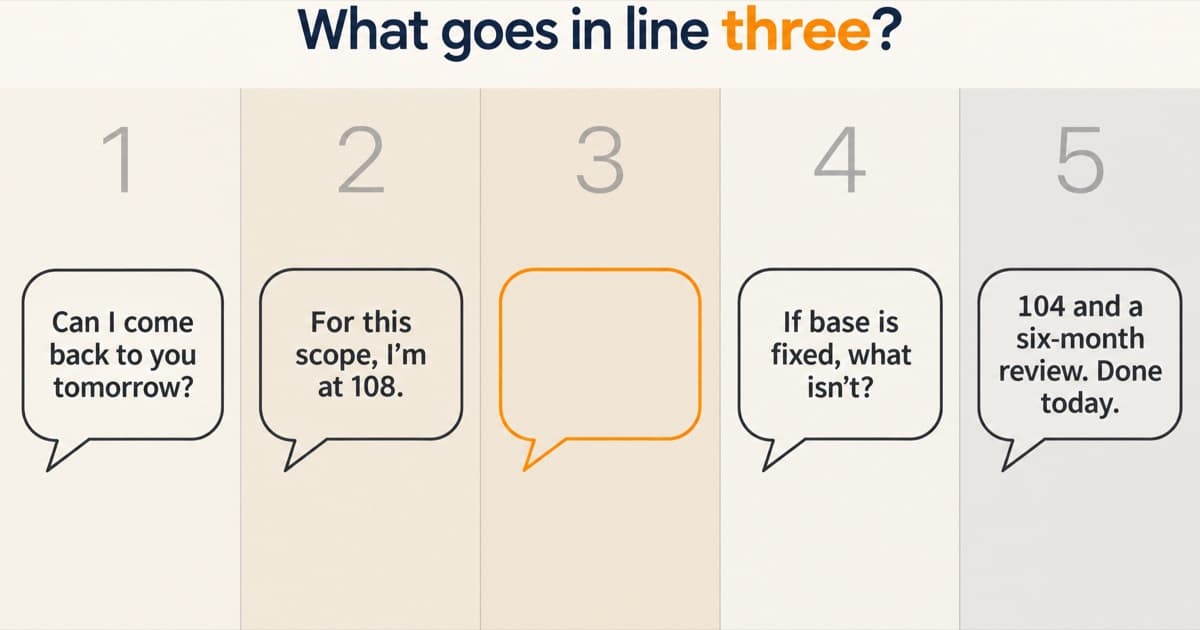
Countering with a feeling instead of a figure. "I was hoping for a bit more" transfers the arithmetic to the other side. Nobody has ever been generous on your behalf.
Justifying with your own costs. Rent, childcare, and a mortgage are real and they are not arguments. They describe your needs, not the value of the role, and they make it awkward for a person who cannot solve them. Market rate and scope are the two reasons that travel.
Accepting on the call because the silence was uncomfortable. You are allowed to say "thank you, this is great, can I come back to you tomorrow morning". Nobody has ever lost an offer to twelve hours.
Negotiating four separate things in four separate messages. Base on Monday, sign-on on Tuesday, start date on Thursday. Every one of them is reasonable and the sequence is exhausting. Bundle everything into one ask, once, and say it is the whole list. The single-round counter is what makes you easy to say yes to. This is the same pattern that costs sellers real money in price negotiation, where the second ask arriving after a settled point is the move that quietly reprices the deal.
Bluffing a competing offer. Sometimes it works. When it does not, it fails permanently and in front of the people you were about to work with. Real leverage does not need to be invented, and a search that gives you none is telling you something you should hear rather than paper over.
Why this is hard in the mouth, not in the head
None of the above is complicated. You could hold all of it in your head after one read, and it would still not survive first contact with a real voice asking "so, is that something that works for you?"
The reason is narrow and physical. The whole thing turns on maybe forty seconds: naming a specific number, out loud, to a friendly person, and then not speaking again until they do. Reading about the pause does not make you able to sit in it. The silence after you say 145 feels significantly longer from the inside than it is, and the urge to soften it with "but obviously I am flexible" is nearly overwhelming the first time you experience it. Every point you lose is lost in that gap.
Rehearsal fixes it, but only rehearsal that talks back. Practicing in your head does not count, because in your head nobody interrupts you, nobody asks "what is driving 145 specifically", and nobody goes quiet. A friend playing recruiter folds after one push because they want you to win, and they will never say "that is above the band" in a flat voice and then wait.
ConvoSparr exists for exactly that. You talk out loud, in real time, to an AI counterpart that behaves the way a recruiter actually does: it holds the number, it asks you to justify the figure you just named, it lets a silence sit there without rescuing you, and it comes back with a smaller ask after you thought the thing was agreed. Afterwards you get a scored breakdown of how the conversation went, so you can see the exact sentence where you talked yourself down, and then run the same call again with a different one.
Start with salary negotiation practice for how to structure those reps. If you are staring at a number that is genuinely too low, responding to a lowball offer is the specific version. And when the recruiter has already named their figure and it is your turn, the counter offer conversation is that exact moment.
If you have already made one of the slips above, most of them have a one-sentence repair, collected in salary negotiation mistakes. For the rehearsal itself, practicing salary negotiation with AI covers what a counterpart has to do to be worth talking to, and what to look for in a salary negotiation simulator covers how to tell one from a quiz.
The offer is not going anywhere. The only real question is whether the number in it is the one they opened with, or the one you asked for.