The deal is in good shape. Discovery was real, the technical review went fine, three people have told you this solves something that has been annoying them for a year. Then the last call before signature starts, and someone you have barely spoken to says the sentence: "We like it, we just need you to do better on price. Twelve percent and we can get this done this quarter."
What happens in the next four seconds decides most of what you were going to earn on this deal.
Most sellers do one of two things. They hold firm, in a slightly stiff voice, and the call turns into a standoff nobody planned for. Or they say "let me see what I can do", go and get approval for eight percent, come back proud of having saved four, and discover the buyer now wants eight percent and payment terms and the onboarding fee waived. Neither of those is a negotiation. The first is a refusal and the second is an auction where you are the only bidder.
This guide is about the third option, and it rests on one rule that sounds obvious and is almost never followed under pressure: your price never moves on its own. It moves only when something else moves back. Everything below is that rule, applied to the moment it actually gets tested.
Why does every buyer ask for a discount?
Start by taking the request less personally than it feels.
A procurement lead who does not ask for a discount has failed at their job. The ask costs them nothing. There is no downside, no relationship damage, no risk of losing the deal, because they know you are not going to walk away over the question itself. Somewhere between a third and most of the time, depending on who they are selling to, it just works. A free lottery ticket that pays out that often gets bought every single time.
So the request tells you almost nothing about whether your price is actually a problem. It is not a signal, it is a reflex, in the same family as the brush-offs covered in brush-off versus real objection. What it does tell you is that the buying process has moved into its commercial phase, which is genuinely good news that most sellers hear as bad news.
The important question is not "how much can I give". It is "what is this person actually being measured on".
A procurement professional is usually measured on savings achieved, and savings means a delta from a starting number, not an absolute price. They have to walk into a meeting and say what they got. That is why a seller who holds the number flat and hands them nothing creates an enemy for no reason: the buyer does not lose money, they lose the ability to show a win. And it is why a seller who trades something valuable that is not the unit price often closes at full price with a delighted counterpart. They got their win. It just was not your margin.
A budget holder is measured on something different: whether this spend was defensible when the year gets reviewed. They are not hunting for a discount, they are hunting for certainty. Trying to buy them with five percent when what they need is proof the project will not stall is a category error, and it is the same mistake as pitching a finance lead on features, worked through in selling to a CFO.
And an end user who raises price is almost never talking about price at all. They are telling you they are not confident enough in the outcome to defend the number internally. Discounting for that person makes it worse, because a cheaper thing they are unsure about is still a thing they are unsure about, and now it looks less serious.
Three different people, three different currencies, and only one of them is the currency you were about to spend.
Nothing moves unless something moves back
Here is the whole play, and it fits in a sentence: every movement on your price is attached, in the same breath, to a movement on theirs.
Not later. Not implied. In the same sentence, out loud, in the shape of a conditional. "If you can do X, I can do Y." The order matters, because "I can do Y if you can do X" gets heard as a yes with some noise after it, and the noise gets forgotten by the time the contract is drafted.
The reason this works is not psychological trickery. It is that it changes what the buyer is deciding. When you drop your price unilaterally, the buyer's next decision is "was that everything, or is there more". When you attach it to a trade, the buyer's next decision is "is that thing worth it to me". The first question has no natural end. The second one does.
The mechanics have three parts, and skipping any of them is what turns a trade back into a concession.
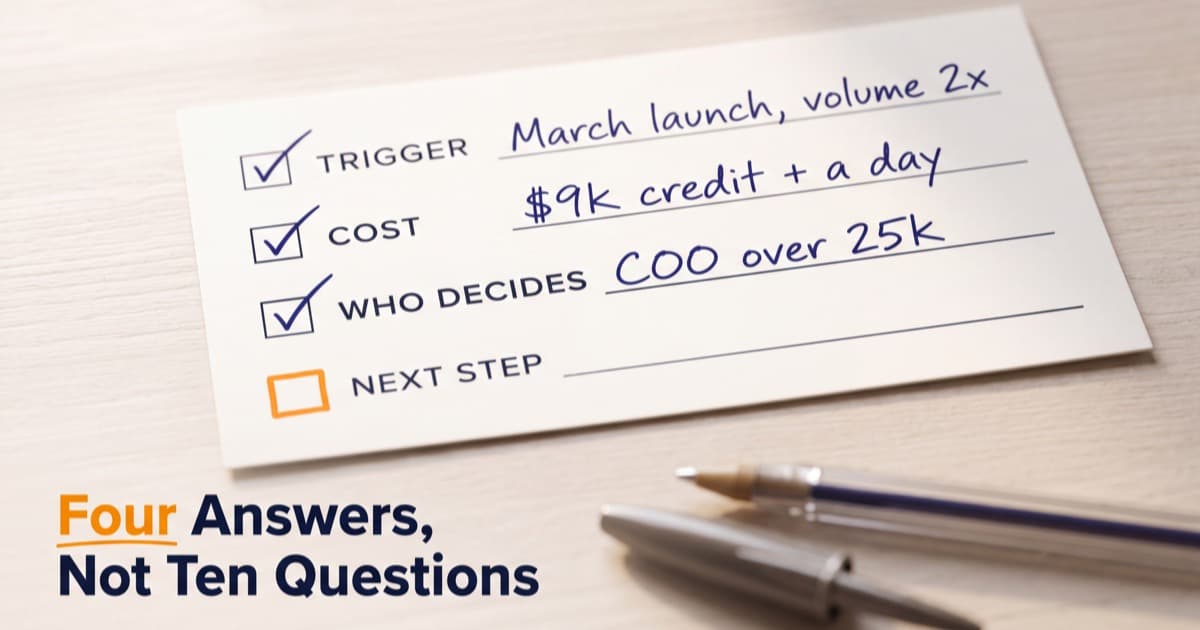
One: never respond to the number, respond to the shape. "Twelve percent" is not a fact you have to engage with. Before anything else, find out what the number is anchored to. Sometimes it is a budget line, sometimes a competing quote, sometimes an internal rule that says everything over a threshold must show a negotiated saving, and sometimes it is a number invented on the walk to the meeting room. Those four situations have four completely different answers, and you cannot tell them apart without asking. The full mechanics of that question live in answering "your price is too high".
Two: know what you own that is not margin. Most sellers behave as if price is the only variable in the contract, which is why they run out of room so fast. Almost every deal has a dozen other dials, and several of them are worth real money to your side and cost the buyer very little to give:
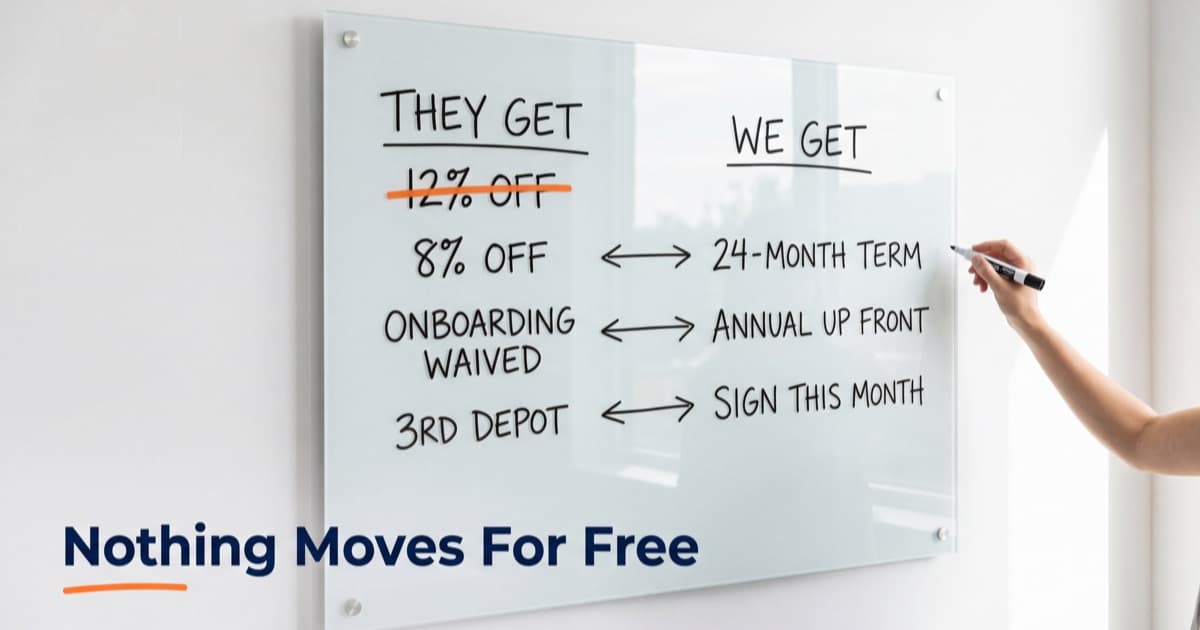
Term length. A twelve month deal turned into twenty four is worth more to your company than the discount it usually buys. Payment timing. Annual up front instead of quarterly in arrears has a genuine cash value that finance can quantify for you if you ask. Volume or scope, meaning more seats, more sites, the second department in the same signature. Timing of the signature itself, which matters enormously to you at quarter end and often not at all to them. A reference commitment, a case study, a willingness to take a call from a prospect in their industry. A pilot narrowed to the group that actually needs it now, rather than a discounted rollout to everyone. Onboarding scope, support tier, the professional services days that get thrown in without anyone counting them.
Write your list down before you ever need it. Under pressure nobody invents a creative trade; they reach for the one lever they have already rehearsed, and if the only rehearsed lever is price, that is the lever that gets pulled.
| Lever | Why it is worth real money to you | Why it is cheap for them |
|---|---|---|
| Term length | Twelve months to twenty four lowers cost to serve | The tool is not going anywhere |
| Payment timing | Annual up front has a cash value finance can quantify | Budget is already approved for the year |
| Volume or scope | More seats, more sites, one signature | They were going to expand anyway |
| Signature date | Matters enormously to you at quarter end | Often matters to them not at all |
| Reference or case study | Shortens every future deal in that industry | Costs an hour, and they usually enjoy it |
| Onboarding scope | Real delivery cost, and it happens once | They may have the internal capacity already |
Three: price the trade honestly, then say it plainly. "I can get to eight percent if we move to a twenty four month term" is a real sentence a buyer can accept or refuse. "Let me see what I can do" is not a sentence at all. It is a delay that hands the buyer a free round and teaches them that pressure produces movement without cost.
Decide your floor when nobody is looking at you
The reason sellers concede badly is not that they do not know this. It is that they are doing arithmetic in real time while a person waits on the line, and the part of your brain that wants the awkwardness to end is faster than the part that does the maths.
So the work happens before the call. Three things, written down, ideally on the same page as your deal notes.
Your opening, your target, and your floor. Three numbers, not one. The target is what a good outcome looks like. The floor is the point below which this deal stops being worth doing, and it should be a real number derived from something (margin, delivery cost, the precedent it sets with similar accounts), not a feeling. A floor you invented in the moment is not a floor, it is a mood.
Your concession ladder. Decide in advance the exact sequence of what you will give and what each rung must cost the buyer. The first rung should be small and cheap for you. Each rung after that should get smaller, and this is the part people get backwards. If you go from twelve percent to eight to four, you have taught the buyer that the gaps are shrinking and the end is near. If you go four, then seven, then eight, you have taught them that pushing works better the longer they push, and a competent procurement lead will keep going until the pattern breaks. Shrinking increments are a message, and buyers read it correctly.
The precedent question. Before you agree to anything, ask what happens if every account like this one gets the same terms. Discounts propagate. Procurement teams talk, renewal conversations start from the last number, and the deal you rescued in March becomes the benchmark you are arguing against for three years. This is the cost that never shows up on the deal you are trying to close, which is exactly why it gets ignored.
One more thing belongs on that page: the alternative. What actually happens to you if this deal does not close on acceptable terms. Not the catastrophized version, the real one. Sellers negotiate badly mostly because they have quietly decided they cannot lose the deal, and the buyer can hear that decision in the first two seconds of the answer.
Ninety-six thousand, held and given away
Fictional, but the shape is ordinary. Anneke sells route planning software at Alderwick. The buyer is Vellmore Logistics, a regional freight company. The evaluation went well and the operations director is a fan. On this call is Dan Okafor, head of procurement, who has not been in any previous conversation. The quoted price is 96,000 a year. Anneke's floor is 84,000. Renewal season across her other logistics accounts starts in two months.
The version that ends at 82,000:
Dan: So we have been through it and the team is happy with the fit. The issue is commercial. We are looking at 96 and I have got approval at 84. So we need you to come down about twelve percent and then we can move.
Anneke: Okay. Twelve is a lot. Let me be honest, that is going to be difficult for me to get signed off.
Dan: I understand, but that is where we are. The number has to work.
Anneke: Right. Let me take it to my VP and see what is possible. I do think we can find some movement.
Dan: How quickly can you come back?
Anneke: End of day tomorrow.
(the next call)
Anneke: Good news, I got approval for eight percent. So that puts us at 88,300, which is genuinely the most flexibility I have had on a deal this size.
Dan: I appreciate you going to bat. It is still four above where I am. And I should flag, the onboarding line, the 6,000, that was not in the budget I had approved either. So realistically I need the 84 with onboarding included.
Anneke: The onboarding covers a real cost on our side, we put two people on it for three weeks.
Dan: I hear you. But I cannot go back for more money, and I do not think either of us wants this slipping into next quarter while I re-open the budget.
Anneke: ...Let me see what I can do.
She got to 82,000 with the onboarding absorbed, which is below the floor she wrote down, and the deal closed. Everyone congratulated her.
Look at what actually happened, because none of the individual moves feel like errors.
She engaged with the number instantly. "Twelve is a lot" accepted twelve percent as the topic and made the rest of the conversation an argument about how far down from twelve, which is a conversation with only one direction in it. She never learned where 84 came from, and 84 is the single most useful fact in the room. It was a budget approval, which means it was a number somebody wrote before they knew what they were buying, and budget approvals get amended for a reason all the time.
Then she left the room. "Let me take it to my VP" gave Dan a free round: no cost, no commitment, and a guaranteed improvement in his position. It also told him she is not the decision maker, so every subsequent number she brings back is provisional in his mind. Worse, she came back with a unilateral eight percent, attached to nothing. In Dan's world that is not an offer, it is evidence. Eight percent appeared out of thin air, so more can appear out of thin air.
The onboarding fee appearing at the end is not bad luck. It is the standard second ask, and it lands right after a unilateral concession because that is when it works. And the deadline pressure at the end was hers, not his, which she handed him herself by making the quarter matter out loud.
The version that ends at 89,000 on better terms:
Dan: So we have been through it and the team is happy with the fit. The issue is commercial. We are looking at 96 and I have got approval at 84. So we need you to come down about twelve percent and then we can move.
Anneke: Okay, that is useful, thank you for being direct about it. Can I ask where the 84 comes from? Is that a budget line that was set earlier in the year, or is it benchmarked against something you have seen?
Dan: It is the budget. It was set in planning, before we had scoped this properly.
Anneke: Got it. So the 84 predates the scope. Has the scope changed since then? Because when we started, this was the two southern depots, and last week Ravi was talking about including Hartleigh from the start.
Dan: That is right, Hartleigh is in.
Anneke: Then I want to make sure we are comparing the same thing, because 96 covers three depots and the 84 was built for two. I am not saying that fixes it, but I do not want you defending a number that was never meant to cover this.
Dan: Fair. It is still not going to get me to 96.
Anneke: Understood, and I am not going to pretend the number is untouchable. Here is how it works on my side. I can move on price when something moves on yours, because the price is built on a twelve month commitment paid quarterly. Two things are worth real money to us. One is term. If we go to twenty four months, our cost of servicing the account drops and I can pass that back. The other is payment. Annual up front rather than quarterly is worth something to our finance team, and I am allowed to convert that into price.
Dan: Twenty four months is possible. Annual up front I would have to check.
Anneke: Then let me be concrete rather than vague. On a twenty four month term, I can do 89,000 a year, and I will hold the onboarding at the quoted 6,000 rather than repricing it for the third depot, which would normally add about 2,000. If you can also do annual up front, I can take the onboarding to zero. That is your twelve percent, roughly, it is just arriving as scope and fees rather than all off the headline.
Dan: So on the two year, up front version, what is my total first year cash out?
Anneke: 89,000, against 102,000 as it stands today with the third depot and onboarding. And the second year is fixed at 89, which is the part I would put in front of whoever approved the 84, because that is a two year certainty that the original budget line does not have.
Dan: That is a better story than a discount, honestly. Let me test the up front piece with finance. If they say no?
Anneke: Then we are at 89 with 6,000 onboarding, on twenty four months, and I would still sign that today. What I cannot do is 89 on twelve months, because the whole reason 89 works is the second year.
Dan: Understood. One thing. If I can get the up front approved, I would want the Hartleigh rollout inside the first quarter rather than staged.
Anneke: That I can commit to if the signature lands this month, because it is a scheduling question for our delivery team. After that, the first slot is April.
Dan: Let me come back to you Thursday.
The gap between those two calls is not toughness and it is not a script. It is preparation and three specific moves.
She priced the comparison before she priced the deal. The 84 was built for two depots and the deal is now three. That single question moved the argument from "how much off" to "off what", which is the only reframe that ever creates room. Nobody was tricked; she just refused to let a stale number be treated as the reference point.
Every movement was conditional and simultaneous. Term for price. Cash timing for fees. She never said "let me see what I can do", because leaving the room is a concession made of time. She stayed in it, and made the offer herself, which is only possible because she knew her floor before the call and did not have to compute it while Dan was breathing on the line.
She gave Dan something to present. He walks into his meeting with a two year fixed cost, expanded scope inside the original envelope, and a fee waived. Not one of those is a headline discount, and every one of them is a win he can say out loud. That is what he was actually shopping for.
And she attached a cost to the last request. Hartleigh in the first quarter was a real ask, so it bought a signature date rather than being folded in for free. Late asks are where profitable deals quietly become average ones. That specific moment, the round after you think it is over, is worked through in the price negotiation roleplay.
The second ask is the one that decides the deal
Almost every seller handles round one acceptably. What separates outcomes is round two, which arrives about eighty percent of the time and is very rarely about price again.
It comes as a small thing at the end of a call that felt finished. Waive the setup fee. Add the two extra licences. Include the premium support tier for the first year, we can revisit at renewal. Individually trivial, deliberately so, and asked in a tone that makes refusing feel disproportionate.
Two rules cover it.
The first: the second ask is priced exactly like the first. "I can include the two licences if we keep the twenty four month term and sign this month." A free yes on a small item at the end does more damage than the item is worth, because it retroactively teaches the buyer that your earlier conditions were negotiable too.
The second: nothing that was already traded gets traded again. If term bought your price, and the buyer later wants to shorten the term, the price goes back up. Said once, calmly, without any implication that they were trying something on. "The 89 is a two year number, so on twelve months we are back at 96." That sentence is the entire defense of everything you agreed earlier, and it has to be said in a completely level voice, because said defensively it sounds like a bluff.
There is also a version of round two where the buyer stops asking and starts waiting. Silence, a slow reply, a meeting that moves. The instinct is to fill it with an improved offer nobody requested, which is how sellers negotiate against themselves and lose several points to a person who was on holiday. Ask a question instead of making an offer, and the question is about process, not price: who else needs to approve, what is the sequence, what is the actual date this has to be live by.
Where sellers lose money without noticing
These survive a deal review because they all look reasonable in the summary.
Discounting to fix a value problem. If the buyer is unconvinced, a lower price makes them less convinced, not more. The signal you send is that the number was arbitrary, which means the whole thing might be. When price resistance is actually confidence resistance, the fix is upstream, in what a buyer can repeat back to their own colleagues, covered in the objection handling guide.
Negotiating with someone who cannot buy. If the person pressing you on price cannot sign, you are not in a negotiation, you are in a rehearsal for one, and everything you concede here becomes the starting point for the real conversation later. Establish who signs before you move a number.
Announcing your own deadline. Quarter end is your pressure, not theirs. The moment a buyer knows your date, waiting becomes their cheapest tactic. If a date is going to be used, it should be a real constraint on delivery or scheduling, and it should be true.
Giving the discount to end the discomfort. This is the honest version of most of the above. The silence after "that number does not work" is genuinely unpleasant, and a large share of margin in the world gets given away by people whose only real motivation was making a conversation stop being awkward.
Treating the printed price as sacred and refusing to engage. The opposite failure and a real one. A flat "our pricing is our pricing" gives the buyer nothing to work with, no story to tell internally, and no reason to feel the process was worth running. Firmness without flexibility loses deals that should have closed at full price with a term change.
Sending the number before you understand the shape. Pricing into a vacuum removes every trade you might have made, because you cannot attach a condition to a document. What to do when they just want the sheet is in "just send me your pricing".
Forgetting the renewal exists. The concession you make today is the price your successor argues from in eighteen months. Deals are not settled at signature; they are settled at the second renewal, and a heavy first discount is a debt paid by someone who was not in the room.
The part you cannot learn from reading
Everything above is simple to understand and hard to do, and the reason is narrow. The whole method lives in about six seconds of real time: the moment after the buyer names a number, when your mouth wants to say "let me see what I can do" and the correct move is to ask a question, or to make a conditional offer with a floor you set an hour ago.
Six seconds is not a knowledge problem. Reading this does not put the sentence in your mouth. What puts it there is having said it out loud, badly, several times, before the call that matters.
Which is exactly the rehearsal nobody can arrange. A colleague playing procurement is on your side and folds after one push, and they never come back with the small second ask at the end because they have already decided you passed. If your practice never gets to the second ask, you have practiced the easy eighty percent and skipped the part that costs money.
ConvoSparr is built for that gap. You talk out loud, in real time, to an AI counterpart that behaves the way a buyer does: it holds its number, it does not accept a claim because you said it with conviction, it goes quiet and lets the silence sit, and it comes back with the fee waiver at the end after you thought the deal was done. Afterwards you get a scored breakdown of the call, so you can see the moment you moved without asking for anything back, and run the same conversation again with a different answer.
For how to structure those reps so they build something rather than just filling time, start with negotiation roleplay exercises. If your deals arrive at this call without a trade available, the shortage was created earlier, in the discovery call guide. And for the single moment sellers most often fumble, work through answering "your price is too high".
The specific moment the discount gets asked for, and the four different questions hiding inside those six words, is worked through in how to respond to discount requests.
The buyer will ask for a discount. That was never in doubt, and it is not a problem. The only question is whether the asking gets them something, and whether you find out what it cost them before you agree.