A price negotiation roleplay is only realistic if it keeps going after the first counter, because the second ask is where margin actually leaves. Reframe the discount as a structural trade, then separate a stacked second and third request instead of folding on all of them at once.
The rounds nobody rehearses
Most objection-handling practice stops at the first no. Someone pushes back on price, the rep answers, the scenario ends, and everyone moves on as if that settles it. Real price negotiations rarely work that way. The buyer who pushes back once is often just opening a round, not closing the conversation, and what actually decides the deal is what happens in the second and third exchange, after the rep has already used their best line and the buyer comes back with a different ask: a bigger discount, a longer payment term, an extra seat thrown in for free, or all three stacked together in one email.
A price negotiation roleplay scenario has to run that whole sequence, not just the opening volley. It has to put a rep through naming a number, absorbing a counter, deciding what to trade and what to hold, and doing it again when the buyer comes back a second time with a different pressure point. That's the part almost nobody rehearses, because it's the part that requires the practice partner to actually negotiate back instead of accepting the first answer and ending the roleplay there.
Three ways round two costs more than round one
Treating the first counter as the whole negotiation. A rep answers the initial pushback well, feels the relief of having handled it, and drops their guard for what comes next. When the buyer opens a second front two messages later, the rep is negotiating from a weaker position because they already spent their best argument and didn't expect to need another one.
Discounting in round two to protect a relationship that was never actually at risk. Buyers who are still negotiating are still interested. A rep who reads persistence as anger and caves to keep the peace is solving a problem that doesn't exist, and training the buyer that a second ask always works.
Trading concessions without getting anything back. A free extra seat, a shortened onboarding fee, a locked-in renewal rate: each one is a real cost, and giving it away because the buyer asked twice, with nothing exchanged for it, quietly resets what the buyer believes the actual price is.
What is a buyer testing when they ask twice?
The buyer pushing on price a second time usually isn't rejecting the deal. They're testing where the floor actually is, and how the rep behaves under repeated pressure tells them almost everything they need to know.
They're checking whether the first number was real. If a rep folds easily on the second ask, it retroactively proves the first number was padded, and the buyer will keep pushing until they hit something that actually holds.
They're pricing in what a stack of small asks is worth together. A discount plus an extra seat plus a longer payment term isn't three small requests to a procurement-savvy buyer, it's one large concession broken into pieces that feel easier to ask for individually. They're watching whether the rep notices the total.
They're deciding if this rep is safe to work with after the contract is signed. A rep who trades every concession for nothing signals a vendor relationship where every future renewal will be a fight. A rep who trades fairly, something for something, signals a partner worth trusting with the account long term.
Watch the second ask arrive
The rep sells a workflow automation platform called Ravel Systems. The buyer is Delphine Anand, VP of Operations at Ostmark Foods, a mid-size regional food distributor evaluating a two-year enterprise contract after a strong pilot.
Conceding each ask:
Delphine: The number you sent works in principle, but our budget owner wants to see fifteen percent off before this goes to signature.
Rep: I think we can make that happen. Let me get you a revised number with fifteen percent off by tomorrow.
Delphine: Appreciate it. One more thing while you're revising it, can we also get the onboarding fee waived and bump us from three seats to five at no extra cost? That would really help get this across the line.
Rep: Sure, I can throw those in too. I want this to work for you.
Delphine: Great, send it over whenever it's ready.
Fifteen percent went through without a single question about what it was actually protecting against, and the moment it did, Delphine immediately opened a second ask, because the first one taught her the price was soft. By the time the rep agreed to waive onboarding and add two free seats on top of the discount, they had given away roughly a third of the deal's value in one exchange, with nothing traded back and no signal to Delphine that any of it cost the vendor anything.
Trading each ask:
Delphine: The number you sent works in principle, but our budget owner wants to see fifteen percent off before this goes to signature.
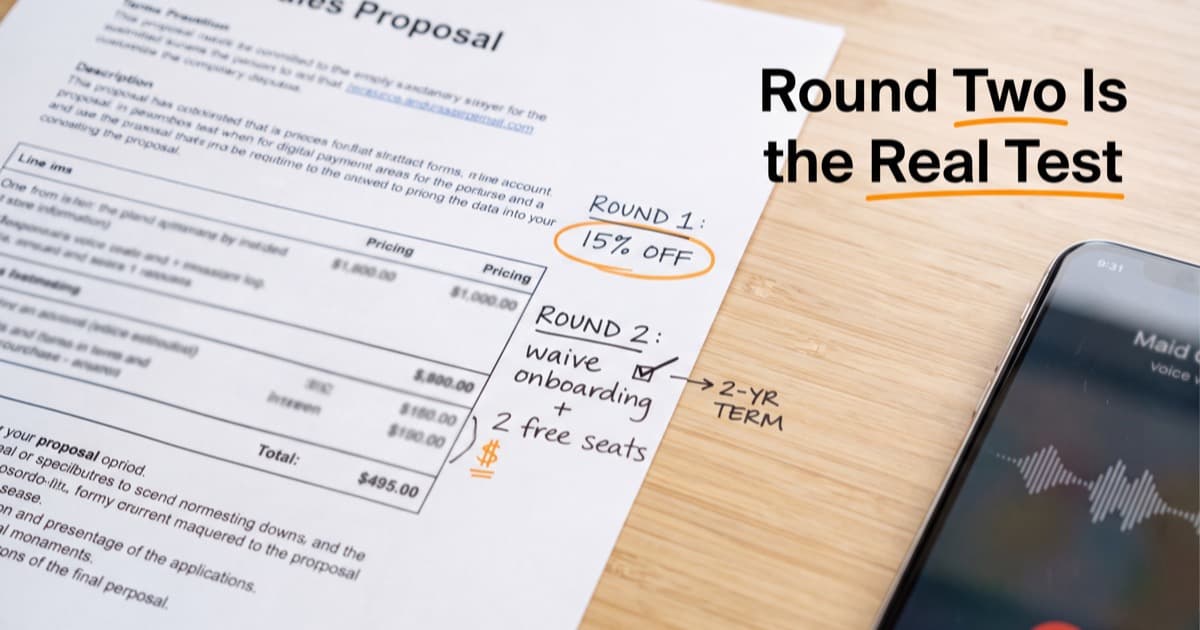
Rep: I want to get you there if I can. Fifteen percent isn't something I can move on the list price, but I can get close to it if we shift from a one-year to a two-year term, that lets me apply a multi-year rate instead of a discount. Does a two-year commitment work on your side?
Delphine: Possibly. If we do two years, can we also get onboarding waived and go from three seats to five?
Rep: Let's separate those. The multi-year rate already covers most of the gap on price. Onboarding I can waive if we lock the two-year term today, that's a fair trade since it removes my ramp risk on your side. The extra two seats would need to come in as a paid add-on at the multi-year rate, I don't want to build a pricing model your budget owner can't defend next renewal.
Delphine: That's fair. Let me take the two-year term and the two extra seats at that rate to my budget owner, and I'll come back on onboarding.
Rep: Works for me. I'll send the revised proposal with the two-year multi-year rate and the onboarding waiver built in, and the two additional seats priced separately so it's clear what's included and what's added.
The rep never simply agreed to the discount, they reframed it as a structural trade, a longer term for a better rate, which held the actual number while giving Delphine something real to bring back to her budget owner. When the second ask arrived stacked with a third, the rep separated them instead of folding on all of it at once, trading the smaller item for a real commitment and holding the line on the one that would have reset the pricing model for every future renewal. Delphine left with less than she asked for, but with a clear, defensible reason for every number, which is what actually gets a deal to signature.
Rehearsing past the first held line
Set up a negotiation scenario against a buyer persona and don't let the roleplay end at the first counter. Goals for the practice run:
- Name a real number and hold it through the first pushback with a reason, not just a restated price.
- Watch for a second ask arriving stacked with the first, and separate what you're willing to trade from what you're not.
- Get something back for every concession, a longer term, a faster signature, a case study, anything that makes the trade two-directional.
- Notice when you're caving to make the tension stop rather than because the trade genuinely makes sense.
Run the scenario once against a buyer who accepts your first held line, and once against a buyer who keeps stacking asks past round two. A negotiation that only gets tested against a buyer who gives up easily isn't proof you can hold a number, it's proof you got lucky once.