
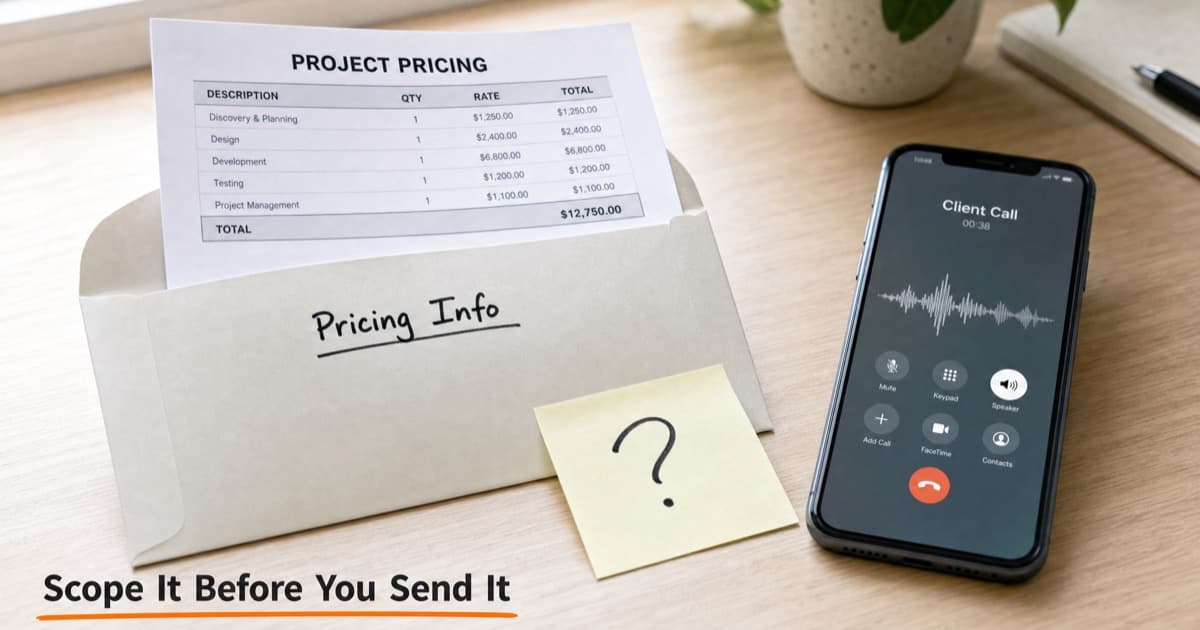
"Just send me your pricing" is a real request and an exit at the same time, and which one it is only shows up if you ask. Scope the number before you send it, then ask directly whether price is the actual blocker. Often it is not, and the answer gives you a next step instead of a PDF nobody opens.
A number requested is not a deal advanced
The call has gone fine. Not great, not a slam dunk, but the prospect answered a couple of questions, didn't hang up in the first ten seconds, and now they say the line that stops most reps cold: "Just send me your pricing." It sounds like progress. A number was requested. Surely that means interest.
Except an unqualified price sent into an inbox rarely turns into anything. Without context attached to it, the figure lands next to three other vendors' figures, gets skimmed for thirty seconds, and never gets a reply. The prospect isn't lying when they ask for pricing, they usually do want the number eventually, but "just send it" is also the fastest way to end a call that's starting to ask something of them. The request is real. So is the exit it doubles as.
Three ways a pricing ask ends the conversation
Treating the request as a green light. A rep who hears "send me pricing" and immediately promises to email it has mistaken a request for a commitment. The prospect asked for a document, not a next meeting, and a document with no conversation attached to it competes with nothing but its own number.
Sending a number with no anchor. Pricing means almost nothing without a reference point: number of seats, current spend on whatever it replaces, which tier actually fits. A generic price sheet forces the prospect to do that translation alone, and most won't bother.
Not securing anything before hanging up. The call ends with "I'll send that over today" and nothing else. No date to follow up, no reason for the prospect to open the email when it lands, no next conversation on the calendar. The rep has handed over the one thing of value they had left to trade.
Why do buyers ask you to just send pricing?
They want a data point, not a decision. Early in a search, prospects often want pricing purely to rule vendors in or out of a bracket. That's a legitimate use of the number, and it doesn't require them to talk further right now.
They're testing whether you'll push. Some prospects ask for pricing specifically to see if the rep will just comply and disappear, or whether there's actually a person on the other end who will ask a real question back.
They don't want to commit to a call before they've seen a range. A prospect who hasn't been on a call with you yet may genuinely prefer to see if the number is even in the neighborhood before spending thirty more minutes. That's a fair sequencing preference, not necessarily a stall.
They're already past this vendor and being polite. Sometimes it really is the brush-off it sounds like, a request made specifically because it's easier to say than "not interested." The tell is usually how little else they've engaged with on the call.
What one scoping question buys you
Talia is a fictional marketing operations lead at Ellisbridge Media, a mid-size ad agency. The rep is selling a campaign reporting platform.
Sending it blind:
Rep: So the platform pulls all your campaign data into one dashboard instead of five different exports.
Talia: Okay, that sounds decent. Can you just send me your pricing?
Rep: Sure thing, I'll get that over to you today.
Talia: Great, thanks.
Rep: No problem, talk soon.
Nothing here is wrong exactly, but nothing is secured either. The rep will send a flat number that has no idea how many campaigns Talia runs or what she's currently paying for the five exports it replaces, and there is no date, no call, no reason for Talia to do anything with the email besides glance at it once. The conversation is over and the rep has no way back into it.
Scoping it first:
Rep: So the platform pulls all your campaign data into one dashboard instead of five different exports.
Talia: Okay, that sounds decent. Can you just send me your pricing?
Rep: Happy to, and I want the number to actually mean something when it lands rather than just being a figure on a page. Roughly how many active campaigns is your team managing at once right now?
Talia: Depends on the month, but usually somewhere around fifteen to twenty.
Rep: Got it, that puts you solidly in our mid-tier, so I'll send that range specifically instead of the full sheet with every tier on it. One more thing, is pricing the main thing standing between you and moving forward, or is there something else you'd want to see first, like how the dashboard actually looks with your kind of data in it?
Talia: Honestly, seeing it with something close to our actual campaigns would probably matter more than the number by itself.
Rep: Then let's do this: I'll send the mid-tier range today, and I'll also block fifteen minutes Thursday to walk through the dashboard with a mock setup close to what you're running. If the number's in the right zone, you'll actually have something to react to instead of a PDF sitting in your inbox. Does Thursday morning work?
Talia: Yeah, Thursday morning's fine.
The rep didn't fight the request, he narrowed it, sending a relevant range instead of an undifferentiated sheet. Then he asked the question that actually mattered: was pricing the real blocker, or was it something else wearing pricing's name. Talia's answer revealed the real blocker was seeing the product against her own data, not the number at all, and the rep used that to lock in a specific next step instead of leaving the door open and hoping she'd walk back through it.
Drilling the scoping question before the send
Set up a cold call scenario with a buyer persona that engages through the first part of the pitch before asking for pricing, so the objection lands mid-conversation instead of as an opening move. Goals for the practice run:
- When you hear "just send me your pricing," resist agreeing and hanging up in the same breath.
- Ask a scoping question first, seats, current spend, or scale, so any number you send actually fits their situation.
- Ask directly whether pricing is the real blocker or whether something else needs to happen before a decision, like seeing the product against their own data.
- Close every version of the call with something concrete: a specific range sent, a specific day booked, never just a vague promise to follow up.
Run it once against a buyer who's genuinely early in a search and once against a buyer who's using the request to end the call politely. Telling those two apart by how they answer the scoping question, not by the request itself, is the point of the drill.