Most negotiation roleplay exercises follow the same shape: one person plays the buyer, states an objection, and the rep responds with a line from training. The rep says the line correctly, the roleplay ends, and everyone moves on with the sense that negotiation skills got practiced. What actually got practiced was reciting a rebuttal once, against a partner who had no reason to push back a second time.
That's the gap. A real negotiation is rarely a single objection and a single answer. It's a sequence: the buyer pushes, the rep responds, the buyer pushes again from a different angle, and somewhere in that back-and-forth the rep either holds a defensible position or gives away margin they didn't need to give away. A roleplay exercise that stops after one exchange never tests the part where deals are actually won or lost.
What should a negotiation roleplay exercise test?
Three things separate a roleplay that builds skill from one that just performs it.
A buyer who doesn't fold on the first good answer. If the counterpart accepts a reasonable response and moves straight to agreement, the rep never learns what to do when a real buyer says "I hear you, but I still need something off that number." Most actual negotiations take two or three rounds before either side settles. A roleplay that ends after round one is training for a negotiation that doesn't happen.
A concrete ask, not an abstract scenario. "Practice negotiating a discount" gives a rep nothing to prepare against. "The buyer wants 15% off a two-year contract and has a competing quote at that price" gives the rep a specific number, a specific reason, and a specific decision to make about what they're willing to trade for it. Vague scenarios produce vague, generic answers that don't transfer to a real call with a real number attached.
Something at stake for holding the line. In a low-stakes roleplay, a rep can cave on price with zero consequence, so caving becomes the path of least resistance. The exercise should force a real tradeoff: give up the discount and lose momentum toward close, or hold the price and offer something else instead, like payment terms or a smaller initial commitment. Practicing that tradeoff, not just the opening rebuttal, is what changes what a rep actually does on the call that matters.
Where the roleplay should have kept going
Havard is an account executive at a fictional supply chain software company called Barrow Analytics. She's negotiating a renewal with Grant, the procurement lead at a fictional logistics company called Colverton Freight, who has come back asking for a 20% price cut to renew.
Roleplay that stops after the first exchange:
Grant: We need this renewal at 20% off, or we're putting the budget toward something else next quarter.
Havard: I understand budget is tight. Let me see what I can do and get back to you with a number.
Grant: Sounds good, appreciate it.
The exercise ends there, with Havard's partner satisfied that she "handled the pushback" by staying calm and not agreeing on the spot. But Havard never actually negotiated anything. She deferred the decision, which is a reasonable real-world move, but the roleplay never forced her to practice the conversation that happens next: coming back with a counter and defending it in real time.
Roleplay that continues through the counter:
Grant: We need this renewal at 20% off, or we're putting the budget toward something else next quarter.
Havard: Twenty percent is a big jump from where we've been. Before I look at pricing, can I ask what's driving the number, is it a budget cut across the board, or is it specifically about what you're paying us relative to other tools?
AI buyer (Grant, Colverton Freight): Honestly, it's that a competitor quoted us 20% under what we're paying now for something close to the same feature set.
Havard: That's useful to know. I can't match a flat 20% and keep the account healthy on our end, but I can bring the renewal down if we move to a two-year term instead of annual, which also locks your rate through the increase we'd otherwise apply next year. Would a fixed two-year rate at a smaller discount solve the budget problem, even if it's not the full 20%?
AI buyer: That might work. What number are we talking about?
Havard: Let me get you an exact figure by tomorrow, but directionally we're looking at something closer to 10% off, locked for two years instead of one.
The second version is a real negotiation. Grant introduced a competing quote, which is a specific reason the rebuttal has to address rather than a generic budget complaint. Havard asked a clarifying question instead of immediately naming a number, found out the actual driver, and then traded a longer commitment for a smaller discount instead of just splitting the difference on price. None of that gets rehearsed in a roleplay that ends after the first "let me get back to you."
Common mistakes with negotiation roleplay exercises
Ending the roleplay at the first objection. The first thing a buyer says is rarely their real position, it's an opening move. If the exercise stops there, the rep only ever practices responding to openings, never to the second and third round where the actual negotiating happens.
Letting the counterpart play a pushover. A colleague running the buyer side will often accept a rep's first counter to keep the exercise short, especially in a scheduled training session with limited time. That teaches the rep that holding a position works easily, which isn't true of a buyer who's genuinely trying to get the best deal they can.
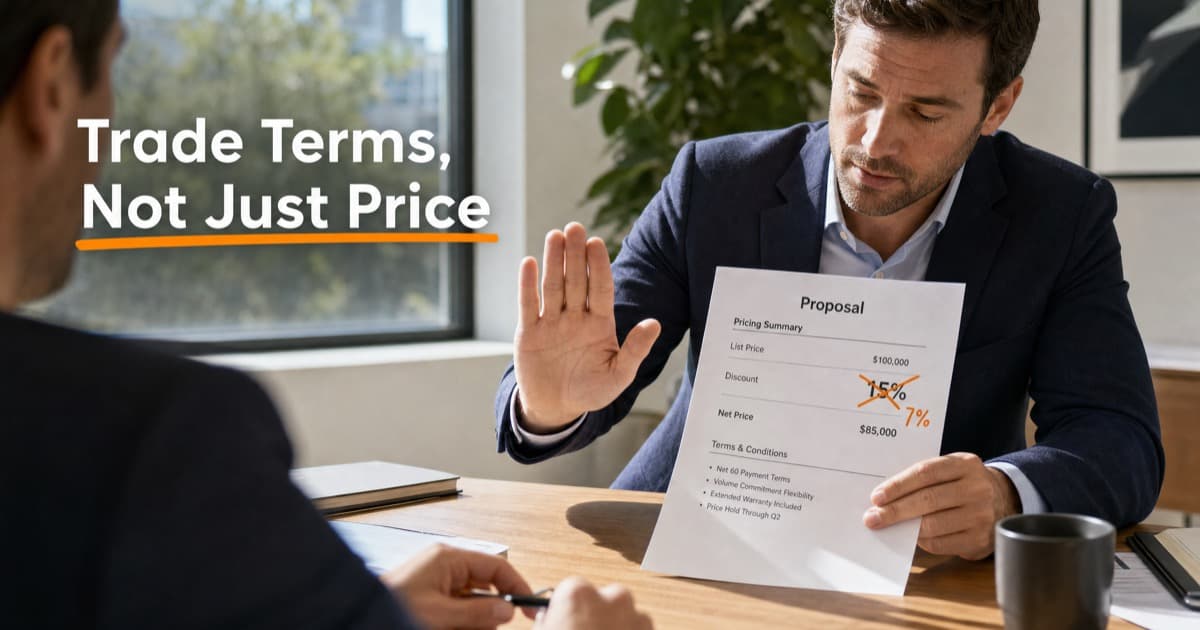
Practicing price without practicing tradeoffs. Reps who only rehearse "here's a lower number" learn to negotiate by discounting. Reps who rehearse trading term length, payment timing, or scope for price learn to protect margin, which is the skill that actually matters once they're in front of a real buyer with a real number in mind.
Using the same scenario every time. A rep who's negotiated the identical discount request ten times in practice has memorized a script, not a skill. Rotating the ask, the buyer's stated reason, and what the rep has room to trade keeps the exercise testing judgment instead of recall.
No follow-up on what was actually conceded. A roleplay with no debrief lets a rep walk away from a session where they gave up more than they needed to and never notice. Reviewing what was traded, and whether it needed to be, is what turns a single roleplay into a repeatable improvement in how a rep negotiates.
Treating every negotiation like a price negotiation. Not every pushback is really about the number. Sometimes a buyer says "the price is too high" when what they actually mean is that they haven't gotten internal buy-in yet, or that the timeline feels rushed. A roleplay that only ever hands the rep a discount lever teaches them to reach for one even when it isn't the thing standing between them and a signed deal. Rotating in requests that aren't about price, a faster start date, a smaller pilot scope, an extra approval step, keeps the exercise honest about what negotiation actually involves.
A negotiation roleplay exercise that ends the moment the rep says something reasonable isn't testing negotiation. It's testing whether they can deliver one line under mild pressure. The exercises worth running are the ones that keep going after that line, through the counter, through the second ask, to the point where the rep has to decide what they're actually willing to give up and what they're not. That's also the part most training sessions run out of time for, which is exactly why it's worth rehearsing somewhere that isn't a live call with a prospect watching the clock.
What to trade, and what each trade is actually worth to your side, is in the price negotiation guide.