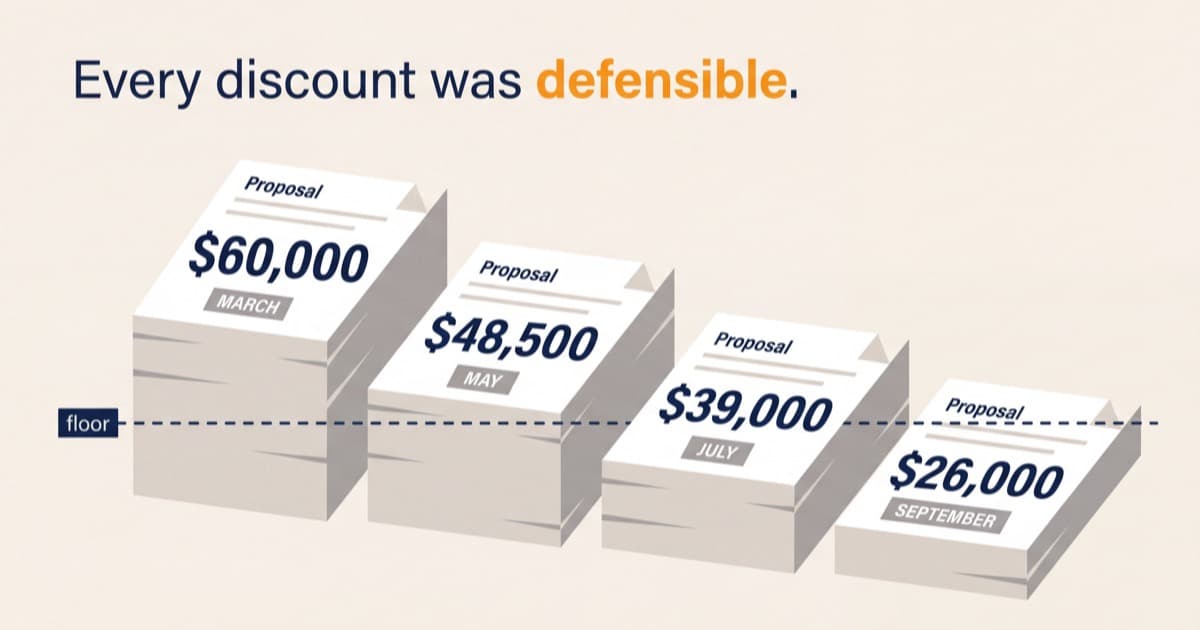
The deal ran from March to September. It opened at sixty thousand dollars, went out four times as a revised proposal, and signed in the last week of the quarter at twenty-six. Nobody ever decided to accept twenty-six. It arrived one concession at a time, and every concession was defensible on the day it was made.
What was missing was not discipline in the moment. It was a number written down in March, before anybody was invested, saying what this deal had to be worth for it to still be worth doing. Without that line, every revision gets judged against the last revision rather than against the reason for the deal.
So here is the answer to the question in the title. You walk away from a deal when a condition you wrote down before the negotiation started has been met and the buyer has declined to change it. Not when the deal gets hard, not when the buyer is rude, and not in the last week of the quarter when the arithmetic finally becomes impossible to ignore. The decision is made in advance, in writing, with a number and a date in it, and the conversation itself only checks whether the condition was met.
What makes a deal worth leaving?
A deal is worth leaving when one of three things is true: there is no path to somebody who can say yes, the only terms the buyer will accept sit below the floor you set before you started, or you have learned something about their situation that means the product will fail after they sign. Everything else is a deal that is hard, and hard is not the same as dead.
The access condition is the one reps ignore longest, because a friendly contact feels like progress. Six calls with someone who cannot sign is not a late-stage deal, it is a deal that has not started. If nobody with signing authority has been in a room with you by the third proposal, the proposals are not the problem.
The floor condition is the one reps set too late. A floor is not an opening position and not the lowest number you would accept under pressure. It is the point below which winning and onboarding this customer costs more than the contract returns, which is a fact about your business rather than a feeling about theirs. It also moves with scope, and that matters more than it sounds like it does.
The fit condition is the rarest and the most expensive to get wrong. A customer who signs and cannot use what they bought costs you a refund, a bad reference, and the support hours of three good accounts. That is not a lost deal, it is a loss you decided not to buy.
Write the condition down before the negotiation opens
A usable walk-away has three parts, and each one has to be testable by somebody who was not on the call.
The floor. The number or structure below which this deal stops paying for itself, attached to a specific scope. "Thirty-one thousand for the full platform" is a floor. "Somewhere around thirty" is a hope.
The access. Who has to have been in a conversation with you, by when. "The person who signs has joined a call by the second proposal" is a condition. "Get to the decision maker" is a goal.
The expiry. The date after which this deal stops counting toward anything, and what you do the day after that date passes. Most walk-aways fail here, because the condition is met and nothing happens.
Write those three when you would normally build the first proposal, and store them where your manager can read them. A condition that lives only in your head gets renegotiated by the person who wrote it, quietly, on the day it starts to hurt. One rule about using it: the floor does not go into the room as an opening number, because a floor stated early is just a price and will be treated like one.
Stalled deals and dead deals send the same signals
From your side of the table, a deal that is slow and a deal that is over look almost identical. Both go quiet, both produce a request for a smaller number, both add new names late. Waiting for a clearer signal is how March becomes September.
| What you see | On a stalled deal | On a dead deal | The question that separates them |
|---|---|---|---|
| Replies get slower | Answers still come, late and short, and they reference specifics you sent. | Answers stop entirely on anything that asks for a decision. | "In June you wanted this live before the fall run. Is that still the plan, or has it moved?" |
| They ask for a lower number | They ask, and they offer something back: term, timing, a reference, a start date. | They ask, give nothing, and ask again after you move. | "If I could get to that number, what could you move on your side?" |
| New people appear | The new names arrive with implementation questions. | The new names re-ask the questions you answered in month one. | "Who signs this, and has anything been in front of them yet?" |
| The timeline moves | It moves once, onto a date tied to something real: a season, a contract end, a hire. | It moves repeatedly, onto dates with nothing behind them. | "What happens on that date that cannot happen this month?" |
The useful part of that table is the right column. You do not diagnose a deal by watching it, you diagnose it by asking one question and listening for anything specific in the answer. A stalled buyer gives you a reason. A dead buyer gives you a sentence that could apply to any vendor.
Saying it out loud without turning it into a threat
Soraya Ibarra sells for Marlbeck, a fictional batch planning and inventory platform for regional breweries. Desmond Tolliver is chief operating officer at Dunmarrow Brewing, a fictional craft brewery running three taprooms and a contract canning line. The deal opened in March at thirty-eight thousand dollars for the full platform. Soraya's floor for that scope is thirty-one, because onboarding a site with Dunmarrow's canning schedule takes about two weeks of her brewing team's time.
How it went in July, when the line was a deadline:
Soraya: "Desmond, I want to be upfront with you. The pricing I sent in May was built for a second quarter start. If we can't get this signed by the end of the month, I'm going to have to take it back to list."
Desmond: "Then take it back to list. I can't sign something the board hasn't approved and they don't sit until the twelfth."
Soraya: "That's fair. Let me see what I can do about holding it a couple more weeks."
Desmond: "Appreciated. Send me a revised sheet and I'll get it in front of them."
That exchange cost more than it looks like it did. The deadline was invented, Desmond tested it with one sentence, and Soraya withdrew it in the next, so every date she names after this one is a suggestion. The deal did not end. It got slower and cheaper, which is the expensive outcome, not the dramatic one.
How it went in September, with the condition already written:
Soraya: "Before we get into the revision, I want to put something on the table that I should have said in May. Onboarding a site with your canning schedule is about two weeks of our brewing team. Below thirty-one thousand, that work costs us more than the contract brings back, so thirty-one is where I stop on the full platform. I'm not saying it to push you onto a date. I'm saying it so you're not waiting on a number I'm never going to send."
Desmond: "Thirty-one is above what I have. I'm at twenty-six, and that's the ceiling finance gave me in August."
Soraya: "Then let me ask the useful question. Is twenty-six the number for all three taprooms and the canning line, or the number for what you can justify this year?"
Desmond: "This year. The canning line is the piece nobody upstairs understands yet."
Soraya: "That helps. Taprooms only, without the canning module, is twenty-four. My floor on that scope is twenty-two, because the onboarding is four days instead of two weeks, so twenty-four is a deal I can actually do. You'd add canning when the volume makes the argument for you, which from your own numbers is probably spring. And if twenty-four doesn't work either, that's a real answer and I'll stop sending you revisions."
Desmond: "Twenty-four I can sign. Put the canning piece in writing as a next-year option so I'm not starting that from scratch."
Two things made the second version work, and neither was firmness.
The floor was stated as a fact about Marlbeck rather than a demand on Desmond, so there was nothing for him to call. A deadline invites a test. "This work costs us two weeks" invites a question instead. It was also said once, and then Soraya asked something rather than waiting for a reaction, which is where most reps lose the sentence: they soften it in the silence, or add the flexibility clause that deletes it.
And the walk-away was named calmly instead of used. "I'll stop sending you revisions" is the real consequence, stated without heat, and it is what got Desmond to say where the constraint actually was. The deal that signed is smaller than the one she chased in March and worth considerably more than the twenty-six she would have discounted her way into.
Notice the scope move, because most reps skip it. A floor is attached to a scope, not to a customer, so taking the expensive piece out moved the floor down honestly. That is a different act from discounting the same thing twice, and it is the trade discipline the price negotiation guide is built on.
Three ways a walk-away turns into a burned bridge
Leaving over behavior rather than terms. A buyer who is short with you on a Thursday is not a reason. If you cannot write the condition as a number, a name, or a date, it is not a condition.
Going quiet instead of saying the sentence. The silent walk-away feels tactful and it is the version that ends the relationship, because the only reading available to the buyer is that you lost interest. Say the condition, say you are stopping, say what would bring you back.
Coming back at the old number two weeks later. This is the one that costs the next three deals. A floor you return to teaches the buyer that your floors are theatre, and it is the same failure as the discount request you answer by asking what you can trade for it, only louder.
Before your next negotiation call, answer three things
What is the floor for this scope, and the floor if I take the expensive piece out? Two numbers, written before the first proposal. The second one saves deals like Dunmarrow.
Who has to have been in a conversation with me, by which proposal, and what happens the day after that passes? The date matters less than the answer to the second half.
What is the one sentence, and what am I leaving open? Every good walk-away has a door in it: a scope, a season, a next year.
Answer those three and the hardest decision in the deal gets made while you can still think clearly about it, rather than in the week the number has to close. On ConvoSparr you can run this negotiation against a buyer who pushes on price, brings a new stakeholder in late, and moves the date twice, so the sentence is not new the first time it has to be said.