The first number said out loud in a negotiation changes the last number agreed, without persuading anybody of anything. Once a figure is in the room, every number after it gets judged as a distance from that figure, including by the person who thinks they ignored it.
That is why the most expensive four seconds of a renewal call are the ones where a rep asks "so, how are you thinking about the renewal?" and goes quiet. Nothing has gone wrong yet. The rep is being consultative, and the call is already priced.
So here is what anchoring in a sales negotiation is worth doing about. An anchor is not an aggressive opening number. It is the first figure, range, or unit of comparison that enters the conversation with a reason attached, and the rule is to put yours in the room before the buyer puts theirs in, because whoever goes first defines what you spend the call arguing inside. A number without a reason is a bid, and bids invite counter-bids. A number with a reason is a frame, and frames have to be argued with.
What anchoring in a sales negotiation actually moves
It does not move what the buyer is willing to pay. Budget, alternatives, and appetite for the switch are all set before you dial.
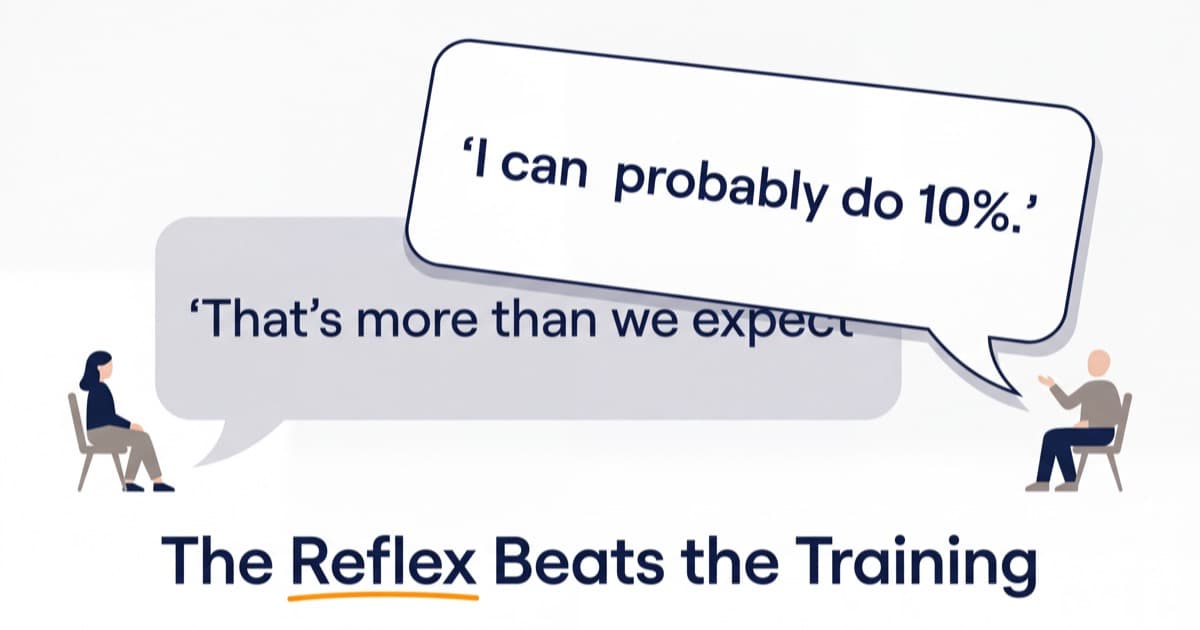
What it moves is the range that feels discussable. If the buyer opens at twenty percent below today's price, the call runs between that number and today's, and landing at eleven percent off feels to both of you like a fair result. Open above today's price with a reason and the same call runs between your number and today's, and the same buyer signs a small increase feeling equally well handled. That gap is not skill applied during the call. It is who spoke first.
Two things follow. Concessions get scored against the anchor rather than against value, so a buyer who asked for twenty percent and got eleven reports internally that they halved the renewal ask. And it works on you: when procurement names a figure in the first minute, your own sense of what is achievable moves, which is why the counters that follow cluster near the midpoint.
You can anchor more than the price
Price is the anchor everyone reaches for and the one with the least room in it, because list price is public and the buyer has already discounted it mentally. Three others do more work and cost you less.
| What you anchor | What it sounds like | What it constrains | Where it backfires |
|---|---|---|---|
| Price | "For sixty seats at the dispatch tier, renewals land between 49 and 54." | The band the final figure sits in. | If you cannot say what decides which end, the range reads as padding. |
| Scope | "You are on the version with the permitting queue. That is the piece most teams your size add in year two." | What counts as the same deal, so a cut has to give something back. | If it is something they never use, naming it advertises what to drop. |
| Term | "Two years is where the pricing is built. One year is the exception, and it prices like one." | Which structures are normal versus special. | If you concede the term later without payment, every other anchor loses credibility. |
| Comparison set | "Installers your size usually weigh this against hiring a second dispatcher, not against a cheaper tool." | The alternative they measure you against. | If the comparison flatters you rather than being true, one question exposes it. |
The comparison anchor is the one most reps never use and the highest leverage of the four. A buyer weighing your platform against a cheaper platform is running a feature argument you will probably lose. The same buyer weighing it against a salaried hire is running arithmetic in which your price is small. You do not control the comparison, but you usually get to say it first.
What do you say when the buyer asks for your number first?
Give a range with the reason attached, in the same breath, then ask the question that decides which end applies.
The instinct is to deflect. "It depends on what you need" is true and costs you twice: the buyer hears evasion, and the next number in the room is theirs anyway. You did not avoid anchoring, you let somebody else do it.
The line that works has three parts and none can be dropped.
The range. Narrow enough to be a real answer, wide enough to be honest. "Teams at your headcount land between 49 and 54."
The reason it exists. This is what turns a bid into a frame. "The spread is the permitting queue and how many crews you dispatch out of a second yard."
The question that resolves it. "Are you still running everything from the one yard, or did the second location go live?"
Together that takes about eight seconds, and it hands the specificity problem back to them. The buyer now has to talk about their operation to move your number, which is where you wanted the call to go.
When their number lands before yours
Sometimes you lose the coin toss and procurement opens with a figure. Re-anchor once, explicitly, then stop.
Name their number without insulting it: "twenty percent under is a clear place to start, so let me put the other end in the room." Restate your range with its reason, unchanged by what they said, because a range that moves the moment they speak was never a range. Then ask what produced their figure: "is the twenty a budget number you were handed, or what this has to beat to get approved?" Most buyers will tell you, because the number came from somewhere specific and repeating that is easier than inventing a reason.
What you do not do is counter at the midpoint. That is a concession dressed as firmness, conceding that their anchor is one of two legitimate poles. If their figure is outside anything you would sign, say so once and go back to trading scope and term, which is the ground the price negotiation guide prepares.
Inside a renewal call that opens at twenty percent off
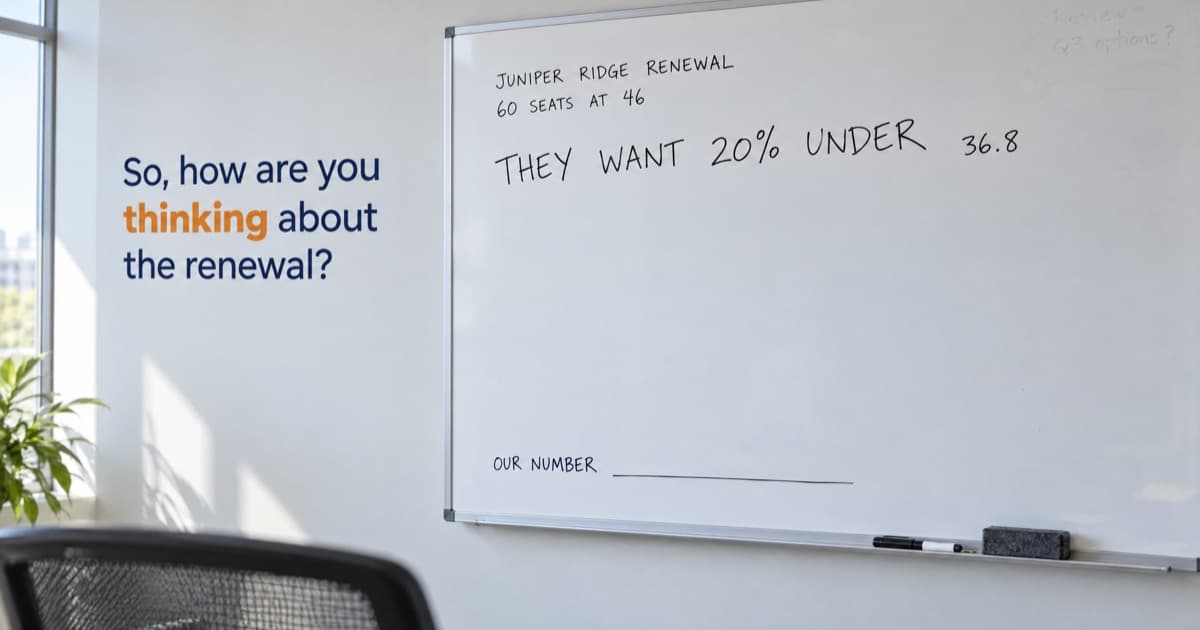
Brynn handles renewals at Ambrell, a dispatch and scheduling platform for field crews. Teodor is VP of Operations at Juniper Ridge Solar, a rooftop installer that grew from thirty-eight crews to sixty over the contract year. The current deal is 46,000 dollars for sixty seats, and Brynn dialed in first.
The version where Teodor's number lands first:
Brynn: "Thanks for making the time. Before I get into anything, how are you thinking about the renewal this year?"
Teodor: "Honestly, we need to be about twenty percent under where we are. Finance flagged every software line this quarter and ours is one of the bigger ones."
Brynn: "Understood. Twenty is a lot, but let me see what I can do on my side. Would something in the low teens work if I can get it approved?"
Teodor: "Get me a number and I will take it to finance."
Three sentences in, the call is over and only one number has ever existed. The open question was polite and it handed Teodor the frame for free. Then "twenty is a lot, but" accepted the anchor while sounding like resistance, and "low teens" capped Brynn's own outcome before finance had seen a proposal. That call lands at eleven percent off and both people will call it reasonable.
The version where Brynn's number lands first:
Brynn: "Before we get to numbers, one thing I want to check. You went from thirty-eight crews to sixty this year. Are you dispatching all of them out of the one yard?"
Teodor: "Two yards now. The second opened in March."
Brynn: "That changes what this renewal should look like. Installers running two yards at your headcount land between 52 and 56 for the year, and where you sit depends on whether the permitting queue stays in scope. I have you at 52. That is up from 46, and the reason is the second yard, not an increase."
Teodor: "That is going the wrong direction. Finance told me to bring this in twenty percent under."
Brynn: "That is a real constraint and I would rather work with it than argue with it. Is the twenty a target you were handed, or the number this has to beat to get signed?"
Teodor: "Every software line got told the same thing. It is not specific to you."
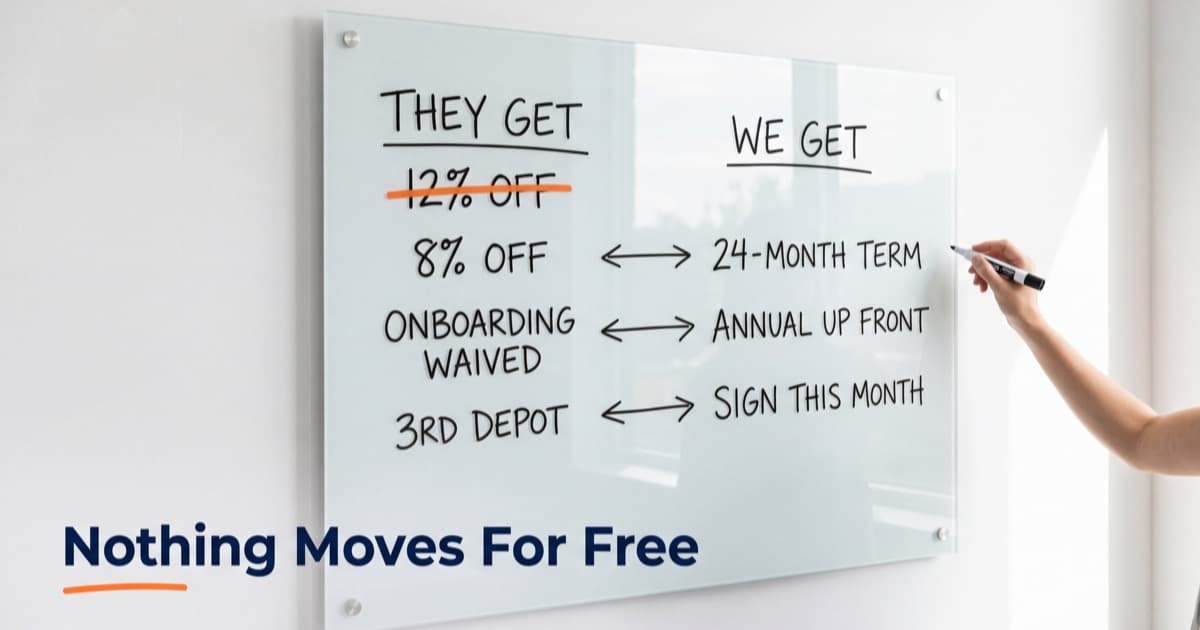
Brynn: "Then let me give you something specific to take back. Since the second yard opened, your reschedule rate went from fourteen percent to six, which is about a hundred and fifty truck rolls you did not run this year. If this line cannot grow, I can hold you at 46 flat on a two-year term with the permitting queue included. What I cannot do is 46 for one year, because that is the price of the smaller operation."
Teodor: "A flat renewal with the queue included, I can defend. Send me that and the truck roll math."
The second call is not more aggressive. Same rep, same product. A defensible number and its reason were simply in the room before Teodor's was. Watch the sequence: one operational question first, so her figure arrived as a consequence of his business rather than as an ask; the increase and its cause named in a single sentence, which is what makes 52 a frame rather than a bid; and when the twenty percent landed, she neither countered it nor moved her range. She asked what produced it, learned it was a blanket instruction, and paid for the concession with term instead of margin.
Flat is a win here, too. From 52 with a reason, holding at 46 is something Teodor can defend in a finance meeting. From "how are you thinking about the renewal?", the same 46 reads as a failure to reach twenty percent.
Four anchoring habits worth unlearning
Anchoring on a number you cannot defend for two more sentences. An anchor lives or dies on the sentence after it. If your reason is "that is our list price", you have made a bid, and it will be treated like one.
Softening it in the same breath. "We are at 52, but there is definitely some flexibility" is a starting bid with a coupon attached. Say the number, say why, then stop.
Treating list price as your anchor. It is not, because the buyer discounted it mentally before the call. Your real anchor is the first figure specific to them: their headcount, their yards, their volume.
Re-anchoring twice. Once is a correction. Twice teaches the buyer that your numbers regenerate under pressure, so the cheapest move available is to push again. That is the same discipline that keeps a discount request from becoming a discount.
Back to the first number
The first number said out loud changes the last number agreed, and on most calls nobody decides who says it. It gets handed over by an open question asked out of politeness in the first minute.
The alternative takes ninety seconds to rehearse, and it is worth doing out loud rather than in your head, because this is a speaking failure and not a thinking failure. Say your range, say the reason, ask the question that resolves it, then be quiet for three full seconds. Most reps can write that line perfectly and cannot survive the silence at the end of it without adding "but obviously there is some room there."
Practice the version where your number lands first. On ConvoSparr you can run this renewal against a buyer who opens with a procurement figure and pushes back on yours, as many times as it takes to stop filling the pause.