
It usually arrives as six words at the end of a good call. "Can you do better on price?" Or it lands in your inbox on a Thursday afternoon from someone you have never spoken to, with a target percentage in the second line and a deadline in the third.
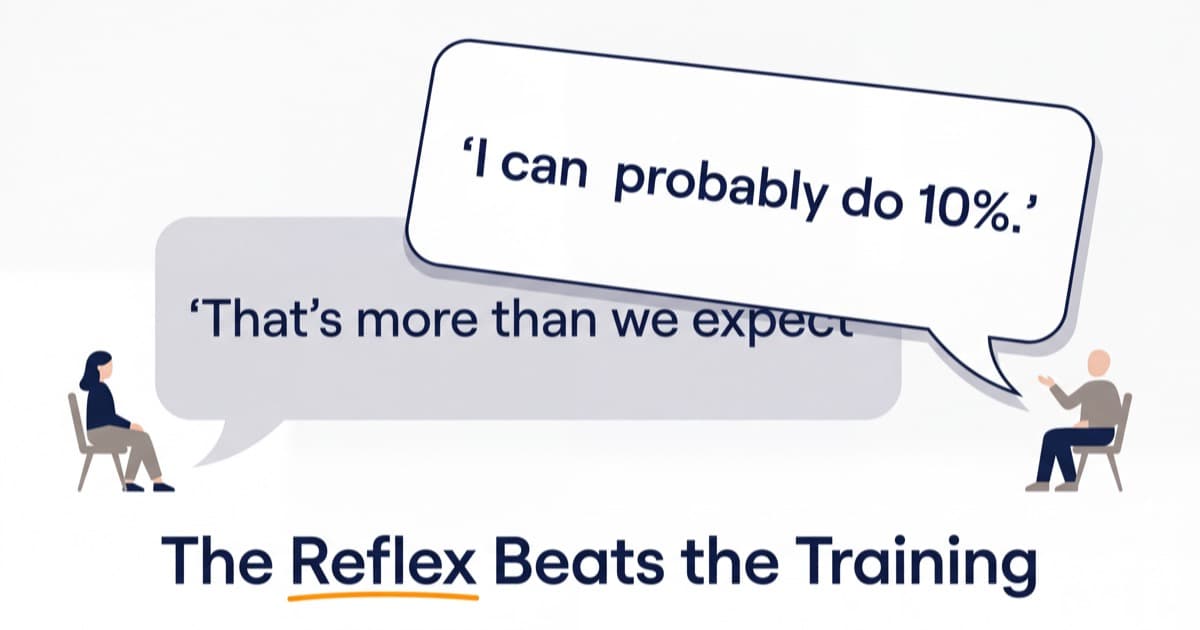
Whatever you say next, you will say within about eight seconds, and it will be one of two sentences: "let me see what I can do" or a number. Both hand the negotiation away before it starts, because both answer a question you have not read yet.
The ask looks identical every time. The thing underneath it is not, and the reason you cannot script a single response is that you are actually being asked one of four different questions.
What is a buyer actually asking for with a discount?
The reflex. Someone asks because asking is free and their last three vendors moved. There is no target, no mandate and no ceiling. They want to know whether the number is real. Discount here and you have bought nothing, taught this buyer that your first quote is decoration, and guaranteed the same ask at renewal.
The mandate. Procurement is measured on a reportable saving. Often it is a percentage against the submitted quote, sometimes a flat figure, and almost always on the first-year total rather than the rate. This person is not trying to break your pricing. They need to file something. What they need is a number in a box, and the currency it comes in matters far less to them than it does to you.
The ceiling. The buyer has an approved amount and your quote is over it. Nothing about your price is wrong; the budget was set before you were in the conversation and cannot move without a second approval nobody wants to ask for. A discount here is the wrong instrument. Scope is the instrument.
The comparison. Someone else quoted lower and the buyer is treating the two numbers as comparable. They usually are not, because the scopes differ, but until the difference is on the table any discount you give is a bid in an auction whose rules you have not seen.
Four reasons, one sentence, and the correct response to each is different enough that guessing is close to useless. Refuse the reflex ask and you look firm. Refuse the ceiling ask and you lose a deal you could have won by removing two modules. Trade against the mandate and you keep your rate. Trade against the comparison before normalizing scope and you fund a competitor's number.
| Why they asked | How it sounds | What to move |
|---|---|---|
| Reflex | "Just seeing if there is room" | Nothing. Hold warmly and move on |
| Mandate | "Anything over X needs a savings line" | A one-time fee or payment term, never the rate |
| Ceiling | "I have approval at X" | Scope or timing, not price |
| Comparison | "Someone quoted us lower" | Nothing, until the scopes are normalized |
Ask what the number has to do
There is one question that sorts all four, and it works because it is genuinely useful to the buyer rather than a stall.
"Before I take anything back to my side, help me understand what the number has to do. Is there a figure this has to come under, or are you checking whether there is room?"
The reflex says some version of "just seeing." The mandate tells you what they report and to whom. The ceiling names an approved amount. The comparison mentions the other quote, usually within a sentence, because they want you to react to it.
Two things have to be true for that question to work. The first is that you ask it without flinching. A short, neutral receipt buys the room: "That is a fair thing to ask." Nothing apologetic, no inhale, no "well." The flinch is what most reps actually lose to, and it is a separate problem worth fixing on its own, covered in why reps fumble price objections.
The second is that you do not answer with a number before the answer comes back. "Let me see what I can do" feels like buying time, and it is not neutral. It concedes that there is something to do, sets an expectation that you will return with a lower figure, and guarantees the next conversation starts from whatever you bring. You have moved and received nothing, which is the one thing the price negotiation guide says never to do.
Then answer in the currency the reason lives in. A mandate measured on the first-year total is cheapest to satisfy with a one-time fee, not with a rate that repeats forever. A ceiling is answered with scope or timing. A comparison is answered with a line-by-line difference, and only after that with price if at all. A reflex is answered by holding, warmly, and moving on.
Paying a mandate without moving the rate
Gustav Okonjo sells for Wrenlow, a fictional field service scheduling tool. The buyer is Caldemere Facilities, a fictional commercial maintenance firm running about six hundred engineers. His champion is Hugo Marchetti, who runs field operations and has already said yes. The quote is $64,000 a year plus a one-time $7,500 onboarding fee. On the call today is Tamsyn Beaufoy from procurement, whom Gustav has met once.
The way it usually goes:
Tamsyn: We like the fit. Before this goes any further, we are looking for about fifteen percent off the annual.
Gustav: Understood. Let me see what I can do and come back to you.
Tamsyn: How soon?
Gustav: End of the week. I should be able to get you something.
Gustav comes back on Friday with ten percent off the subscription rate, which is $6,400 a year, every year, forever.
Tamsyn: I appreciate that. It is not fifteen though, and fifteen is the number I have. Can you get the rest?
Gustav: I might be able to get to twelve if we sign this month.
Tamsyn: Let me take twelve back and see.
Gustav has now moved twice, unprompted, and confirmed both times that the price was soft. He never learned what the fifteen was for, and he gave away a permanent reduction to satisfy a first-year target, so next year's renewal opens at $57,600 rather than $64,000.
The way it can go:
Tamsyn: We like the fit. Before this goes any further, we are looking for about fifteen percent off the annual.
Gustav: That is a fair thing to ask. Before I take anything back to my side, help me understand what the number has to do. Is fifteen a figure this has to come under, or is it a target you are working toward?
Tamsyn: It is what I report. Anything above fifty thousand goes to the finance committee with a savings line on it, and a single digit tends to get sent back.
Gustav: So the committee sees the first-year total and the reduction against our submitted quote.
Tamsyn: Correct.
Gustav: Then let me show you where I have room, because it is not in the same place you are looking. The $64,000 is the rate for six hundred engineers and I am not going to move it, partly because I would have to explain the new number to Hugo at renewal and I would rather not have that conversation with him. The $7,500 onboarding fee I can move, because it is a real cost rather than a margin, and it only exists once.
Tamsyn: Move it how far?
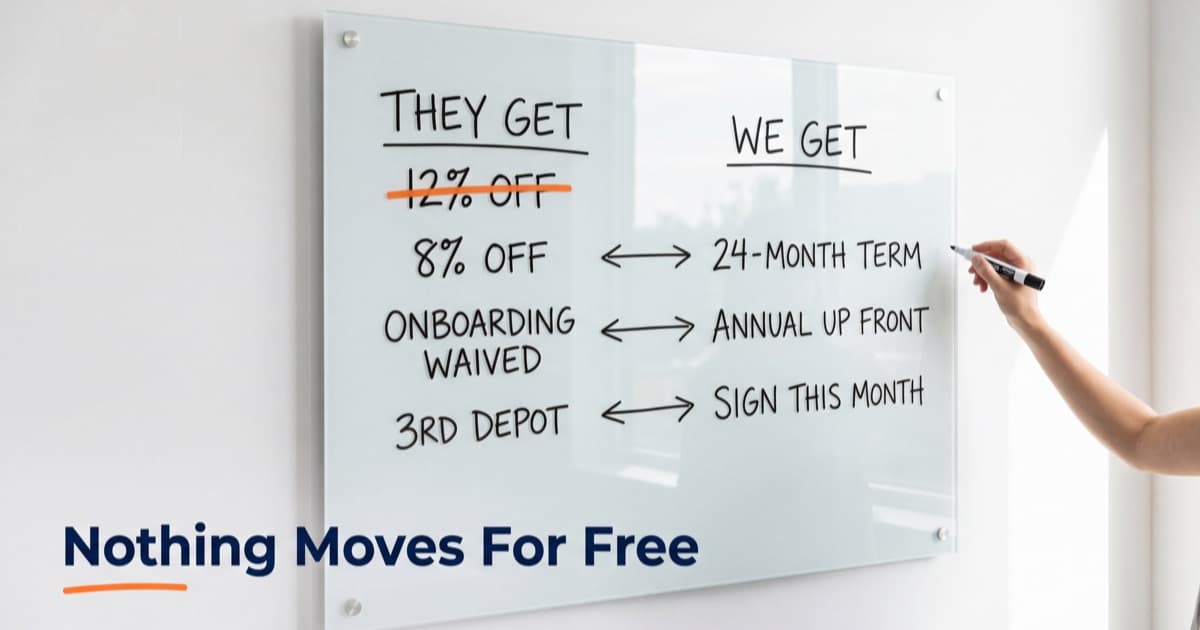
Gustav: All of it, if Caldemere runs the engineer training internally. We hand Hugo the materials and the two sessions for his supervisors, his team delivers the rest. And if you pay annually up front instead of quarterly, I can take a further $1,000 off year one. That is $8,500 against a first-year total of $71,500, which is close to twelve percent, and the annual rate is untouched at every renewal after that.
Tamsyn: Twelve is not fifteen.
Gustav: It is not. Fifteen on the rate is not available at this volume, and if I invented it today you would be right to wonder what the original number was. What I can add is the second region at the same per-engineer rate for the first year rather than the tiered one, if Hugo wants it in Q2. That is worth more than the three points and it does not show up as a discount line.
Tamsyn: Send it through as two options and I will put the annual-up-front one to the committee.
Same deal, and Gustav kept the rate. The mandate lived on the first-year total, so he paid it with a one-time fee and a payment term, both of which cost Wrenlow less than $6,400 a year does. He named his floor and gave a reason for it that Tamsyn can repeat, which is what makes a refusal survive being carried into a room he is not in. He also offered something with real value that does not appear on the savings line, because the constraint was reportability rather than money.
The mistakes that survive good training
Answering the number instead of the reason. Fifteen percent is the output. What generated it is the only thing that tells you what to move.
Discounting the rate to satisfy a first-year target. A rate cut repeats every year of the contract and resets the renewal baseline. A one-time fee, a payment term, a delayed start date or a bundled module usually costs you less and reads the same in the box.
Moving before you know the scope is comparable. When the ask comes from a comparison, ask for what the other quote covers before you touch price. Half the time you are being asked to match a number that excludes implementation, a support tier, or two hundred users.
Giving the discount to someone who cannot sign. If the request comes by email from a name you have not met, find out whether they can approve anything before you respond with a figure. A concession sent into a procurement inbox is a starting point for the person who actually decides.
Pre-empting the ask. Offering a discount because you expect one to be requested is the most expensive habit in the list. It costs money in every deal that would never have asked.
Moving twice in one conversation. The second move tells the buyer the first was not real, and everything after it is priced accordingly.
The thing worth practicing is not the trade itself, which is easy to plan on paper. It is the eight seconds between the ask and your first word, when the polite instinct is to say something accommodating. Say the neutral receipt and the sorting question enough times out loud that they arrive before the flinch does, and most of the rest of this takes care of itself.