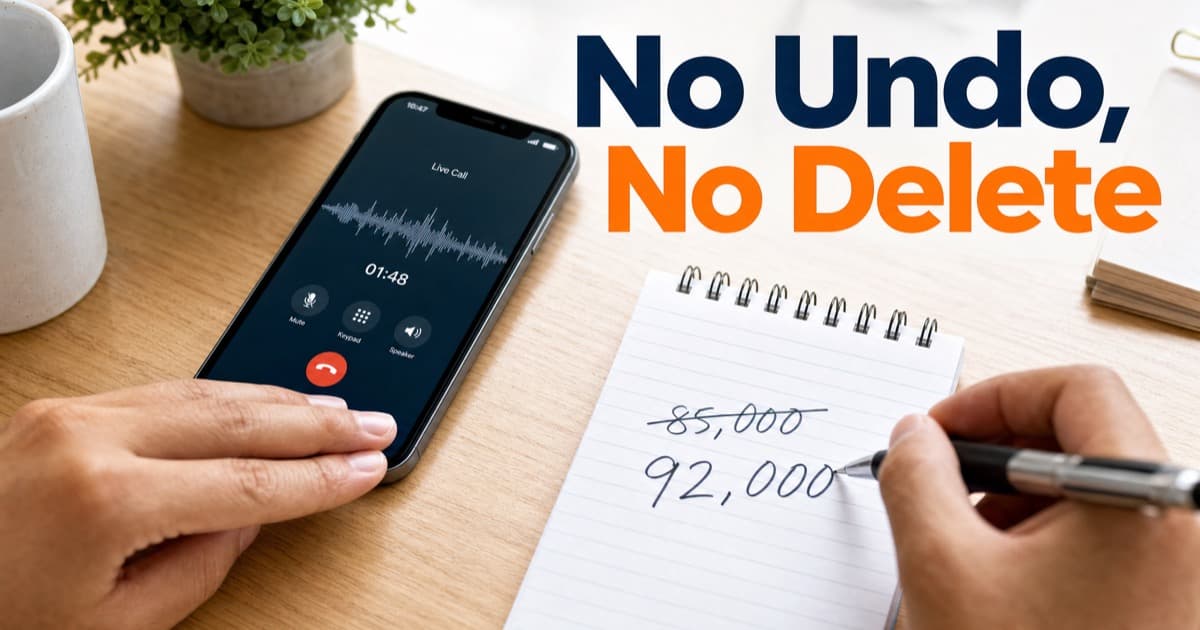

You are three weeks into a process and the number you gave a recruiter in the first ten minutes is now sitting inside your offer email, give or take a thousand. You know exactly which sentence did it. You have read the advice that says never name a figure in the screen, and it is good advice, and it is completely useless to you now, because you already did.
That is the gap in almost everything written about salary negotiation mistakes. The lists are accurate and they are written for someone who has not made the mistake yet. The more common situation, by a wide margin, is being partway through a conversation you have already damaged and needing to know whether the damage is permanent. Mostly it is not. These slips have a repair, the repair is a specific sentence rather than a strategy, and the window for saying it is shorter than people assume.
Can you take back a salary number you already gave?
Watch what actually happens when someone says the wrong thing on a compensation call. They hear themselves say it, they register that it was wrong, and then they spend the next half minute doing damage control in the least useful way available: softening, laughing, adding qualifiers, or going quiet and hoping it slides past. By the time they have finished being embarrassed, the other person has written the number down and moved on.
The slip costs you almost nothing on its own. A figure named too early is just a data point until someone builds an offer on top of it. What makes it expensive is silence, because silence is agreement. If you name 125 in the screen and never mention it again, you have not made one mistake, you have made one mistake and then confirmed it four separate times by not correcting it.
So the repair is not a rescue mission you mount later over email. It is a sentence you say in the same conversation if you catch it there, or at the start of the next one if you do not. The salary negotiation guide covers the moves that keep you out of these positions in the first place. This is what to say once you are in one.
Four common slips and the sentence that walks each one back
You named a number in the recruiter screen. The repair is to retire the figure explicitly rather than hope it was forgotten, and to give a reason that is true and neutral: "Before we go further, I want to correct something. The number I gave you in our first call was based on my current job, and I had not seen the full scope yet. Now that I have, I would ask you to treat that figure as out of date." Nobody argues with this, because it is factually what happened. You are not withdrawing a commitment, you are saying a data point was collected under bad conditions. It works because it gives the recruiter a defensible line to repeat internally, which is the only form your argument travels in once you are off the phone.
You countered with a feeling instead of a figure. "I was hoping for a bit more" hands the arithmetic to the other side, and they will do it in their favor, politely. The repair has to arrive in the very next breath, before they answer the feeling: "Let me be more specific than that. I am looking for 138 base." If they already answered, you can still take it back on the same call: "I was vague a second ago and that was not fair to you. The number is 138." A correction offered inside the same conversation reads as clarity. The same correction three days later reads as a second negotiation, which is a much harder thing to open.
You justified the ask with your own costs. Rent, a mortgage, childcare, a partner's relocation. These are real and they are not arguments, because they describe what you need rather than what the role is worth, and they put a person who cannot solve them in an awkward position. The repair is a pivot inside the same answer, not a retraction: "That is my situation, and it is not really the reason. The reason I am at 138 is the vendor reporting and the on-call rotation, neither of which was in the description I answered your first question against." You do not have to apologize for mentioning it. You do need the last thing they hear to be scope.
You said yes on the call. This is the hardest one and it is still not fatal, as long as nothing is signed. Raise it fast, frame it as one item rather than a reopening, and own what happened: "I said yes quickly yesterday because I am genuinely excited about this, and I want to raise one thing before we paper it. The base works if we can put a sign-on against the bonus I am walking away from." Verbal acceptance is not a contract, but your leverage is lower now, so ask for one item and expect a smaller answer than you would have had an hour earlier.
The same offer call, with and without the repair
Ellis Moreau is interviewing for a senior operations analyst role at Kestrel Grid Systems, a fictional utilities analytics company. In the first screen, three weeks ago, the recruiter Marisol Trent asked what Ellis was looking for, and Ellis said "I am at 118 now, so somewhere around 125 would work." The scope of the job turned out to be larger than the posting suggested. Here is the offer call, run twice.
Without the repair:
Marisol: Good news. We are able to come in at 126 base, plus the standard ten percent bonus target. You had mentioned around 125, so I think we are in good shape.
Ellis: Yeah, that is right in the range I said. Although, I guess I was hoping for a bit more, honestly, now that I know how broad the role is.
Marisol: I hear you. 126 is where we landed against the band for the level, and it is a solid step up from where you are today. Can I send the paperwork over this afternoon?
Ellis: Sure, that works.
Two things went wrong and neither was the original number. Ellis confirmed the anchor before objecting to it, which retired the only argument available: once you agree that 126 matches what you asked for, the scope point has nowhere to stand. Then the objection arrived as a feeling with no figure attached, so Marisol got to respond to the feeling, which costs nothing to do warmly and settles the matter. "Can I send the paperwork" is not pressure. It is Marisol correctly reading a conversation that is over.
With the repair:
Marisol: Good news. We are able to come in at 126 base, plus the standard ten percent bonus target. You had mentioned around 125, so I think we are in good shape.
Ellis: Thank you, and I am glad it is moving. One thing I want to correct before we go further. The number I gave you in our first call was based on my current job, and I had not seen the scope then. Now that I have, I would ask you to treat it as out of date. I am at 138 base.
Marisol: Okay. That is a real jump from what we discussed. What changed?
Ellis: The vendor reporting and the on-call rotation. Neither was in the posting I answered your question against, and they are the two things that make this a different job from the one I have.
Marisol: That is fair, and it is not what I have approved. Let me take 134 back to the hiring manager with the scope point, because that part I can defend.
Ellis: I appreciate it. If 134 is where the base lands, I would want to look at the sign-on to cover the difference. Can we do both in the same conversation rather than in two?
Marisol: Reasonable. Give me until Thursday.
Same slip, three weeks old, same recruiter, same opening line. The difference is that the correction was stated as a fact rather than an apology, a number arrived in the same breath so there was nothing vague for Marisol to answer, and the reason was scope rather than need, which is the only reason that survives being repeated to a hiring manager who was not on the call. The last move matters as much as the first: Ellis bundled the sign-on into the current conversation instead of raising it on Friday, which is what turns one counter into a sequence of small asks nobody enjoys.
Where a repair stops working
After you sign. The signature is the hard boundary. Before it, you are negotiating. After it, you are asking for a favor and telling your new employer that your word has a short shelf life.
When you have bluffed an offer that does not exist. Every other slip here is a communication problem with a communication fix. This one is a credibility problem, and no sentence unbluffs it. If it gets checked, it fails permanently, in front of the people you were about to work with.
When the repair is the fourth separate ask. Base on Monday, sign-on on Tuesday, start date on Thursday. Each is reasonable alone and the sequence is exhausting. Correct the thing, state the whole remaining list at once, then say it is the whole list.
When you send it instead of saying it. A repair delivered by email arrives without tone, gets forwarded, and gets answered by someone who was not there. The same words spoken on the call are a clarification. Written down two days later they are a renegotiation.
When you apologize instead of correcting. "Sorry, I know I said 125, I do not want to be difficult" invites exactly one answer: "right, you did." Say what changed and say the number. There is nothing to be sorry for in a figure you gave before you knew the job.
None of these repairs is complicated. Every sentence above fits in a breath, and you could hold all of them in your head after one read. They fail because the moment you need them is the moment you are most embarrassed, and embarrassment reaches for softening language automatically. That is a mouth problem, not a knowledge problem, and it is the same one that decides salary calls run over the phone. The fix is having said the correction out loud, to something that answers back, before the call where getting it wrong costs twelve thousand dollars.