Most people looking for salary negotiation scripts are looking for a paragraph. Something to keep on a sticky note beside the laptop, read off while the recruiter talks, with their own numbers swapped in where the brackets are. That is the wrong object. A paragraph is a speech, and nobody has ever delivered a speech into a conversation where the other person answers back after your second sentence.
Here is the whole thing in one line. A salary negotiation script is five short sentences, one for each moment where the number can still move, and the only test that matters is whether you can say each one in your own voice while somebody friendly waits on the other end. Not five paragraphs. Five sentences you have said out loud enough times that they arrive without a run-up.
What Should a Salary Negotiation Script Contain?
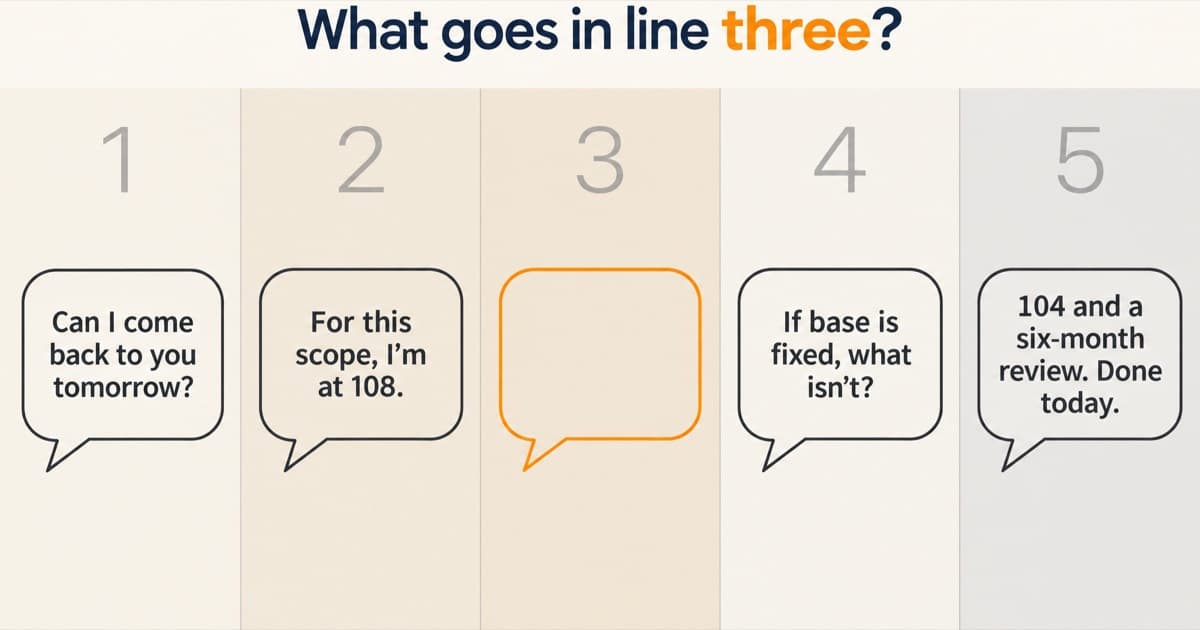
A salary negotiation script should contain one sentence per decision point, and nothing else. The decision points are fixed and there are five of them: the moment the offer lands, the moment they ask what you are looking for, the moment right after you say your number, the moment they tell you the base is fixed, and the moment you are one step apart and somebody has to end it. Everything that goes wrong in these conversations goes wrong at one of those five, and it goes wrong because the person had a general intention rather than a specific sentence.
That is the difference between a script and a plan. "Be confident and know my worth" is a plan. It survives the drive to the call and dissolves the moment a real person says "so, what were you thinking?" in a warm voice. "For this scope I'm at 108" is a script, because it is short enough to say while your heart rate is up and specific enough that you cannot half say it.
The sentences also have to be yours. A line copied from a page and never spoken comes out sounding recited, and recited reads as rehearsed hostility rather than as preparation. The salary negotiation guide walks the full arc from first screen to signed offer. This page is only about the five sentences and the order they go in.
Five Lines, and the Job Each One Has to Do
| The line | The moment | What it has to do | What kills it |
|---|---|---|---|
| "Thank you, that's good news. Can I come back to you tomorrow with the whole package in front of me?" | The offer lands | Buys a night without reading as doubt | Reacting to the number in the same breath it arrives, which locks in whatever your face did |
| "For this scope, I'm at 108." | They ask what you are looking for | Puts one forward-looking figure on the table, attached to the job rather than to your history | A soft range. They hear the bottom of it and build from there |
| Nothing. | The two seconds after you say the number | Leaves them the next move, which is the only way you learn what the number really is | Justifying unprompted. Every reason you add invites a counter to that reason |
| "If base is fixed, what isn't? Start date, review timing, sign-on?" | They say the band will not move | Moves the conversation off the one axis where they have already said no | Hearing "fixed" as the end rather than as one closed door in a room with four |
| "If you can do 104 with a review at six months, I'll accept today." | You are one step apart | Makes the yes concrete, dated and easy to take upstairs | "Let me think about it" after they have already moved, which spends their goodwill and buys nothing |
Read down the middle column and you can see why the order is not optional. The hold protects the number before you know what you think of it. The number goes second because whoever names it first sets the frame, and it should be you, naming a figure pointed at the job you are about to do. The silence is third and is the hardest to hold. The trade only exists because base is one variable in a package with several. The close is last because a negotiation nobody ends drifts back into email, where nothing moves.
Where the Script Gets Interrupted
Thistlebank Veterinary Group runs fourteen clinics across two states and is hiring a regional operations manager to own scheduling, supply contracts and clinic staffing. Selin is the recruiter. She has an approved band, a hiring manager who wants this closed before the end of the month, and the verbal offer already in her mouth. Anika is the candidate, and has the five sentences.
Reciting it
Selin: Good news. We'd love to bring you on. The offer is 94 base, standard bonus, starting the sixth.
Anika: That's great, thank you so much. I was hoping for something a bit higher, honestly. I've been doing multi-site scheduling for four years now and I know the supply side pretty well, and I've had a couple of other conversations going, so I was thinking maybe more in the range of 105 to 110? But I'm flexible.
Selin: I hear you. 94 is where we are on this one, it's a banded role. What I can tell you is people move quickly here.
Anika: No, that makes sense. Honestly the role is the main thing for me. Let me think about it and come back to you.
Selin: Of course. I'll send the paperwork over so you have it.
Every sentence Anika said was true and she still lost the conversation in four lines. She reacted to the number before she had seen the package, so the hold was gone. She justified before she named, which turned her figure into the conclusion of an argument Selin could disagree with instead of a fact Selin had to respond to. "105 to 110" got heard as 105, and "but I'm flexible" took even that back. When Selin said banded, Anika accepted it as a property of the universe rather than as a statement about one variable. And she closed with "let me think about it" at the exact moment a concrete ask would have cost Selin nothing to take upstairs. The paperwork arrives at 94.
Landing it
Selin: Good news. We'd love to bring you on. The offer is 94 base, standard bonus, starting the sixth.
Anika: Thank you, that's good news. Can I come back to you tomorrow with the whole package in front of me?
Selin: Sure. Anything you want to flag now?
Anika: One thing. For a role that owns supply contracts across fourteen sites as well as staffing, I'm at 108.
Selin: Hm. 94 is the band for this title.
(Anika says nothing.)
Selin: I could probably get to 99, maybe 101 if the hiring manager pushes. Above that I'd have to open the band itself and that's a longer conversation.
Anika: Understood. If base is capped, what isn't? Start date, review timing, sign-on?
Selin: Sign-on we've done before. And I can write in a review at six months rather than twelve.
Anika: Then here's what works. If you can do 104 with the review at six months, I'll accept today.
Selin: Let me take 104 to her this afternoon. I think that lands.
Same offer, same recruiter, fourteen thousand dollars and a review cycle apart. The hold cost one sentence and moved the real conversation to a moment when Anika had the package in front of her. The number went out naked, with the scope attached and no argument wrapped around it, so there was nothing to rebut. The silence after "94 is the band" is the line that did the most work, and it is not a line at all: two seconds of nothing pulled 99, then 101, then the shape of the constraint. The trade question treated "banded" as information rather than as a verdict, which it was. And the close named a specific figure with a specific condition and a same-day yes attached, which is the version a recruiter can walk into an office and repeat.
Notice what Anika never did. She never said what she currently earns, never explained why she deserved 108, and never apologized for any of it. If the current-salary question comes earlier in your process, that answer has its own shape and it is worth having ready, because a figure handed over in the screening call quietly sets the ceiling for everything above.
The Habits That Undo a Good Script
Four habits break these lines, and all four are attempts to be agreeable.
Justifying before you are asked. The instinct is to earn the number by explaining it. But a reason is a surface, and the person across from you will engage with the reason rather than the number. Say the figure, stop, and let them ask why if they want to know. They usually do not.
Naming a range you would accept the bottom of. Ranges are heard from the bottom, always. If 105 is your real floor, 105 is your number. "105 to 110" is a 105 offer with extra steps.
Softening the sentence after you have landed it. "But I'm flexible", "if that's possible" and "obviously the role matters more" are retractions. They arrive because silence feels rude. It is not.
Moving to email after a voice conversation. Once a live call ends without a number attached to it, the negotiation moves into writing and slows to a stop. If a call is going anywhere, land the close in the call. Doing this over the phone has its own rules, mostly about what you do with the gaps.
There is a fifth failure that is not a habit so much as a fact about preparation: the first time most people say these five sentences out loud is to the person who decides the number. Reading them is not saying them. The sentence you have only read goes out with an upward inflection at the end, and an upward inflection turns a figure into a request.
Which Line Would You Struggle to Say?
Go back through the five. The hold, the number, the silence, the trade, the close. One of them is harder for you than the other four, and it is probably not the one you expect. Most people assume it will be the number and find out it was the silence, or find that the trade question feels presumptuous in a way the figure never did.
Whichever one it is, that is the sentence standing between you and the fourteen thousand. So: which line would you struggle to say out loud right now, to a real person who is waiting for you to finish?