
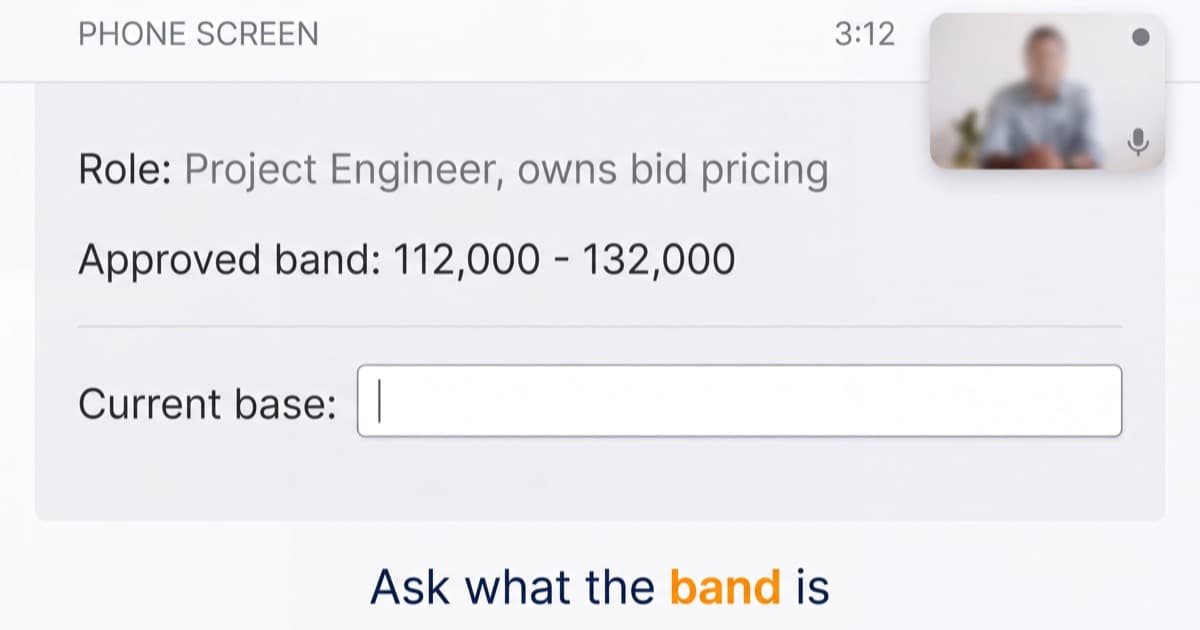
"Before I set up the next call, I just need to fill in a couple of fields on my side. What are you on at the moment?"
That is how it usually arrives. Not as a negotiation and not as a test, but as paperwork, three minutes into a screening call with someone friendly and organized who has not yet told you one thing about the budget for the role. The tone is the trap. Nothing in the delivery suggests that the next four seconds set the ceiling on everything after them, and by the time you understand that they did, the figure is sitting in a field.
The answer fits in one move. You do not give your current salary. You give a range for the role you are applying to, you attach that range to the scope of the job rather than to your history, and then you stop talking. Two sentences: acknowledge what they need, name your target range for this scope, hand the question back. The redirect works because it is cooperative. You are not refusing to answer. You are answering a more useful version of the question, which is the one they need answered to move you forward.
Why the question arrives before anyone has read your resume
The screening call exists to disqualify cheaply. The person running it usually does not own the budget, and they are measured on not wasting five interview rounds on someone who will decline at offer. Your current salary is the fastest proxy they have for "will this person accept our band," and it costs nothing to ask.
That changes what a good answer has to do. At the moment it is asked, the question is a filter. It only becomes an anchor later, when someone builds an offer and reaches for the most concrete number in your file. So your answer has two jobs that pull against each other: pass the filter by giving them something usable, and leave no historical figure behind, because that figure outlives the conversation.
This is why a flat "I'd rather not share that" underperforms. It is defensible, it is your right in many places, and it fails the filter. The recruiter is left with nothing to write, no way to tell whether you are plausible for the band, and a small note that comp was awkward. The salary negotiation guide covers the full arc from screen to signed offer. This page is about the ninety seconds where most of the damage gets done.
Is HR allowed to ask what you currently make?
In a lot of the United States, no. A long and still growing list of states and cities restricts employers from asking candidates about salary history, and several also require a pay range to be posted or given on request. The specifics vary more than the headlines suggest: some rules cover only public employers, some kick in above a headcount threshold, and some bite on the posting rather than on the conversation.
Three things are worth knowing before you lean on that protection.
It restricts the employer from asking, not you from answering. Volunteering the figure is generally still fine, so the protection disappears the second you helpfully fill it in. Most people who lose the number in a banned jurisdiction lose it this way, not to an illegal question.
It does nothing for you in the four seconds after the question lands. Nobody has ever improved a screening call by citing a statute, and a recruiter who asked out of habit will remember the correction longer than the candidate will.
And it usually comes with something worth collecting. Where asking is restricted, the band is normally posted or available on request, which is a far better use of the moment than a legal objection. Check what applies where you are hiring, then treat the law as the reason your redirect is unremarkable, not as a line to quote.
Three answers, and what each one leaves on the table
Almost everything said in this moment falls into three shapes, and they are not equally expensive.
| What you say | What gets written down | What it costs |
|---|---|---|
| The figure. "I'm on 96 right now." | 96, in a field, with a date on it | The offer gets built from 96 upward. A 9 percent bump reads generous internally and still lands under the band |
| The refusal. "I'd rather not share that." | Nothing, plus a note that comp was tense | You fail the filter. Either they guess, or the call ends with a vague next step that never firms up |
| The redirect. "For this scope I'm targeting 118 to 130." | 118 to 130, attached to this role | Almost nothing, if the range is defensible. You have set the first number and it is a forward-looking one |
The redirect only holds if the range is tied to something. "I'm looking for 118 to 130" invites the obvious follow-up about what you make now. "For a role that owns bid pricing as well as delivery, I'm targeting 118 to 130" does not, because the reason now lives in the job description rather than in your history. Scope is the hinge, and it is the honest argument, which is why it survives being pushed on.
Pick the bottom of your range as a number you would genuinely accept, not as a number you are hoping to be argued upward from. Ranges get heard from the bottom.
Five minutes inside a screening call at Calverton Ground Engineering
Calverton Ground Engineering is hiring a project engineer who will also own bid pricing, wider than the candidate's current job. Thandi runs the first screen. The candidate is at 96,000 today.
Answering the question asked
Thandi: Before I set up the next call, I just need to fill in a couple of fields. What are you on at the moment?
Candidate: Right now I'm at 96, plus a small bonus that's been about 4.
Thandi: Got it, 96 plus 4. And what would it take to move you?
Candidate: I mean, I'd be looking for a meaningful step up. Maybe something in the low hundreds?
Thandi: That's helpful, thank you. I'll put you through to Yusra on Thursday.
Four lines, and the whole compensation conversation is over. The candidate answered honestly and precisely, which felt cooperative, then softened the only number that was theirs to set. "Maybe something in the low hundreds" is not a range, it is a flinch with a number attached. When the offer is built in three weeks, the most concrete figure anyone has is 96, and 104 will look like a real win to the person writing it.
Notice also what the candidate never got. Thandi asked two questions about money and answered none, and the band is still unknown.
Answering the question behind it
Thandi: Before I set up the next call, I just need to fill in a couple of fields. What are you on at the moment?
Candidate: Happy to give you a number for the field. I'd rather give you the one that's useful, though, because this role is wider than what I do now. For a role that owns bid pricing as well as delivery, I'm targeting 118 to 130.
Thandi: Okay. Is that base?
Candidate: Base. And that's the range I'd move for, so if it's in the band, I'm a real candidate rather than someone you spend four rounds on.
Thandi: That's within what we have approved for this one. It's at the upper end, so it would depend on how the technical round goes.
Candidate: That's fair. Out of interest, what's the full band?
Thandi: 112 to 132.
The redirect takes one breath more than the flinch and does four things the first version did not. It gives Thandi something to write, so the filter is satisfied. It sets the first number and points it forward. It names the scope difference out loud, the argument that has to survive to offer stage anyway. And the last exchange gets the band, which was in the room the whole time.
"Happy to give you a number for the field" is doing quiet work. It signals cooperation first, which is what keeps the redirect from reading as a dodge. Refusing and then explaining is the same content in the order that makes people tense.
What happens to your answer after you hang up
The figure does not stay in the call. It goes into a field, gets pasted into a two-line summary for the hiring manager, and surfaces weeks later when someone assembles the offer. By then nobody remembers that it described a smaller job at a different company in a different year. It is just the number attached to your name.
That cost compounds. An offer built as a percentage step from 96 becomes the base your first raise is a percentage of, and then the base your second raise is a percentage of. One sentence in a screening call is still visible three review cycles later.
When the number is already out there
Often it is. You entered it on an application form six weeks ago, a previous recruiter has it, or a referral who knew your old package passed it along. This is recoverable, and the repair is one sentence rather than a campaign.
Re-date it and re-scope it in the same breath, the next time compensation comes up: "The figure on the form is my current base, and it's for a role without the bid ownership. For this scope I'm at 118 to 130." You are not retracting anything or claiming you were misquoted. You are saying the old number described an old job, which is true and which nobody can argue with. Say it once, without apology, then stay on the new range. The salary negotiation mistakes page carries the repair lines for the other slips in this family, and they share a shape: one sentence, no relitigating.
The version to avoid is the hopeful one, where you assume the figure has been forgotten because nobody has mentioned it. Silence around a number is not amnesia. It is a note in a file.
Say your range before someone asks for it
This is a two-sentence skill and it fails for a boring reason: the first time most people say their range out loud is to the person who decides it.
So say it out loud now, before the call exists. Your redirect, your range, your scope reason, three times through, until the pause before the range stops being a swallow. Then say the follow-up that asks for the band, because that is the sentence people plan and then skip. Practicing it against a voice that asks back, and asks again, is what turns a line you know into a line you can say on a Tuesday morning to a stranger with a form open.