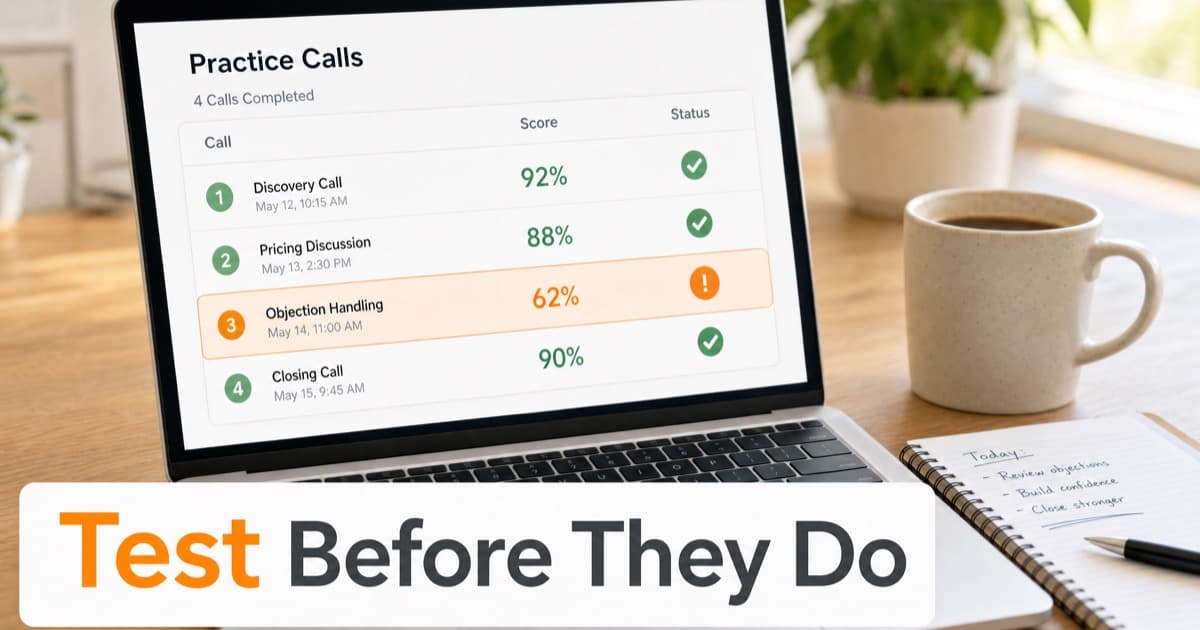

A sales manager at Copperloom, a fictional scheduling software company, rolled a roleplay tool out to eleven SDRs in March. Adoption was excellent. Inside three weeks every rep had run twenty practice calls and average scores climbed from the low sixties into the nineties.
Connect-to-meeting rate over the same six weeks: unchanged. Not up, not down. Flat.
The problem was the counterpart. It accepted answers a real operations lead would have argued with, forgot the objection it had raised ninety seconds earlier, and scored a call as strong whenever the rep sounded confident. Reps got better at the simulator.
That is the buying question, and it is why the best AI sales roleplay software is not decided by feature lists, scenario counts, or how the dashboard looks in a demo. It is decided by five things you can test inside twenty minutes of a trial: does the buyer push back, does it stay in character, does it remember, does the scoring quote you, and can you lose. A tool that fails those five still produces rising scores, the easiest number in this category to manufacture.
What you are actually buying when you buy roleplay software
You are buying a counterpart. Everything else is packaging.
The scenario library is not the product, because a scenario is one paragraph of setup and any manager can write forty in an afternoon. What matters is minute four, when the rep says something slightly evasive and the counterpart decides whether to let it go.
The scoring is not the product either, though it is what the demo spends the most time on. It is a report on a conversation that already happened, so if that conversation was easier than a real one, the report is precise measurement of the wrong thing.
The third component nobody demos is friction. A rep who has to book a slot or coordinate with a partner practices when their manager is watching and never otherwise. Volume comes from starting alone in under a minute. But the counterpart still comes first, because a low-friction tool that trains you against an agreeable buyer just buys you repetitions of a habit that loses calls.
Five tests that separate real practice from a demo
Run each of these in a trial. Every one is designed to fail a tool that is really a script reader with a voice.
One: does the buyer refuse a good answer? Handle an objection cleanly, the way a training deck would approve of, and watch what comes back. Real buyers answer technically correct replies with "I hear you, and it is still not this quarter". A weak simulator treats a well-formed reply as a key that opens the next door, so the rep learns that saying the right words ends resistance.
Two: does it stay in character under pressure? Mid-call, ask it what you should say next. A tool built on a thin prompt breaks frame and starts coaching you, because the underlying model would rather be helpful than difficult. A serious one stays the buyer and answers as the buyer would, usually with confusion. A counterpart that switches sides will do it every time a rep gets stuck.
Three: does it remember what you said two minutes ago? Say implementation takes two weeks in minute two and four to six weeks in minute seven. A real buyer catches that, and catching it may be the most useful thing a practice partner does, because keeping your story straight under pressure is nearly impossible to rehearse alone.
Four: does the scoring quote you? Look for your own sentences in the feedback. Useful analysis quotes the question you asked at eleven minutes in and what the buyer's answer changed. Useless analysis says your discovery was strong, consider asking more open questions. If a rep cannot point to the line the score is about, it cannot change what they do on Monday.
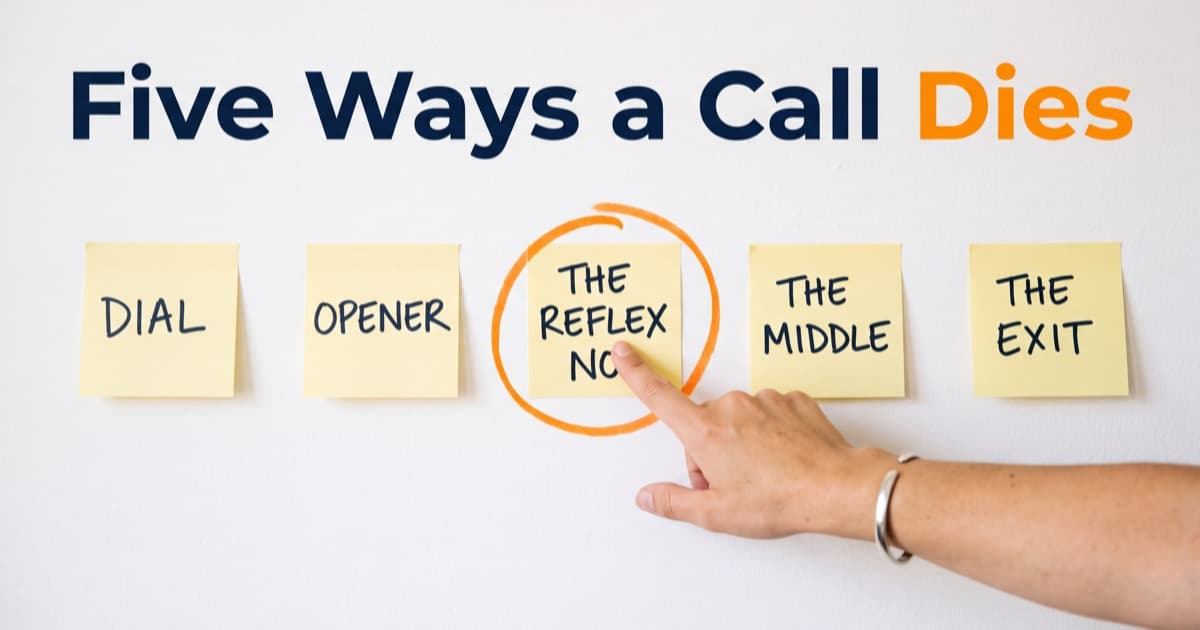
Five: can you lose? Run a deliberately bad call. Interrupt, pitch features for four minutes, ignore the buyer's stated priority. If it still ends with a booked follow-up and a passing grade, the tool has no failure state, and a tool with no failure state is a demo you talk to. The cold calling guide works through the five moments where real calls die. A practice partner is worth the seat only if it can kill a call at each one.
Which practice format actually builds skill?
Every format trains something. The questions are what it misses and how many repetitions you get in a week, because a format nobody sustains teaches nothing.
| Format | Trains well | Misses | Realistic reps per week |
|---|---|---|---|
| Peer roleplay | Comfort saying the words out loud to a person | Peers are kind, break character, and share your blind spots | 1 to 2 |
| Manager roleplay | Real pressure, expert feedback | Depends on one busy person, and reps perform for the grade | 0 to 1 |
| Text or chat AI roleplay | Structuring an argument, choosing words | No timing, no interruption, no silence, unlimited edit time | Many, low value |
| Recording your own pitch | Hearing your filler words and pace | Nothing pushes back, so you rehearse a monologue | 2 to 3 |
| Voice AI roleplay | Real time pressure, interruption, recovery, scored specifics | Only as good as the counterpart, and a weak one trains bad habits | 5 to 15 |
Text practice is easy to sustain and trains the wrong muscle, because typing gives you an edit window a live call never will. Manager roleplay trains the right muscle and happens once a month. Only voice practice puts both together, which is why the counterpart carries so much of the decision.
What the buyer says back is the whole product
Imani is an SDR at Copperloom, twelve weeks in, cold calling Kirsten, operations lead at Ashgate Dental Group, a fictional eleven-clinic practice group. Same rep, same opening, same objection, two different counterparts.
The version that agrees with you
Imani: Hi Kirsten, Imani from Copperloom. We help multi-site dental groups cut the time front desk staff spend rebuilding the schedule after late cancellations. Is that something you run into?
Kirsten: We do, yes. We looked at something like this last year and it was not worth the disruption.
Imani: Totally understand. A lot of our customers said the same thing before they saw how quick the rollout is now. We can be live in two weeks with no downtime for your front desk teams.
Kirsten: That sounds a lot better than what we saw. What would next steps look like?
Imani: I can put thirty minutes on the calendar and walk you through it.
Kirsten: Send it over.
Score: 91. Booked meeting. Imani finished that session believing her objection handling is a strength.
Kirsten raised a real objection, took an answer that addressed none of it, and folded on the next line. Imani never asked what the disruption was or whether the earlier project failed on the software or on the change. She was rewarded for a vendor claim delivered confidently, which is the habit that gets calls ended early.
The version that stays difficult
Same opener, same objection. The difference starts at Imani's third line, which is word for word the one that just scored 91.
Imani: Totally understand. A lot of our customers said the same thing before they saw how quick the rollout is now. We can be live in two weeks with no downtime.
Kirsten: That is what the last one said too. Two weeks turned into most of a quarter with my practice managers doing double entry the whole time. I am not doing that to them again on the strength of a phone call.
Imani: That is fair, and I am not going to argue with something you lived through. Can I ask what the double entry actually was? Was it the appointment history that would not come across, or the recall lists?
Kirsten: Recall lists, mostly. Nothing mapped, so the team rebuilt eighteen months of it by hand.
Imani: Then the honest answer is that I do not know yet whether we would do that to you. If we cannot map your recall data cleanly, you should not buy this. So before anyone talks about a rollout, I would want one of your practice managers looking at a recall export with our implementation lead for twenty minutes. If it maps, you have the answer you did not get last year. If it does not, you have saved yourself a quarter.
Kirsten: Twenty minutes I can probably do, after the fall rush.
Imani: Understood. Is that the first week of November?
Kirsten: Around then. Send me something and I will find a slot.
Score: 74. No meeting, a conditional and a rough date. This is the better call by a wide margin, and a tool that cannot tell you so is worse than no tool.
Kirsten stayed in her own history instead of resetting when Imani made a claim, so the reflex answer had a cost and Imani had to abandon it live. That abandonment is the skill, and it exists only because the buyer held onto her own detail rather than letting the call move on. Notice too that Imani says she does not know. A counterpart that rewards confidence over accuracy never produces that sentence in training, and a rep who has never said it in practice will not find it on a real call.
The demo tricks that make a weak tool look strong
Scenario counts. Two hundred scenarios is two hundred paragraphs of setup running through one counterpart.
Scores that only move up. If nobody has ever scored badly, the scale has no bottom. Ask to see a failing session.
Voice quality standing in for buyer quality. A natural voice that never interrupts is not a live call. Timing is part of the difficulty.
Judging it on your best rep. Strong reps make weak tools look fine, because they supply the difficulty themselves. Test with someone in week three, who is who this is for.
Run this test on your next trial
Whatever you are trialing this week, take twenty minutes. Run one call where you handle everything correctly and see whether you still get told no. Run a second where you contradict a number you gave two minutes earlier and see whether it is caught. Ask the buyer, mid-call, what you should say next, and watch whether it stays in character. Then open the scoring and look for a sentence of your own quoted back to you.
Four checks, one sitting. A tool that clears all four is worth rolling out. One that clears none will still show you rising scores next quarter, and that is the expensive failure, because the dashboard says it worked.
That is the bar ConvoSparr is built against: a voice counterpart that stays in role and pushes back in real time, then scored analysis of the call you actually had. Run the four checks on it too.