Count two numbers from last week's dialer history: how many dials ended at a voicemail prompt, and how many of those you left a message on. For most reps the first is most of the working day and the second is close to zero.
That second number is a decision being made sixty times a week without anyone deciding it, and the reasoning behind it is sound as far as it goes. Cold voicemails rarely get returned, so why spend the twenty seconds. What it misses is that the returned call was never the main job.
So, the answer before the argument. When a cold call goes to voicemail, say your name and company, name one specific thing you already know about their operation, say in one sentence what that thing tends to cost, and tell them when you will call again. Then hang up. Three sentences, about twenty seconds, no request to call you back. A message like that sometimes earns a callback. What it reliably does is make your name recognizable before the next dial, which is the difference between a hang-up and a first sentence.
What should you say on a cold call voicemail?
Say four things, in this order: who you are, what you know about them, what it costs them, and when you are calling back. Nothing else fits in twenty seconds, and nothing else does any work.
The order matters because of how the message gets heard. Voicemail is played once, at speed, usually while doing something else, and in the first few seconds the buyer answers one question. It is not "is this relevant." It is "is this a person or a pitch." Everything a rep front-loads, the boilerplate, the value proposition, the note about not taking up much time, answers that the wrong way.
The twenty seconds, sentence by sentence
Your name, slowly, with the company. Say it at half the speed you want to. Reps rush the opening because it feels like throat clearing, and then the one part the buyer needs to recognize the next call is the part they did not catch. "This is Ansel Rafferty at Halomark." Full stop.
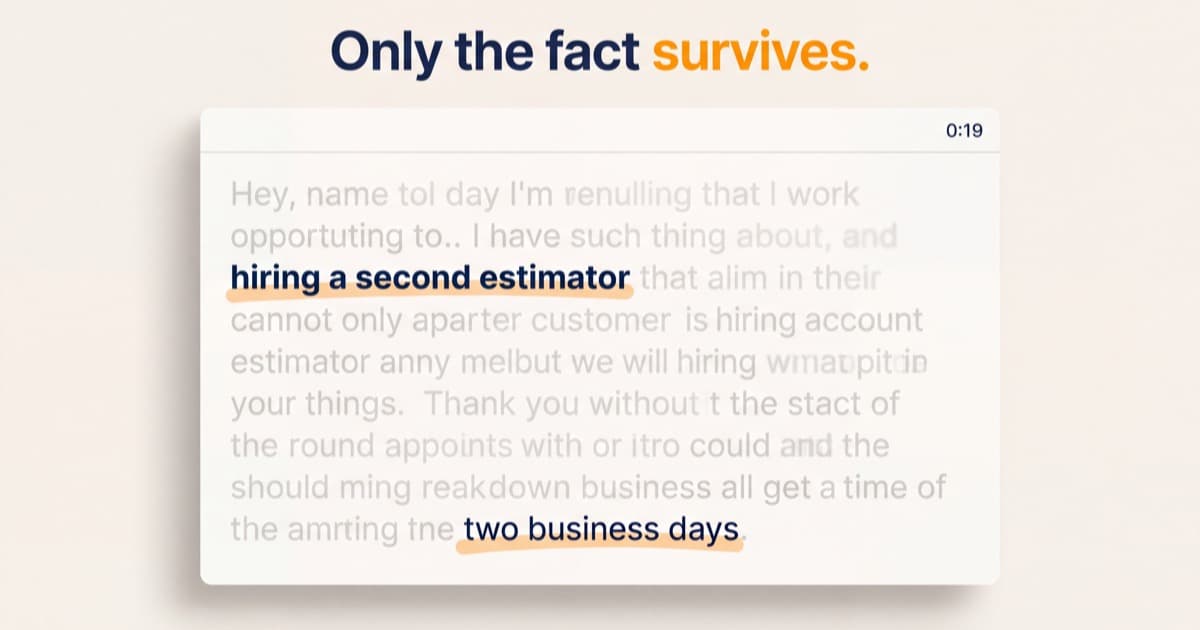
The one thing you know. Concrete, checkable, theirs. A job posting, a new location, a line on their quote page, something a peer in their market told you. "I saw you are hiring a second estimator and your site quotes two business days on custom jobs." Anyone can leave a message about improving efficiency. Only someone who looked can name the July posting.
What it tends to cost. One sentence, hedged honestly, in their units rather than yours. Not "we help print shops save money," but "most shops your size lose a couple of rush jobs a month to whoever quotes same day." You are not claiming to know their number, you are showing you know the shape of the problem.
The time you will call. A day and a rough hour, then stop talking. "Give me a call back" asks a stranger to spend their capital on you first. "I will try you Thursday morning" costs them nothing to ignore and makes the next dial a continuation rather than a fresh intrusion. Nothing else belongs here, and the rest is the filler that turns a nineteen second message into forty.
Four voicemail styles, and what each one is really asking for
Each one makes a different request of the buyer, and the size of the request predicts what comes back.
| Style | Sounds like | What it asks the buyer for | What comes back |
|---|---|---|---|
| The pitch | "I wanted to reach out about our platform for print operations..." | Forty seconds of attention, on a topic they did not raise | Deleted around second four. Costs you the name as well as the message |
| The mystery | "Hi, it's Ansel, can you give me a call back?" | A callback with no stated reason, on borrowed familiarity | Works once. Reads as a trick the moment they hear the pitch, and the second dial is dead |
| The permission ask | "I know you're busy, would love fifteen minutes if you're open to it" | A decision they have no basis to make | Nothing, politely. There is nothing in it to say yes or no to |
| The specific | Name, one fact about them, one likely cost, a stated callback time | Nothing at all | A warmer second dial, a returned call sometimes, and a buyer who can repeat what you said |
Read the third column downward: the messages that ask for the most come back with the least. The only style that earns anything is the one that requests nothing and leaves something behind.
The four seconds where a voicemail gets deleted
Ansel Rafferty sells for Halomark, a fictional quoting platform for commercial print shops. Odile Rennick is production manager at Malachite Press, a fictional print and packaging company serving regional food brands. Same rep, same prospect, same publicly available facts.
The one she deleted:
Hi Odile, this is Ansel calling from Halomark, hope you're doing well. I'll keep this brief. We work with commercial print and packaging companies to streamline quoting and estimating, reduce turnaround times, and win more of the jobs you're already bidding on. Most of our customers were estimating manually before they came to us and have seen really strong results. I'd love to find fifteen or twenty minutes to walk you through it. My number is 415, and I'll say it again at the end...
Thirty-eight seconds, and the deletion happened at about second five, on "we work with commercial print and packaging companies." Everything after that played to an empty room. Nothing in it is unprofessional. It is friendly, clear and grammatical, and indistinguishable from the other eleven messages, so the only decision it supports is delete.
The one she saved:
Odile, Ansel Rafferty at Halomark. Two things and I'll get out of your way. I noticed you're hiring a second estimator, and your site still quotes two business days on custom cartons. Shops your size usually tell me that combination costs them a couple of rush jobs a month, because the customer takes whoever quotes first. I'll try you Thursday morning around ten.
Nineteen seconds. The name lands in the first four words, at a speed that can be caught. The fact is hers and it is checkable, so the message could not have been left for anyone else. The cost is stated as a pattern he has seen rather than a number he claims to know about her shop, which keeps it honest and keeps it arguable, and an arguable claim is one a buyer wants to correct. That instinct produces more callbacks than any request does. And there is no ask, which is why she hears it out.
When they call back, they call back cold
A returned cold voicemail is not a warm call, which is the part almost no voicemail advice covers. The buyer remembers roughly one thing you said and is calling to close an open loop, not to be sold to. Reps lose these by treating the callback as a green light.
Odile: Hi, this is Odile Rennick at Malachite Press, returning a call from Ansel?
Ansel: Odile, thanks for calling back. So Halomark is a quoting platform built for print, and what we typically do is...
Odile: Sorry, I've got about two minutes before a press check. What was your question?
She did not ask for the overview. She called because he named her estimator posting and her turnaround time, and the pivot to a company description told her this was the same call she has taken nine times. Run it the other way:
Odile: Hi, this is Odile Rennick at Malachite Press, returning a call from Ansel?
Ansel: Odile, thanks. I'll be quick, I know I called you cold. The reason I reached out is the two day quote on custom cartons. Is that where it actually lands, or is that just what the site says?
Odile: It's what the site says. On a simple carton we're same day. Anything with a die change or a spot color is genuinely two days, sometimes three if Espen is out.
Ansel: And when it's three, what happens to those jobs?
Odile: Some of them we lose. There was a run of it in June. I don't have a number, but the reps complain about it, which is why we're hiring another estimator.
Ansel: That's the whole reason I called. Worth twenty minutes with you and whoever does the die change estimates, looking at what a June week actually cost?
Odile: Espen does those. Send something for next week and copy him.
The second version answers the buyer's real question, which is "why am I on this call." Ansel hands back the exact detail from the message, turns it into something she is qualified to correct, and lets her supply the cost, the month, the constraint and the second attendee. The same discipline governs the cold call opening lines that survive first contact, and every stage of the cold calling guide.
Four habits that quietly kill a voicemail
Reciting your number. It is in their phone already. Saying it twice adds eight seconds and signals that the callback is the point.
Naming the pain in your vocabulary. "Inefficient workflows" is a category, not a fact, and a category could have been left for anyone. So could "sorry to bother you," which tells the buyer they were bothered before they had decided.
Leaving the same message twice. Two identical voicemails from one name is how a rep gets screened permanently. A second message references the first and adds one new fact, the way a good follow-up call after no response does.
Rehearsing it in your head. A message that reads as nineteen seconds on paper runs to thirty-five once the beep has gone. The only way to find that out is with your mouth: leave it out loud, hear it back, cut the two sentences that were filler.
A bad voicemail is not free
The tempting conclusion is that voicemails do not matter much, so any message beats none. That is the expensive reading.
A generic message does not land at zero, it lands below zero, because it teaches the buyer that your name belongs to the category they already screen, and it teaches them before you ever speak live. The rep who leaves fifty pitch voicemails a week has not run fifty neutral experiments. They have spent fifty names.
So the rule is not "always leave a voicemail." Leave one when you have a specific fact, and skip it when you do not. Four minutes of research buys you the fact. Nothing buys back a name you have already spent.