An elevator pitch is not a short description of your company. That is what almost every one of them is, which is the problem: a compressed About Us page delivered at speed, ending with a polite nod and nothing after it.
Watch what happens at a trade show. Somebody at the coffee station asks what you do. You have a sentence ready, you say it well, and they say "oh, nice." Then they look at their badge lanyard, or at the pastries, and the conversation is over. Nothing went wrong. You were clear, you were brief, you did not stumble. It just did not go anywhere, because nothing you said gave them anything to ask about.
Here is the flip that makes the format work. An elevator pitch for sales reps is a setup, not a summary. Its only job is to earn the next question, and you should score it on the reply it gets rather than on how smoothly it comes out. That means one sentence, roughly thirty words, about twelve seconds spoken, naming one specific person's specific problem and what that problem costs them. Every clause describing you, your company, or your category is competing for that budget and losing.
What is an elevator pitch for a sales rep supposed to do?
It is supposed to make a stranger ask you a question.
That is the whole function. The person in front of you has exactly two available moves once you stop talking. They can say some version of "nice" and exit, or they can ask something. If they ask, you now have a conversation with a real thread in it, and you learn whether they have the problem before you say another word about your product. If they do not ask, you have spent your one turn and you get nothing back, no matter how polished the sentence was.
This reframes what "good" means. Most pitch coaching optimizes for clarity and confidence, which are delivery qualities, measurable in an empty room. Earning a question is a content quality. You can deliver a flawless twelve seconds of category description and get nothing, and you can stumble through a specific, uncomfortable number and get "wait, how do you know that?"
So stop asking whether your pitch is clear. Ask what the most likely next sentence out of their mouth is. If you cannot name it, the pitch is not finished.
The twelve-second budget
Twelve seconds is roughly thirty spoken words. It is not a rule handed down from anywhere; it is the length of one breath of attention a stranger will extend before deciding whether to spend more. Treat it as a budget, because the interesting decision is what you refuse to buy with it.
Here is what a typical pitch spends it on. Who you work for. What category you are in. How many customers you have. What the product does. Some qualifier about how you are different from the others in the category. Five claims, all about you, none of which the listener can verify or care about yet.
Here is what fits instead. One buyer, described concretely enough that the listener knows whether they are that person. One thing that goes wrong for that buyer. What it costs when it does. That is three claims, all about them, and the third one is the hook, because a cost invites arithmetic and arithmetic invites a question.
The hardest part is that you have to cut the sentence you are proudest of. Your company name and category are the parts you have said most often and the parts that feel like the answer to "what do you do." They are also the parts that let a listener file you and move on, which is exactly what filing is for.
Build it backward from the question you want them to ask
Do not start with your company. Start with the sentence you want to hear next, and then write the setup that makes that sentence the obvious thing to say.
Pick your target question first. "How do you know that?" is a good one, because it hands you your proof. "How much is that costing them?" is better, because it means they are already doing the math on their own operation. "Is that a real number or a marketing number?" is the best one, because a skeptic who asks it is engaged, and you get to answer with something specific.
Then work back one step. What single sentence makes that question feel natural to a person who owes you nothing? Almost always it is a claim about a specific group of people that is precise, slightly surprising, and clearly checkable.
| Pitch shape | What it sounds like | What the listener does next |
|---|---|---|
| The company summary | "We are a platform that helps operations teams get better visibility into their equipment." | Says "nice", files you under vendor, and leaves. |
| The feature list | "We do sensor monitoring, alerting, and maintenance scheduling, all in one place." | Picks the one feature they already own and tells you they already own it. |
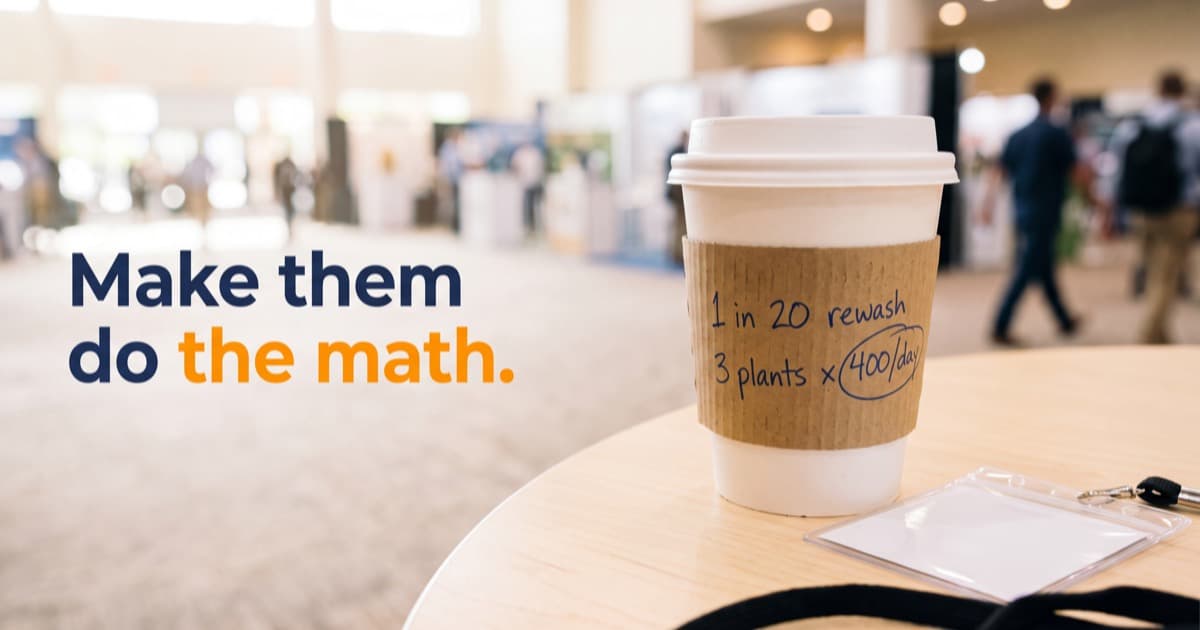
| The named consequence | "Most commercial laundries rewash about one load in twenty because a dryer runs cold and nobody notices until the linen comes back." | Asks how you know that, or starts counting their own loads. |
Only the third shape gives the listener something to push on. Notice that it never says what you sell. That is not a trick or a withhold; it is a sequencing decision. Whether you sell sensors, software, or a service contract is a question they will ask in about four seconds if the first sentence lands, and the answer means far more once they have asked for it.
At the coffee station, second morning of the expo
Bridget sells for Aquilo, which monitors industrial washer and dryer performance. Malik runs operations for Halcombe Linen Services, a commercial laundry with three plants serving hotels and hospitals. They are both standing near the coffee at a textile care expo. Malik asks what Aquilo does.
What most reps say:
Bridget: "We are an equipment intelligence platform for industrial laundry. We put sensors on your washers and dryers, pull the data into one dashboard, and give your maintenance team alerts before something fails. We work with a lot of the bigger linen services."
Malik: "Oh, nice. We have a maintenance system already, I think our service company handles that side."
Bridget: "Sure, a lot of our customers had something in place too. Ours is more predictive, so instead of reacting you get ahead of it."
Malik: "Makes sense. Good luck with the show."
Nothing here is a mistake in the way a script would mark a mistake. The sentences are true, clear, and confidently delivered. But look at what Malik was given: a category, a mechanism, a dashboard, and a name-drop. The only concrete thing he could grab onto was the word maintenance, so he matched it against what he already has and closed the loop himself. The second line then argues with him, which converts a polite exit into a slightly faster one.
What earns a question:
Bridget: "Most commercial laundries rewash about one load in twenty. Usually a dryer is running ten degrees cold and nobody catches it until the linen comes back from the hotel."
Malik: "One in twenty. Where does that number come from?"
Bridget: "Eleven plants we instrumented last year. It ranged from one in thirty to one in twelve, and the worst ones did not know they had a problem, because the rewash gets absorbed into the night shift."
Malik: "That is the part that would get us. Our rewash sits in the same bucket as regular volume, so I could not tell you our number."
Bridget: "That is normal. Do you meter dryer exhaust temperature per machine, or per line?"
Malik: "Per line. Which I am now realizing means very little."
That is a discovery call happening at a coffee station, and Bridget has still not said what Aquilo sells. She did not need to. The number did the work, the follow-up handed over the evidence without overclaiming, and the range made it more credible rather than less, because a single tidy figure sounds like marketing and a spread sounds like measurement.
The move worth stealing is her third line. Malik admitted he does not know his own number, and instead of jumping to the product she asked one operational question that makes his blind spot concrete. A pitch that earns a question and then wastes the reply is only half a pitch, which is the same failure mode the sales pitch guide describes on longer calls, just compressed into thirty seconds.
Four ways a good pitch still lands flat
You answer a different question than the one asked. "What do you do" is a social question about you, and answering it literally is what produces the company summary. Answer the question underneath it: who has a problem, and what happens to them.
You name your category. The moment you say the category, the listener stops listening and starts sorting. They have met four companies in your category this week. Categories are for filing, and filing ends conversations.
You soften the number. "Quite a lot of waste" and "significant rewash" invite nothing, because there is no edge to grab. Numbers with a decimal point or an odd range invite challenge, and challenge is engagement. If you are not certain of the figure, say where it came from and how wide it ranges, which is more credible than a round number anyway.
You keep talking. The sentence lands, there is a two second gap, and the gap feels enormous, so you fill it with a qualifier. That gap is not empty. It is the listener deciding what to ask. Every pitch that works ends with the rep stopping and letting silence do the last part of the job, which is also why the structure of a longer pitch matters less than what survives being cut off.
Which sentence would you cut?
Write your current pitch down and count the words. Then find the clause that describes you, your employer, or your category, and ask what the sentence loses if you delete it. Most of the time the answer is that it loses nothing except your comfort, and gains eight seconds you can spend on a number that makes somebody do arithmetic about their own operation.
So: which sentence is yours, and what would it cost you to say the rest without it?