
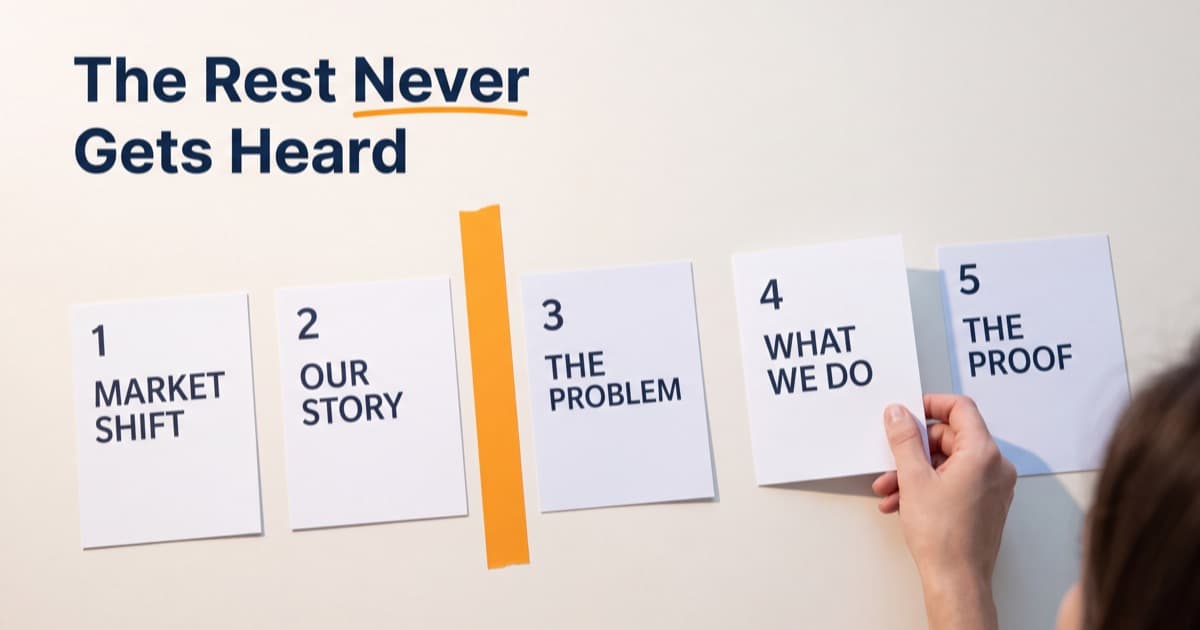
You have a structure. Somebody taught it to you in onboarding, or you reverse engineered it from the deck: set up where the market is going, describe the problem the buyer probably has, agitate it a little, introduce the product, land the customer proof, ask for the next step.
It is a good structure. Read it out loud in an empty room and it lands.
Then you use it on a live call, and somewhere around the second sentence the buyer says "Sorry, what does this actually do?" and the rest of the order is gone. You answer that, they ask about pricing, you answer that too, and the call ends with them saying it sounds interesting and asking you to send something over. The structure never failed. It just never ran.
Why do standard pitch structures fail on live calls?
Problem, agitate, solve. Before, after, bridge. Feature, benefit, so that. Every one of these is a narrative sequence, built so a person who receives the whole thing in order arrives at the intended conclusion. They come from writing, where the reader cannot interrupt, and from stage pitching, where the audience has agreed in advance to sit still for four minutes.
A sales call is neither. The buyer can stop you at any word, and usually does inside the first minute, because interrupting is how a busy person finds out whether the next ten minutes are worth spending.
That rewrites the question. It is not which pitch structure is best. It is which order still leaves the buyer holding something useful if you are cut off after any sentence.
Try it on whatever you say today. Write your pitch as separate lines, cover everything after line one, and ask what the buyer now knows about you. If the answer is market context, company history, or a category name, your payload is sitting at the back of a sequence that frequently does not reach the back.
Most reps fail the test at line one. The opening sentence describes a trend, or a category, or a founding observation. It is the sentence you would keep if the pitch were an essay, and it is the sentence that costs you the most when the interruption comes early.
Put the part they can argue with first
Order the pitch in three slots, in this order, and hold everything else back.
Slot one is the claim. The specific change you make, said in the buyer's operational terms, and specific enough that they could tell you it is wrong. "We help service teams work smarter" cannot be argued with, which is exactly the problem: nothing that cannot be disagreed with can be confirmed either. "Dispatchers stop rebuilding the afternoon by hand when a job overruns" can be wrong, and if it is wrong, you want to know inside fifteen seconds rather than at the end.
Slot two is one proof. The shortest thing that makes the claim plausible: a comparable situation and a number, or the mechanism if the mechanism is the doubt. One. Not the strongest three. The second and third pieces of evidence are not reinforcement, they are the tell that you do not believe the first one.
Slot three is the handoff. A question that gives the turn back and tells you which sentence to expand. "Is that a real problem in your week, or is dispatch already handled?" is a handoff. "Does that make sense?" is not, because the only available answer is yes, and yes tells you nothing.
Everything else you know, the integrations, the security posture, the roadmap, the pricing shape, the two other use cases, is reserve. Reserve is not deleted, it is held, and released only where the buyer pushes. This is the sequencing half of what the sales pitch guide treats as a subtraction problem: the guide is about how little to say, and this is about which little goes first.
The ordering rule underneath all of it is one line. Whatever the buyer can disagree with goes first, because disagreement is engagement and agreement is usually politeness.
The same pitch, in two orders
Kenji Rehnquist sells for Braylark, a fictional scheduling platform for field service teams. The buyer is Dermot Kavanagh, operations director at Northmoor Plumbing and Heating, a fictional home services company running sixty vans. It is a second call. On the first call Dermot mentioned that two dispatchers spend their afternoons on the phone reshuffling jobs whenever a morning call overruns.
The narrative order:
Kenji: Thanks for making time. So, a bit of context on where we sit. Field service has changed a lot in the last few years, mostly because customers now expect the same tracking they get from a delivery app, and most scheduling tools were built before any of that existed.
Dermot: Mm.
Kenji: What we see across the industry is that the scheduling layer ends up being the bottleneck. Van count goes up, and the tooling underneath is still a whiteboard with a database attached, so everything routes through two or three people who know how it fits together.
Dermot: Sorry, so what is it that you actually do? Is it routing software?
Kenji: So it is broader than routing. Braylark is a full field service operations platform, so we cover scheduling, dispatch, technician mobile, parts, and then reporting on top of all of it.
Dermot: Right. And what does something like that run to?
Kenji: It depends on the shape of it, per technician per month with a platform component, and there are a few tiers, so let me pull the right numbers together rather than guess.
Dermot: Sure. Send that over with whatever else you have and I will take a look.
Nothing there is untrue and none of it is aggressive. It simply never arrived. Kenji spent his two best sentences on the category and the industry, which is exactly the material buyers suspect is filler, and Dermot did what buyers do with filler: he cut in and asked the blunt question.
After that the order was no longer Kenji's. He answered with a capability list, which invites the pricing question, which turns a live call into a document request. Notice what he never used: Dermot handed him the dispatcher problem on the previous call, and it appears nowhere in the transcript.
The same material, ordered by interruption:
Kenji: Last time you said two dispatchers lose most of the afternoon rebuilding the schedule by hand when a morning job overruns. That is the thing we take away. When a job runs long, the afternoon reshuffles itself and the customers whose slots moved get told automatically, so nobody has to sit on the phone.
Dermot: In theory. Ours is not a clean reshuffle. Half the jobs need a specific engineer because of the boiler type, and nothing automatic has ever respected that.
Kenji: That is the part that decides it. The reshuffle only moves a job to someone who holds the qualification the job needs, and if there is no one, it does not silently reassign, it flags the job for a person to decide. A sixty van heating firm we work with runs Gas Safe and unvented as hard constraints for that reason.
Dermot: How much of the afternoon does that genuinely give back? Because we have bought this promise before.
Kenji: Their dispatchers went from roughly three hours a day of reshuffling to under one, and the hour that is left is the exception queue, which is the part that actually needs a human. I would not promise you the same number, because it depends how many of your jobs carry a hard constraint. Do you know roughly what share of yours do?
Dermot: Maybe half. Perhaps more in winter.
Kenji: Then the honest version is that half your afternoon reshuffling stays manual on day one and the other half stops. If that is worth a conversation, the next useful thing is twenty minutes with one of your dispatchers, because they will find the edge cases faster than either of us.
Dermot: Fiona would take that apart in about five minutes.
Kenji: That is what I want. Thursday or Friday?
Same product, same evidence, same rep, less airtime than the first version, and it ends with a person and a day.
The claim went first, so the interruption landed on the claim rather than on the concept of the company. Dermot's pushback about boiler qualifications is not an obstacle, it is the pitch telling Kenji which piece of reserve to release, and he releases exactly one. The proof arrives second and it is one comparable, not a logo parade. When Dermot asks for a number, Kenji gives it and then declines to promise it, which is what buys the next sentence its credibility.
The handoff question is not rhetorical either. It changes the claim: "half of it stops" is a smaller promise than the one he opened with, and it is the one Dermot can repeat to somebody else without being embarrassed later.
Where the order breaks
The claim is unfalsifiable. If nobody could reasonably say "that is not true here," you have written a tagline. Test it by trying to argue against your own line. If you cannot, it is too abstract to be worth the first slot.
You do not have their terms yet. Slot one only works when you can say the change in the buyer's own vocabulary, and that vocabulary comes from discovery. On a first call with none behind you, the pitch is shorter still and the opening is a permission line, not a claim. That opening is its own problem, covered in how to open a discovery call.
The proof does not match the claim. A named customer answers "does anyone use this," which is not usually the doubt. When the buyer's doubt is mechanical, as Dermot's was, the mechanism is the proof and the customer name is decoration on top of it.
The reserve empties on the first push. One question does not authorize the full deck. Release the piece that answers what was asked and stop, or you are back in the version where the buyer gets the capability list.
You order it correctly and still say it too slowly. Structure is a decision you make before the call. Delivery is a habit built somewhere the deal is not real, which means saying the claim out loud, being interrupted on it, and finding out which sentence you reach for when someone pushes back on the number.
The check after your next pitch is a single question: where did they cut in? That word is where your order was wrong. Everything you said before it was setup they did not want, and everything after it was reserve you never got to spend.