
You have given this pitch a hundred times and it is good. It covers the problem, the product, the two differentiators your competitors cannot claim, and a customer story with a number in it. It takes about ninety seconds and it comes out clean now, even on a bad morning.
The buyer listens to the whole thing. Then they say "interesting, that makes sense" and ask what the pricing looks like, or ask you to send something over. You send it. Nothing happens.
Nothing about that pitch was wrong. That is the confusing part, and it is why pitch coaching so often goes in circles: managers listen to the recording, cannot find a bad sentence, and conclude the rep needs more conviction or a tighter story. So the pitch gets rewritten, gets one more proof point, gets ten seconds longer, and the same thing happens again.
The problem is not the content. It is that a pitch is not a delivery of information, and it never was. It is a bid for the next thing the buyer says. Everything you say is spent buying one specific outcome: a question, from them, about the part that matters to them. Judged that way, most pitches are overpriced. They spend ninety seconds of a buyer's attention and come back with a pleasantry.
This guide is built around that single measure, and it points in an uncomfortable direction. Nearly every fix in it is a subtraction.
How do you know if a sales pitch worked?
Play back the last five pitches you gave and ignore how you sounded. Write down the first sentence out of the buyer's mouth afterwards. There are only about four things it can be.
A question about how it works. "So does that pull from our scheduling system or do people enter it twice?" This is the outcome you paid for. They have accepted that the change would matter and moved to whether it is real. Everything after this point is a conversation between two people solving the same problem.
A comparison. "How is that different from what we get out of the reporting module?" Also good, and better than it feels. A comparison means they placed you against something specific in their world, which is the last step before they can evaluate you at all. Reps hear it as an objection and get defensive, which wastes it.
A logistics question. "What does something like this cost?" This is neutral. It usually means they have understood the shape of it and skipped straight to the only variable they know how to judge. It is not interest and it is not disinterest.
A pleasantry. "Interesting. Makes sense. Send me some information and I will take a look." This is the failure case, and it is the most common one by a wide margin. It means nothing you said produced a question, so the buyer reached for the socially correct way to end a monologue.
| What the buyer says next | What it means | Where to spend the next thirty seconds |
|---|---|---|
| A question about how it works | They accepted the change; now they want proof it is real | Expand the mechanism only |
| A comparison to something they own | They placed you against their world | Expand the proof, toward similarity |
| A price or logistics question | Neutral; they skipped to the variable they can judge | Ask what the number is measured against |
| A pleasantry | Nothing landed hard enough to ask about | Stop; find the pain you aimed at wrongly |
Now the part that reorders how you pitch. Length actively works against the outcome you want, for three reasons that have nothing to do with attention spans.
A buyer cannot form a question while you are still talking. Composing a question takes working memory, and you are occupying it. Every additional sentence you add is a sentence during which they are not building the thing you need them to say.
Long pitches force a choice, and buyers choose the easy branch. Give someone six claims and they will not respond to the most important one. They will respond to the one that is simplest to react to, which is almost always price, timing, or a feature they already have. You handed them six doors and they took the one nearest the exit.
And volume reads as uncertainty. Buyers have sat through enough of these to know that the reps who are sure of one thing say one thing. The rep who says nine things is understood, correctly, to be hoping that one of them lands.
Three sentences, then stop
Here is the whole structure. It is short enough to be uncomfortable the first few times, and the discomfort is the point.
Sentence one: the change, in their units. Not what your product is. What is different for someone in their seat afterwards, measured in the things they already count. Hours, headcount, error rates, days to close, the number their boss asks about.
Weak: "We are a workforce intelligence platform that helps operations teams optimize scheduling." Strong: "Plants your size usually stop rebuilding the shift roster by hand, which is around a day a week for whoever owns it."
Notice the second one is not about the product at all. It is about their Tuesday.
Sentence two: the mechanism, in one clause. How the change actually happens. This is the sentence most reps skip, and skipping it is why good outcome claims bounce off. People do not believe results whose cause they cannot picture. One clause is enough, and one clause is the limit.
Weak: "We use AI and machine learning to optimize your labor allocation." Strong: "It reads your existing shift data and last week's actuals, and drafts next week's roster for the supervisor to approve or change."
An AI reference explains nothing to a buyer in 2026. "It drafts, a human approves" explains it and tells them what their team's job becomes.
Sentence three: the proof, small and checkable. One piece of evidence a skeptic could go and verify. Specific beats impressive. A single named-role anecdote beats a percentage, and a percentage beats a range, and a range is worth close to nothing because the listener silently takes the bottom of it and then discounts that.
Weak: "Customers see forty to sixty percent efficiency gains." Strong: "The last plant we did this with had two supervisors doing it Sunday nights. Now one of them spends about twenty minutes on Monday morning."
Then stop, and ask one question that hands the floor over. "Is the roster a Sunday night job for you too, or has someone found a way around it?"
That is roughly twenty five seconds. The rest of what you know about your product is not deleted, it is held in reserve, and the buyer decides which piece of it they need.
What comes out in the subtraction: the category description ("we are the leading platform for"), the founding story, the funding, the logo slide, the integrations list, the roadmap, and every differentiator aimed at a competitor the buyer has not mentioned. None of that is false. All of it is spending attention on a question nobody asked.
Let the buyer pick which sentence you expand
Once you stop, the buyer's response tells you exactly where to spend the next thirty seconds, and it is almost never where you would have guessed.
If they question the mechanism, they have accepted the change is worth having and moved to whether it can work here. Expand only the mechanism. Get concrete about their systems, their data, the handoff, who touches it. Do not restate the value, they already granted it, and restating it sounds like you did not hear them.
If they question the proof, they believe it works and doubt it works for them. "That is a bigger operation than ours." Expand only the proof, and specifically toward similarity: the closest comparable case in their size, shape, or industry. If you do not have one, say so and offer to find out. Manufactured proof dies later and takes the relationship with it.
If they question the change, they do not think this is a problem worth solving, and that is the most important thing you can learn on the call. Do not sell harder. Ask what does hurt. The pitch was aimed at the wrong pain and no amount of expansion fixes a wrong target.
If they go straight to price, resist quoting into a vacuum. What is missing is what they are measuring your number against, and it is usually something you would never guess. Ask before you answer. The full mechanics of that moment are in answering "your price is too high".
And if they say nothing at all, say nothing back. The silence after a short pitch is doing your work for you. Filling it is how a rep converts three good sentences into ninety seconds of average ones.
You can only pitch with what they gave you
This is why "what is your pitch" is a slightly wrong question. There is no single pitch, because two of the three sentences are assembled at the moment of delivery out of things the buyer told you.
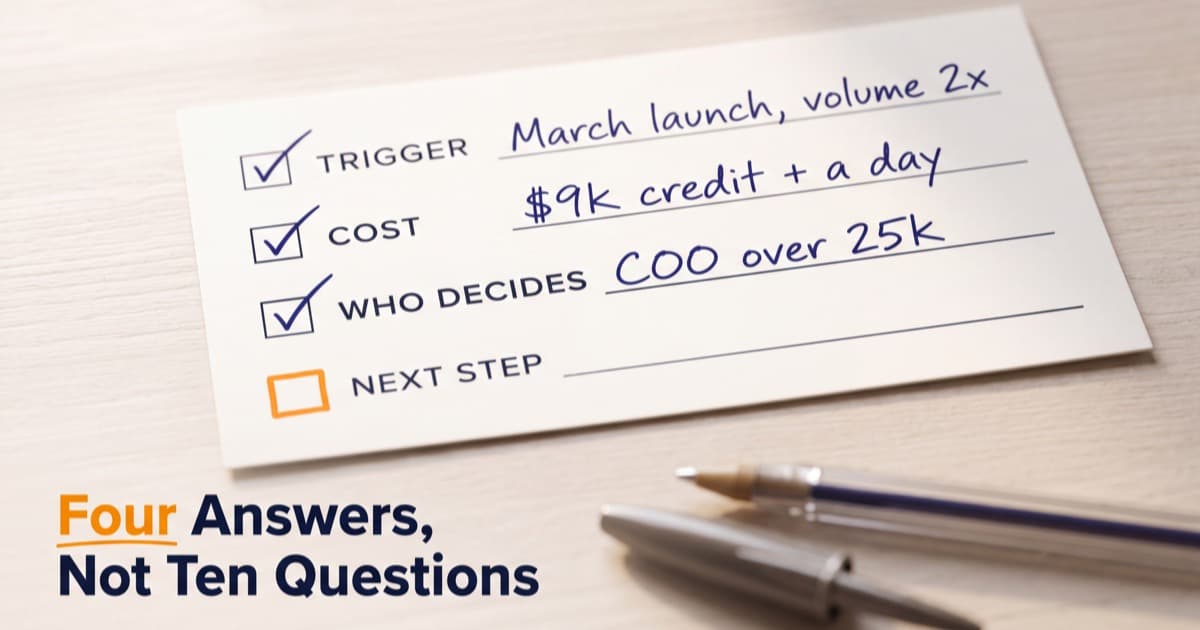
The change sentence needs their unit of pain. The proof sentence needs to resemble their situation. Both come from discovery, which is the actual reason a discovery call matters and the reason a rep who skipped it has no option except a generic pitch. If discovery produced a trigger, a cost in their own numbers, and the names of the people who have to agree, the pitch nearly writes itself. If it did not, you are guessing in front of the buyer. The four answers a discovery call has to produce are in the discovery call guide.
The cold call is the honest exception. There, you have nothing, so the correct pitch is not three sentences, it is one: a single change statement aimed at the role, offered as a hypothesis and immediately checked. "Most ops leads I talk to are still rebuilding the roster by hand on Sundays. Is that you, or have you already fixed it?" The rest of the pitch is not withheld for strategy, it is withheld because it has not been earned with a single fact about them yet. That mechanic, and the four other places cold calls die, is covered in the cold calling guide.
The same three sentences will not work on the whole room
A deal with more than one person in it does not need one pitch, it needs one change sentence and several mechanisms and proofs.
The change stays fixed. That is the point of a deal. Everyone in the room is buying the same outcome or you have a bigger problem than pitching.
The mechanism and the proof rotate by seat. A finance lead wants the arithmetic and the risk of it not working, and their proof is a number with a source, worked through in selling to a CFO. A technical evaluator wants the failure mode, not the happy path, and their proof is how it behaved when something went wrong, covered in what the technical evaluator is actually testing. The end user wants to know what their Tuesday looks like afterwards, and their proof is a person in their job who is now doing less.
Give the finance lead the end-user pitch and you sound naive. Give the end user the finance pitch and you have just told them this project exists to reduce their team, which is how a quiet internal opponent gets created in the one meeting you were not worried about.
Where Tarek's answer changes the whole call
Fictional but ordinary. Teodora sells shift planning software at Tallowbridge. Tarek Ferreira is VP of operations at Crestmill Foods, a regional food manufacturer with four plants. It is a second call. Discovery told him that a supervisor at each plant rebuilds the roster by hand every Sunday, that overtime ran eleven percent over plan last quarter, and that Tarek's CFO has to sign anything over fifty thousand.
The version that gets a pleasantry:
Tarek: So walk me through what you do.
Teodora: Happy to. So Tallowbridge is a workforce intelligence platform built specifically for manufacturing environments. What we do is bring together your scheduling, your time and attendance and your actuals into a single system, and then we apply machine learning to model demand so you are staffing to what is actually coming rather than to last month's guess. There are really three pillars. There is the planning side, which is the automated roster generation, there is the compliance side, so break rules, rest periods, union agreements all get enforced automatically, and then there is the analytics layer where your ops leads get visibility into overtime, absence patterns, all of that. Customers typically see anywhere from a thirty to fifty percent reduction in scheduling admin time and meaningful overtime savings on top. We are also SOC 2 compliant and we integrate with most of the major ERPs, so implementation is usually pretty painless. Companies like yours in food and beverage are a real sweet spot for us.
Tarek: Okay. Yeah, that makes sense. It sounds comprehensive.
Teodora: It really is. Is there a particular piece you would want to go deeper on?
Tarek: I think I have the picture. Can you send me something I can share internally, and maybe some pricing?
Teodora: Absolutely, I will get that over today.
Nothing in that is untrue and none of it survives the afternoon.
Look at what he actually spent. He opened with a category ("workforce intelligence platform"), which is language that exists for investors and competitors, not for the person who has to run four plants. He offered three pillars, which is three doors, so Tarek took none of them. The proof was a range with two variables in it, and a range invites arithmetic the buyer does the wrong way. He answered a question nobody asked when he mentioned SOC 2 and ERPs, which quietly signalled that he does not yet know what she cares about. And he had the actual gold from discovery, one supervisor per plant losing every Sunday night, and never said it, because the corporate version felt safer than the specific one.
Then the tell: "it sounds comprehensive." Comprehensive is what buyers say when nothing landed hard enough to ask about. And "send me something I can share internally" is not progress. It is Tarek deciding to explain this herself, later, from a memory that currently contains the words platform, pillars and machine learning.
The version that gets a question:
Tarek: So walk me through what you do.
Teodora: Shortest version. Plants your size usually stop rebuilding the roster by hand on Sundays, which from what you told me is one supervisor per site, every week. (pause) The way it happens is that it reads your existing shift data and last week's actuals and drafts next week's roster, and the supervisor approves it or changes it Monday morning. The last food manufacturer we did this with had two people on it Sunday nights. Now one of them spends about twenty minutes on it Monday. Is Sunday night the shape of it at all four of your plants, or is one of them worse?
Tarek: Bakersfield is worse. They run three shifts, so it is not just Sunday, it is anytime someone calls out. How would it handle a callout at five in the morning?
Teodora: So it drafts a replacement list ranked by who is qualified, who is under their hours and who is not in a rest window, and your supervisor picks. It does not call anyone or auto assign. Would that be the supervisor's decision at Bakersfield, or does that go through a scheduler?
Tarek: Supervisor. Which is the problem, they are on the floor.
Teodora: Then that is the one I would want to test first, because it is the case where a bad decision costs you overtime rather than admin time. On the eleven percent you mentioned last quarter, do you know roughly how much of that came from callout coverage versus planned?
Tarek: Not precisely. I would guess more than half.
Teodora: That is worth pinning down before you take anything to your CFO, because that split is the number she will ask about. If your team can pull the last two quarters, I will put the callout case side by side with what it looks like on our side, and we go through it together. Does an hour next week work, and should the Bakersfield supervisor be on it?
Tarek: Yes, and yes. He should absolutely be on it.
Trace what changed, because it is not charisma and it is not product knowledge. Teodora said less and knows more.
The change sentence used her fact, not his. "One supervisor per site, every week" was hers from the first call, said back to her, and a buyer cannot dismiss their own number. The mechanism was one clause and it contained a human being approving something, which is what quietly answered a fear she never had to voice. The proof was one company and one person's Monday, not a range, and the smallness of it is what made it credible.
Then he stopped, and the stopping is what earned the whole rest of the call. Tarek's response did two things no pitch could have done: it named the plant that hurts most and it exposed the real problem, which is not Sunday planning at all, it is five in the morning callouts. He had no slide for that and did not need one.
Watch how he expanded. She asked about the mechanism, so he expanded only the mechanism, and then handed the floor straight back with a question about who decides. He never re-pitched the value, never mentioned compliance or integrations, never used the word platform.
And he closed on the person he is not in the room with. The CFO will ask what share of the eleven percent was callout driven, so he sent Tarek to get that number before she is standing in front of her, and put himself in the meeting where it gets interpreted. What that hands off to a buyer to defend on your behalf is the subject of the objection handling guide.
One last count. In the weak version Teodora speaks about eighty percent of the words. In the strong one it is close to even, and every fact the deal now rests on came out of Tarek.
The failure modes nobody flags in a call review
These survive coaching because none of them sound wrong on a recording.
Pitching before you have anything to pitch with. If you cannot fill the change sentence with something they said, you are about to deliver the generic version. Ask one more question instead.
Pitching the category. "We are an AI powered platform for X" tells a buyer only which drawer to file you in, and the drawer is full.
Ranges and superlatives. "Thirty to fifty percent" gets heard as thirty, then halved for sales exaggeration, then rounded down again for their situation being harder than average. One specific number, or one specific person, beats it every time.
Treating a pleasantry as interest. "Makes sense" is punctuation, not agreement. Reps log those calls as strong and are surprised a month later.
Re-pitching after an objection. When a buyer pushes back and the rep responds with a compressed version of the same pitch, louder, the buyer learns that pushing back produces more talking. It is the fastest way to end a call politely.
Reading it off the deck. A slide read aloud is a pitch that cannot adapt, because you are now following a fixed order rather than the buyer. Share the screen after the three sentences, never before.
Practicing it silently. This is the one that quietly undoes everything above. The whole method lives in the pause after sentence three, and a pause is a physical skill. In your head, it costs nothing. Out loud, with another person breathing on the line, three seconds of silence feels like fifteen and almost every untrained rep fills it.
Getting it out of the deck and into your mouth
Two drills, and neither of them is about wording.
The stop drill. Say your three sentences, ask your question, and then say nothing until the other side speaks first. Time it. Most reps discover they cannot hold two seconds, and the fix is not confidence, it is repetition until silence stops feeling like failure.
The branch drill. Have the other side pick one of the three sentences to attack, without telling you which, and expand only that one. The skill you are building is hearing which sentence a question is really aimed at, because buyers rarely ask cleanly. "Is this going to be another system for my supervisors to learn" is a mechanism question wearing worry, and answering it with proof is a miss.
Both need a counterpart, and both need to happen out loud, at conversational speed, which is exactly the practice that is hardest to arrange. Colleagues fold too easily and they let you finish.
ConvoSparr is built for this part. You talk out loud to an AI counterpart in real time, and it behaves the way a real buyer does: it interrupts, it goes quiet when you stop, it asks the follow up you did not want, and it does not accept a claim just because you said it confidently. Afterwards you get a scored breakdown of the call, so you can see where the pitch got long, which question you answered instead of the one they asked, and where the conversation actually turned. You can run the same opening ten times against a counterpart that keeps pushing, which is the one thing a colleague and a mirror cannot give you.
The session structure for that, including how to rehearse a single moment instead of a whole call, is in sales pitch practice. If your pitches keep landing on the wrong pain, the fix is upstream in the discovery call guide. And if they land well and then die in the pushback afterwards, that is a different skill entirely, in the objection handling guide.
Which of the three sentences goes first, once you accept that you will be interrupted, is how to structure a sales pitch. And the same three sentences do not work on every seat in the room, which is pitching to executives vs end users.
Your pitch is probably not too weak. It is too long, and somewhere in the fourth sentence is the question the buyer was about to ask.