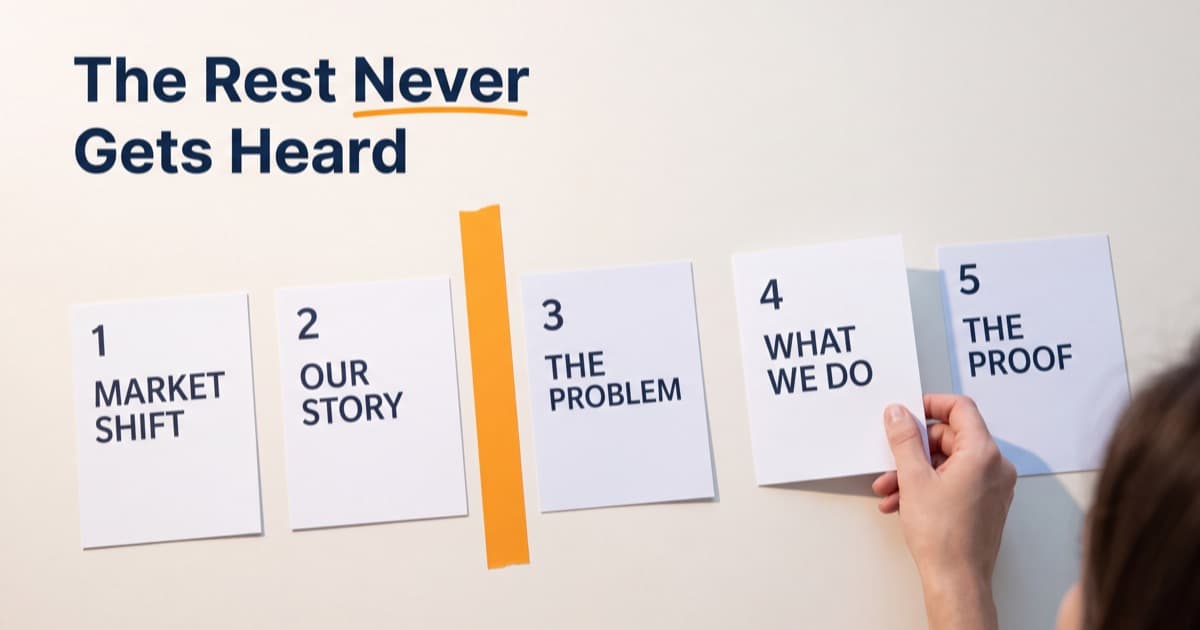
The call with the end user went beautifully. She finished your sentences, told you what her Thursdays look like unprompted, and when you showed her the part that removes the worst hour of them she said "oh, that would be lovely." You left with a champion.
Three weeks later you are in a room with her boss's boss, running the pitch that produced all of that, and the temperature is different. The executive is polite and quick. Around minute four they say "so this is a productivity play for the AP team," you say yes, and that turns out to have been the moment the deal became a nice-to-have.
Nothing went wrong in the second meeting that you could point at. You ran a pitch built for someone who does the work at someone accountable for the result of the work, and those are two different purchases.
What does an executive buy that an end user does not?
The end user is buying relief from a recurring task. The unit is their week. They can verify your claim from memory, because they have lived the task hundreds of times, so what convinces them is watching the thing happen: the screen, the flow, the moment the twenty minutes disappear. Their risk is not money, it is being made to adopt something worse than what they have now.
The executive is buying the removal of a consequence they are accountable for. The unit is a number they get asked about: a cycle time, an error rate, a close date, a headcount plan, a customer that churned. They cannot verify your claim from memory, so what convinces them is a comparable and a mechanism they can repeat. Their risk is spending budget and political capital on something that does not move the number they said it would move.
Same product. Same integration list. Completely different sentence at the front.
The second thing matters more than the first. Most of your executive pitch is delivered when you are not in the room. The end user tells their director, the director mentions it in a staff meeting, someone asks what it costs. By the time you get the executive meeting, a version of your pitch has been repeated three times by people who are not salespeople and were not trying to sell anything.
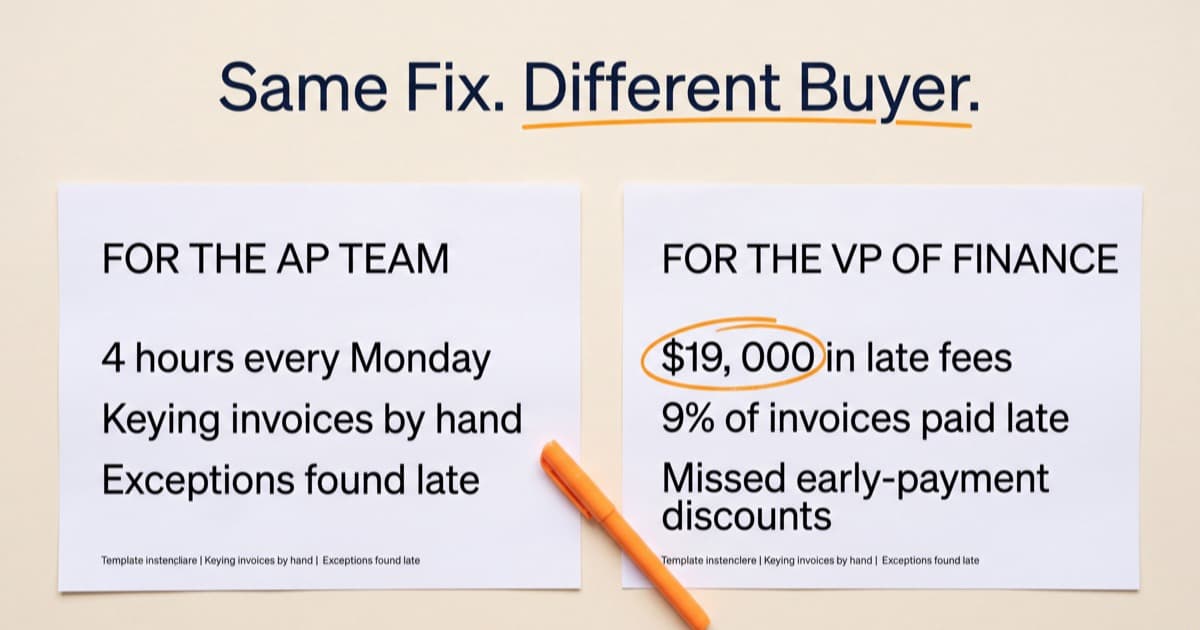
So the real test of an end-user pitch is not "did she like it." It is whether she can repeat it in two sentences to someone senior without it sounding like a preference. "It saves me a lot of time" does not survive that trip. "It takes the four hours a week we spend keying invoices down to about one, and exceptions get flagged instead of found later" does.
Five things change when the room changes
Keep the same truth. Change these five.
The unit. End user: hours, clicks, the specific task. Executive: the number that task rolls up into. Four hours a week per person across five people is not "time saved," it is half a role sitting inside a function that just asked for another head.
The time horizon. The end user cares about the first week, because that is when the change costs them. The executive cares about the quarter, because that is the window they are judged in.
The proof. For the end user, the mechanism is the proof: show it working. For the executive, a demo is decoration. What they need is a comparable of similar shape with a before and an after, plus one honest sentence about what it did not fix.
The ask. The end user's yes is "I would use that." The executive's yes is a decision: a date, a scope, and the name of whoever else has to agree. Leave without knowing what has to be true for this to get funded and you have collected enthusiasm, not a step.
What you leave behind. Detail is fine for the end user. Whatever you leave with an executive has to be short enough to forward with one line of their own on top, because that is what happens to it.
| End user | Executive | |
|---|---|---|
| Unit | Hours, clicks, the task itself | The number that task rolls up into |
| Horizon | The first week, when the change costs them | The quarter they are judged in |
| Proof | The mechanism, shown working | A comparable of similar shape, with a failure named |
| The yes | "I would use that" | A date, a scope, and who else must agree |
| What you leave | Detail | One page they can forward with a line on top |
Everything else, the ordering rule and the discipline about how little to say, works the same in both rooms. That part is covered in the sales pitch guide, and the sequencing detail in how to structure a sales pitch.
Where the executive version diverges
Andrei Solomon sells for Fenwilde, a fictional accounts payable automation tool. The customer is Kestrelane Distribution, a fictional building supplies distributor of about four hundred staff. His champion is Beatriz Nadkarni, who leads a three-person AP team. The executive is Ruth Delacroix, VP of Finance, with thirty minutes and a budget cycle closing in six weeks.
With Beatriz, the pitch that works:
Andrei: You said the worst part of the week is Monday, when the weekend's supplier invoices land as PDFs and someone keys them in.
Beatriz: All morning. And half of them come in with the PO number in the wrong field, so we are looking things up in the ERP one at a time.
Andrei: So the invoice comes in, we read it, we match it to the PO ourselves, and anything we cannot match with confidence goes into an exceptions queue with the reason attached. You are not hunting for the mismatch, it is already named.
Beatriz: Does it handle the ones where a supplier splits a delivery across two invoices?
Andrei: Those flag as a partial match rather than guessing. Your team still decides, but you see three of them instead of ninety.
Beatriz: That is most of my Monday.
Correct pitch, correct room. The unit is her Monday, the proof is the mechanism, the ask is a demo. Nothing here should change.
With Ruth, the same pitch, run again:
Andrei: Thanks for the time. So Fenwilde automates the AP workflow. We ingest invoices in any format, match them against purchase orders automatically, and anything that does not match cleanly goes into an exceptions queue rather than getting missed. Beatriz's team has been through it and the feedback was really positive.
Ruth: Right. So it makes the AP team faster.
Andrei: Considerably faster, yes. Most of the manual keying goes away, and the matching is where the time really goes.
Ruth: Look, I am sure it is good. We are in the budget round now and I have three of these on my desk. Send me a one-pager and pricing and I will keep it in the mix.
Nothing false, nothing rude, and the deal just became one of three. Andrei described a workflow to somebody who does not run it, and "positive feedback from the team" reads to a VP of Finance as a preference. Preferences lose budget rounds to obligations.
With Ruth, pitched to what she owns:
Andrei: Beatriz's team is keying about eleven hundred invoices a month by hand. The reason I asked for this meeting rather than sending the one-pager is that the number that matters is not the keying. It is that you paid roughly nineteen thousand in late fees and lost early-payment discounts last year, and both of those come out of the same place: invoices that sit in someone's inbox because nobody knows they are stuck.
Ruth: Where did nineteen come from?
Andrei: Beatriz pulled it from your own supplier statements, so treat it as her number rather than mine. If it is wrong it is probably wrong low, because it does not count the ones you paid on time by chasing.
Ruth: Assume it is roughly right. What does the tool actually change about it?
Andrei: Every invoice has an owner and a clock from the day it arrives, and anything that stops moving surfaces before the due date rather than after. A distributor about your size went from about nine percent of invoices paid late to under two, over one quarter. What it did not do was reduce their AP headcount, and I would not promise you that either. The team stopped keying and started handling exceptions and supplier queries.
Ruth: That is the honest answer, at least. My concern is the ERP. The last thing finance rolled out took two quarters and a consultant.
Andrei: Fair. Their connector was live in nine days and the longest part was your approval rules, which is a conversation with you rather than with IT. If it helps, the next step I would want is thirty minutes with whoever owns the ERP integration, before you commit anything, so that risk is priced before the budget conversation rather than after.
Ruth: That is Callum. Get it in this week and I will know whether this goes in the round or waits a cycle.
Same product, same three weeks of work behind it, different purchase. The claim is a consequence Ruth is accountable for, not a task Beatriz performs. The number comes from Kestrelane's own data and is attributed to Beatriz, which is what makes it survivable when Ruth repeats it upward. The comparable carries a failure attached to it, and the ask is a date and a name rather than a document.
Where this goes wrong even when you know it
Treating seniority as a volume knob. The executive version is not the end-user version with strategy words on top. "Transform your finance function" is less specific than "eleven hundred invoices a month," and specificity is the thing that survives the retelling.
Assuming executives want less detail. They want less process. They will go deep on the number, the comparable and the risk. What they will not sit through is a walkthrough of a screen they will never open.
Letting your champion carry a pitch they cannot repeat. If Beatriz's summary upward is "the team really liked it," you have handed her the version that loses. Give her the two sentences you would use and ask her to say them back. If they do not fit in her mouth, they are the wrong two sentences.
Winning the executive and skipping the end user. A top-down yes with no user behind it buys a pilot that quietly does not get used, and a renewal you lose without ever hearing why. Both pitches have to land. They just do not have to be the same pitch.
Pricing everything in hours saved. Hours convert to money only if the organization removes the hours, and most do not. Where headcount is not coming out, say what the time gets redirected to and price the thing that is genuinely bleeding, usually error, delay or risk.
The tell that you are in the wrong version is when a senior person says a friendly sentence that turns your deal into a category: a productivity play, an efficiency thing, one of three. That sentence is the summary they will repeat later. If you do not like it, the fix is not more enthusiasm in the next meeting. It is a different first sentence.