
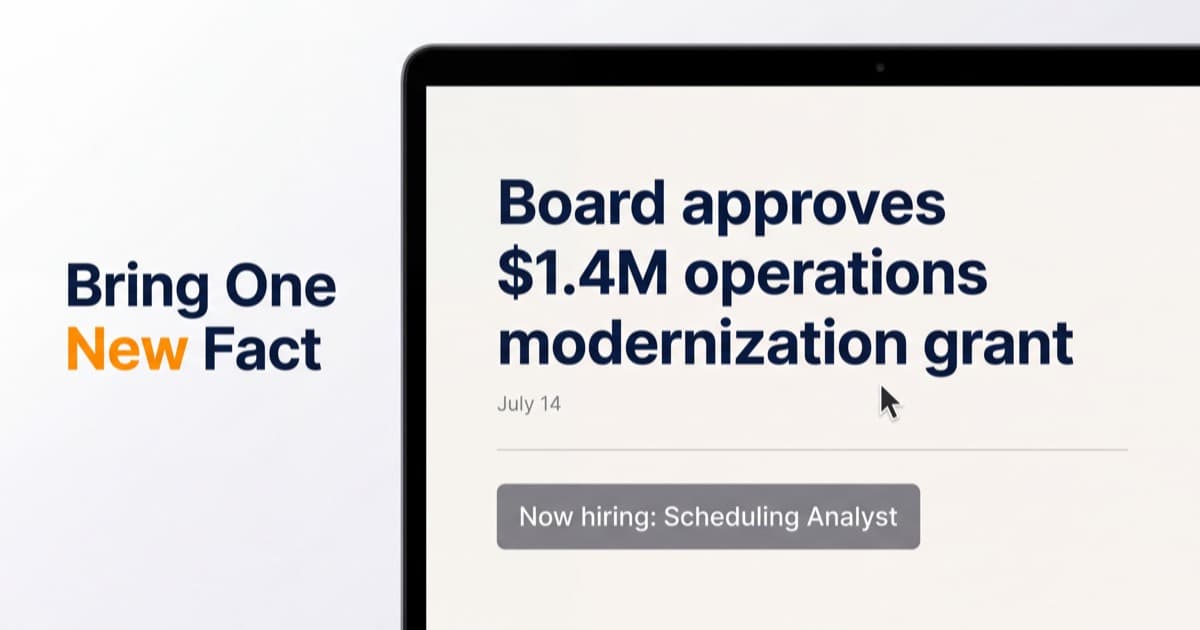
Open your pipeline, filter to every opportunity where the newest message in the thread was sent by you, and read the ones over sixty days old.
Count them. In most rep-managed pipelines the number lands between a fifth and a third of open deals, and they share a shape: a strong call, a proposal, two or three cheerful follow-ups, then nothing. Still forecast, still touched monthly, almost none will close.
Here is what changes your next move. A deal quiet for ninety days is not the deal you were working in June. Budgets got reallocated, headcount moved, a competitor got a meeting, your champion took a different job or a different priority. So the answer to how to re-engage a gone-dark prospect is not a better reminder. Arrive with one fact they do not have yet, ask nothing that requires them to explain the silence, and treat the call as requalification of an account you no longer understand.
What does it mean when a prospect goes dark?
It means the deal stopped being the most important thing on their desk, and nobody on their side has a reason to tell you. Silence is cheap for a buyer and expensive for you, which is why it happens so easily and lasts so long.
Four things change while you wait, and each needs different handling.
The priority moved, and the person did not. Your contact still believes in the project. It sits behind a migration, a peak season, an audit, a reorg. This one expires on its own, usually on a date they would give you if you asked for a date instead of a meeting.
The money moved. A budget line got pulled into something louder. The project is not dead, it is unfunded, and unfunded projects come back at a fiscal boundary, not when you call.
The person moved. Over six to twelve months a meaningful share of champions change roles, teams or employers, so a thread that stays silent is often a thread nobody reads. The most under-checked cause, and thirty seconds on a company page rules it out.
Someone said no on your behalf. Your champion took it to a finance or ops lead who raised something they could not answer. Nobody writes "I lost this argument internally", so they write nothing.
Only the last is close to a loss, and even it is usually one unanswered sentence. What all four share is that your last email cannot reach them: your email is about your deal, and every one of these is about their year.
Bring one new fact, not a reminder
The rule is mechanical: a re-entry attempt must contain something the buyer did not know before they opened it. Not your value restated, not a fresh case study bolted to the old pitch. A fact from their world, true today and untrue when you last spoke.
Three places to find one, best first.
Something that changed at their company. A funding award, an acquisition, a new executive, a site opening, a regulatory deadline, a job posting for the role that would own your product. A posting for a scheduling coordinator tells you more about a stalled scheduling deal than a month of guessing.
Something that changed at yours, but only if it removes their blocker. "We shipped an integration" is not a fact about them. "We shipped the thing your ops lead said was missing" is, and only if you know what he said.
Something a peer did, with the number attached: a transit agency their size cutting overtime approvals from eleven hours a week to two.
Then ask for the smallest possible thing. Not a meeting, not a review of the proposal. One piece of current information: is this live, and when does it come back. A gone-dark buyer will not book thirty minutes for a deal they have not thought about since spring, but they will answer a question that costs six words.
And say the exit out loud. Offering to close the file is what makes the message safe to answer: a door held open, not a door slammed for effect. The follow-up call after no response is the short-horizon version of the same move.
Five ways back in, ranked by what they cost the buyer
Every re-entry asks the buyer to spend attention, effort or awkwardness. The best ones ask least.
| Re-entry move | What it asks of the buyer | What it returns |
|---|---|---|
| "Just checking in" on the old thread | Explain and apologize for the silence | Nothing, plus one more reason not to reply |
| Resending the proposal or deck | Re-read a document they chose not to act on | Nothing. The document was never the obstacle |
| An emailed breakup note | Respond to a small ultimatum | A flattering reply rate and many false positives |
| A new outside fact plus a one-question ask | Read two sentences, answer one thing | Current information, sometimes a correction |
| A call opening with your guess and the exit | Confirm or correct, in a few words | The real reason, and a decision on the deal |
The bottom two are one play in two channels, and the call wins: a correction spoken out loud carries the detail behind it, while a written one arrives stripped to five words.
A ninety-day gap, reopened on a call
Sonia sells crew scheduling software at Ombra, a fictional vendor. In May she ran discovery with Rohan Bexley, director of operations at Tarnbrook Regional Transit, a fictional bus agency: drivers picking shifts on paper, overtime approved by text, a spreadsheet rebuilt on every schedule change. He asked for a proposal. It went out June fifth. Since then, four emails and no replies.
Four minutes on the agency's website turns up two facts. Tarnbrook's August board packet lists a state grant for "operations modernization" awarded in July, and the agency is hiring a scheduling analyst.
The nudge
Sonia: Hi Rohan, it's Sonia from Ombra. I know it's been a while. I wanted to see whether you'd had a chance to look at the proposal.
Rohan: Hi. No, honestly, it's been buried. It's been a summer.
Sonia: Completely understand. You mentioned the overtime approvals and the rebuild on every route change, so I thought twenty minutes on the rollout might be worth it. Would the week after next work?
Rohan: Send me some times and I'll see what I can do.
Sonia: Great, I'll get that over today. Thanks Rohan.
Sonia will log that as a positive call. She learned nothing, and holds a commitment with no date, no owner and no cost to breaking it, which is the same silence wearing a calendar invite.
The re-entry
Sonia: Hi Rohan, Sonia at Ombra. Two minutes, and I'm not chasing the proposal. I saw the modernization grant came through in July and that you're hiring a scheduling analyst, so I'm guessing the plan changed shape since June. I want to know whether this is worth either of us spending time on, or whether I should close it out.
Rohan: It changed shape, yes. The grant has to be spent inside the fiscal year and it came with a list. Scheduling software is on the list, but Lorna in finance wants everything on that grant bought through the state contract, and I don't know if you're on it.
Sonia: That's the most useful thing anyone has told me about this deal. We're not on it today. Before I find out what it takes, what is the analyst meant to do? If they're being hired to run the schedule by hand, the two decisions are related.
Rohan: That's the argument I keep having. I want them on service planning. Right now half the job would be rebuilding the spreadsheet.
Sonia: So what matters is whether we can be bought on that grant before the year closes. Give me until Thursday for two things: our route onto the state contract, with dates, and a one-page note Lorna can read without me in the room. If it's a dead end I'll say so and stop.
Rohan: Get that in front of Lorna by month end and it's a real conversation.
Look at what the new facts bought. Sonia did not know about the grant, the procurement rule, or Lorna, and three months of "just checking in" would never have surfaced them: none existed when the thread went quiet, and Rohan reads that rule as housekeeping.
Notice what she did not do. She did not defend the June proposal, ask why he never replied, or book a demo. She asked one question that requalified the deal, then took the next step onto herself with a date tied to their fiscal calendar, not her forecast. It also passes the test the sales follow-up guide applies to every next step: it survives a room she is not in.
The four habits that keep a dead thread dead
Replying to your own email. Four consecutive messages from you is a public record of being ignored. Start a new thread with a subject line about their world.
Touching more often instead of differently. Six identical touches in three weeks is one message delivered louder. No new fact means no reason to dial, and the touch costs standing.
Never checking whether your contact is still there. Thirty seconds on a company page before every re-entry. A prospect who left in July cannot answer you in October, and that deal is not lost, it is unassigned.
Treating the old opportunity as qualified. Reopening without re-asking about budget owner, timeline and requirement is how a deal gets forecast twice and closed never. Trusting stale discovery is a cousin of the discovery call mistakes that make the original call feel better than it was.
A five-minute checklist before you dial
In order. If you cannot finish the first three, you are not ready to dial.
- Confirm the contact still holds the role. Company page, professional profile, or the receptionist.
- Find one fact about their organization that postdates your last conversation. Grant, hire, launch, acquisition, deadline, leadership change.
- Write your guess in one sentence: what changed, and why they stopped. Being wrong is fine. Having no guess is not.
- Decide the smallest ask. A date, a yes or no, a name. Never a meeting on the first attempt.
- Say the exit line out loud once before dialing, so it lands as an offer rather than a threat.
Six deals go through that list in half an hour. Most end in an honest no, worth more than the same deal sitting at forty percent through Q4. One or two come back with a Lorna, a grant, or a rule you never knew existed. Those were never dark. They were about something else.