
The call went well. That is the part that makes this hard.
They talked for forty minutes, they told you things they did not have to tell you, somebody said "this is exactly the problem we have been arguing about internally", and you hung up genuinely optimistic. Then you sent the recap. Then, six days later, you sent a note asking whether they had any thoughts. Then, the week after that, you sent an article about their industry with a line about how it made you think of them. Nothing. And now you are sitting in front of a blank message trying to invent a reason to appear in someone's inbox again without sounding like you are begging.
That feeling, the hunting-for-a-reason feeling, is the actual signal. It is not telling you the buyer went cold. It is telling you the last conversation ended without one, and you have been paying for that ever since.
This guide is about closing that gap. Not templates for the fourth email, though the wording matters and is covered below. The claim is narrower and more annoying: almost every follow-up problem is a call-ending problem wearing a disguise, and the fix is mostly upstream of the message you are trying to write.
Nothing you send later fixes an unended call
There is a specific moment where deals quietly die, and it is not the moment people think.
It is the last ninety seconds of an otherwise good call. Everyone is agreeable, the energy is high, and somebody says a version of "this has been really useful, let us come back to you". And the seller, who is enjoying the goodwill and does not want to be the one who made it awkward, says "sounds great, I will send over a summary and we will take it from there".
That sentence is where the deal stops being scheduled and starts being hoped for. From that point on, every message you send has to manufacture its own permission to exist, which is why they all end up sounding like nudges. You are not following up on anything, because nothing was agreed to follow up on.
Compare the two states honestly.
In the first, the deal has a next step: a date, a time, named attendees, and a stated purpose. Your follow-up writes itself, because it is administrative. Confirming Thursday. Here is the thing I said I would bring. Ravi asked about the migration, so I have pulled the timeline for that.
In the second, the deal has a sentiment: they liked it, they will be in touch. Your follow-up has to carry the whole weight of restarting a conversation, and it has to do that while pretending it is not doing that. Which is where "just checking in" comes from. Nobody writes that sentence because they think it is effective. They write it because it is the only sentence available when there is nothing real to say.
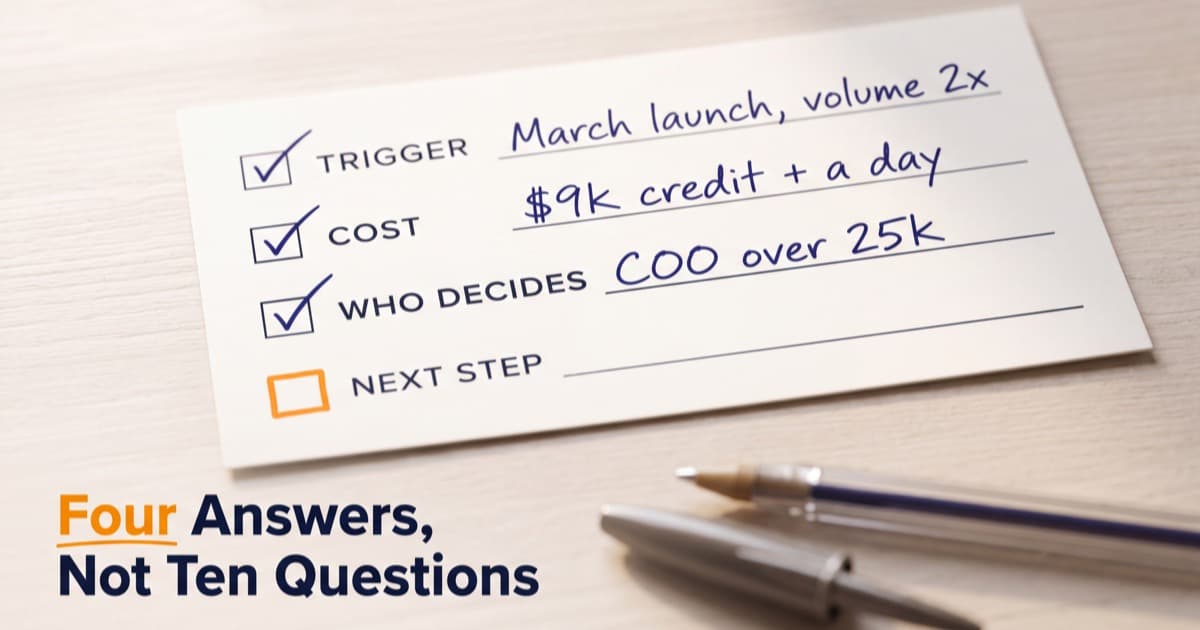
So the first rule of this guide is not about follow-up at all. Never end a call without the next step booked in the calendar while you are both still on the line. Not proposed, not promised, booked. "Can I put thirty minutes in for Tuesday the twelfth at ten while we are talking, and if you need to move it, move it" costs you four seconds of mild awkwardness and saves three weeks of inventing reasons. The difference is enormous, and it comes down to whether you are willing to be slightly forward at minute thirty-nine.
The second-best version, when a date genuinely cannot be set, is a named condition with an owner and a deadline. "You are going to run the numbers past Amara, and you said that will happen in the next two weeks. If I have not heard by the twenty-fourth, I will call you rather than email. Is that all right?" You have just converted your next follow-up from an intrusion into a thing they agreed to.
That single habit, applied consistently, removes most of what people mean when they say they are bad at follow-up. The rest of this guide is for the deals where it still goes quiet, because some of them will.
What counts as a real reason to follow up?
Every touch you make needs a reason. The trap is that sellers grade their reasons on whether the reason is true, when the buyer is grading it on whether it is useful to them.
"I wanted to see if you had any updates" is true. It is also entirely about your needs, which is why it gets deleted. There are only four kinds of reason that survive contact with a busy person, and the good news is that three of them are things you can create rather than wait for.
One: something you owe them. The clean case. On the call they asked about something and you did not have the answer, or you promised a document, a name, a number. Delivering it is not follow-up, it is completion, and it is the only touch that carries zero risk of reading as pressure. Which is why you should deliberately create one of these on every call. If nothing comes up naturally, ask a question whose answer requires you to go and find something out. "How many of your depots run the older scanners? Let me check what our integration does with those and come back to you with something specific" is a reason to exist next Tuesday, generated on purpose.
Two: something that changed on their side. They announced a funding round, opened a site, posted three roles for a team you would be supporting, got a new VP over the function. This is a legitimate reason and it is the one most sellers use badly, because they mention the trigger and then pivot straight back to their own agenda. The trigger has to actually change what you are saying, not decorate it. "You have opened Hartleigh, which was not in scope when we spoke, and it changes the rollout question we left open" is a real reason. "Congratulations on the new site, thought I would use the opportunity to check in on our conversation" is the same empty message with a hat on.
Three: something that changed on your side that specifically touches their problem. Not a product newsletter. The thing they said they were worried about, and the fact that it now works differently. If they walked away because reporting could not do X, and reporting now does X, that is worth a call. If they walked away for that reason and you are writing to tell them about an unrelated feature, you are telling them you were not listening.
Four: an honest close-the-loop. The most underrated message in sales, and the one that generates more replies than any clever nudge: the note that gives them permission to say no. It works precisely because it is not a nudge, and it works only if you actually mean it. More on the exact wording below.
Notice what is not on this list. Sharing an article about their industry, unless they asked. Anniversaries of when you first spoke. Anything beginning "circling back", "touching base", "bumping this to the top of your inbox", or "I know you are busy, so". That last one is worth flagging: acknowledging that they are busy does not soften an interruption, it establishes that you knew you were interrupting and did it anyway.
There is one more test that catches almost everything. Read your message and ask what the buyer gets from opening it. If the only answer is "an opportunity to reply to me", it is not a follow-up, it is a request for attention, and you have a finite number of those before someone stops opening your name.
The sequence, and where it should stop
Cadence advice is usually stated as a number of touches over a number of days, which is fine for prospecting and close to useless for a live deal where you have already spoken to a human being.
Use this shape instead. It assumes a good call happened and the next step was not booked, which is the situation this guide exists for.
Same day: the recap, sent within two hours. Short, structured, and written for the person who was not on the call, because it will be forwarded. Their words for the problem, not yours. What you agreed the impact was, with the number they used. What you said you would do, with a date. What they said they would do, with a date. One question at the end that is easy to answer in a line. Send it while the conversation is still fresh in their head, because a recap that arrives on Thursday for a Monday call arrives to someone who has had four other meetings since.
Day three or four: the thing you owed them. This is the reason you manufactured on the call. It should stand on its own and require no reply. End it with a specific, low-cost question rather than "let me know your thoughts". "Does the March number look right to you, or was that the annualized one?" gets answered. "Thoughts?" does not.
Day eight to ten: the call, not the email. If two written touches have gone unanswered, a third one will not land differently. Pick up the phone. Reps avoid this because the email feels safer, and it is safer, in the sense that nothing happens. A voicemail plus a short note saying you called is two impressions for one effort, and it moves you out of the queue of things that can be deferred silently.
Day fifteen to twenty: the sideways move. If the person you were talking to has gone quiet, the deal has not necessarily gone quiet. Somebody else in that account may have inherited it, or your champion may be stuck waiting on a person you have never spoken to. Going one step sideways, politely and openly, is legitimate. Going over their head without telling them is not, and it will cost you the champion you still need.
Day twenty-five to thirty: close the loop. Not a threat, not a fake deadline, not "I will assume you are no longer interested" delivered with an edge. Something closer to: "I have not managed to catch you, which usually means this has dropped below the line for now. That is completely fine, and I would rather know than keep landing in your inbox. If it is dead for this year, say so and I will stop. If it is just delayed, tell me roughly when and I will go quiet until then." Then actually go quiet, because the whole value of that message is that it is true, and buyers can tell the difference between an honest exit and a manipulation dressed as one.
After that, the deal is not dead, it is dormant, and it belongs on a dated note in your calendar rather than in a weekly guilt cycle. Six weeks, three months, whenever their own timeline said. The reactivation touch then has a genuine reason: you said you would come back after the budget cycle, and it is after the budget cycle.
Two things about this sequence matter more than the intervals.
Vary the channel, not just the message. Four emails is one conversation the buyer is ignoring. An email, a call, a voicemail, and a note through whichever professional network they actually read is four separate decisions they have to make, and one of them is likelier to land on a day where they have thirty free seconds.
Never let a touch be pure request. Every message should contain something, even something small: a number they asked for, a name of someone who solved this, the answer to a question they raised. If you have nothing to put in, that is not a signal to send it anyway with a nicer subject line, it is a signal to go and find something.
Opening with what you owe them
Halewood Foods, a regional food distributor. Camila sells route planning software. Owen Marsh is their operations director. They had a strong first call eleven days ago. Owen said he needed to talk to his finance lead, Priyanka, and that he would come back. Camila sent a recap and one follow-up email. Nothing. She is calling now.
The weak version.
Camila: Hi Owen, it is Camila from Rivet. How are you doing?
Owen: Yeah, good, sorry, it has been a mad couple of weeks.
Camila: No problem at all. I just wanted to check in really, see if you had any thoughts after our conversation, and whether there was any update from your side.
Owen: Not much of an update yet, to be honest. I have had it on my list to sit down with Priyanka and we have not managed it.
Camila: Sure, of course. Is there anything I can do to help move it along? Anything else you need from me?
Owen: I do not think so. I think we have got everything, it is really just finding the time.
Camila: Understood. Well, look, no rush at all. Shall I check back in a couple of weeks and see where things are?
Owen: Yeah, do that. Thanks Camila.
Nothing rude happened. Nothing happened at all, which is worse.
Look at what Camila actually did. She opened by naming her own purpose ("check in", "any update"), which invites a status report rather than a conversation. She asked "is there anything I can do to help", which sounds generous and is functionally a yes-or-no question with a default answer of no. She accepted "finding the time" as an explanation when it is a symptom, not a cause. And she closed by proposing to do the identical thing again in two weeks, which means the next call has already been scripted to fail the same way. She has also told Owen, twice, that there is no rush, which he will remember.
The deeper problem is that Camila never found out what is actually blocking this. "I have not sat down with Priyanka" could mean the project slid down the priority list, or that Owen does not know how to make the case to finance, or that Priyanka has already said something discouraging and Owen does not want to relay it. Those are three different deals with three different next moves, and Camila hung up not knowing which one she is in.
The strong version.
Camila: Hi Owen, it is Camila from Rivet. I owe you the scanner answer from last time, so I wanted to get that to you, and I have got one thing I want to check with you.
Owen: Go on.
Camila: The older handhelds at the two northern depots. You were not sure whether they would talk to us. They do, but only on the newer firmware, and about a third of units in the field are behind on it. So it is not a blocker, it is a half day of updates before go-live. I would rather you heard that from me now than found it in week one.
Owen: Right. Okay, that is useful. Nobody has ever told me a downside on a sales call before.
Camila: It would come out anyway, and it is better it comes out while you can plan around it. The other thing. When we spoke, you were going to walk Priyanka through the numbers, and that has not happened yet. I am not chasing you on it, I want to know whether it has not happened because it is hard to get time, or because the case is harder to make than it looked on our call.
Owen: ...Bit of both, honestly. She asked me what the actual saving was and I gave her a range and she was not impressed with the range.
Camila: That is exactly what I was worried about, and it is my fault rather than yours. A range invites an argument about the low end. Can I ask what you told her?
Owen: I said somewhere between six and twelve percent on fuel and overtime.
Camila: Right. So she heard six, and six on your fuel line is not a number that moves a finance director. Here is what I would do instead. Forget the percentage. On our call you said Tuesday and Thursday are the days you pay overtime because the northern runs get resequenced by hand, and that is roughly nine drivers over their hours most weeks. That is a countable thing. If we take even half of those hours out, we can work out what that is in dollars, from your actual payroll, not from our benchmark. Priyanka can check the number herself, which is the point.
Owen: She would like that a lot more than a range.
Camila: Then let me build it with you rather than send you a template. Thirty minutes, you bring last month's overtime by depot, I will bring the resequencing model, and we come out with one page in her language. If the number is small, we will both see it and you can drop this without spending any more of your time on it.
Owen: That is fair enough.
Camila: I have got Thursday at nine or Friday at two. Which is worse for you?
Owen: Thursday. Nine is fine.
Camila: Booked, invite going over while we are talking. One last thing. Should Priyanka be in that thirty minutes, or would you rather see the page first?
Owen: I would rather see it first.
Camila: Then let us do that, and if it holds up, the next one is you and me and her. I will not send it to her behind you.
Same eleven days of silence, completely different call. Worth naming what changed.
She opened with what she owed him, not with her own need, so the first ten seconds gave him something instead of asking for something. She volunteered a downside, which is the fastest way to be believed about everything else, and it is the same mechanic that makes a proof point land with a technical reviewer rather than bounce off. She named the unresolved commitment directly and then, crucially, offered him two explanations to choose between rather than asking an open "how is it going". People deflect open questions and answer specific ones, and "is it time or is it the case" is much easier to answer honestly than "any update?".
Then, once the real blocker surfaced, she took the blame for it. That is not politeness, it is strategy: a champion who feels caught out goes quiet, and a champion who is told the failure was the seller's fault stays in the room. She replaced a vague benefit with a number the buyer's own finance lead can verify from the buyer's own data, which is the difference between a claim and a case, and it is the same standard a finance audience applies whenever they are asked to approve something, as in selling to a CFO.
And she left with a date in the calendar, set before the call ended, plus an explicit agreement about who gets the page first. The next follow-up will not need an excuse.
The ways this goes wrong
Following up on nothing, repeatedly. Four touches that each ask for a status update are not persistence, they are one message sent four times. Persistence means arriving with something different each time.
Reading silence as rejection. It usually is not. It is usually the buyer being busy with the ninety percent of their job that is not you, or being stuck behind a person they cannot get time with. Deciding privately that they are not interested, and going quiet to protect your own feelings, kills more deals than any objection does. There are only about four causes of the quiet, and saying the likely one out loud is what gets you the real answer: that call is worked line by line in how to make a follow-up call after no response.
Reading silence as encouragement. The other failure. Sending the seventh cheerful nudge to someone who has not replied in six weeks is not resilience, and it costs you the ability to come back honestly in six months.
Fake deadlines and manufactured scarcity. "This pricing is only available until Friday" against a buyer who will still be there in March buys you a reply and loses you the relationship, because it will not be true and they will know within a week. The one legitimate version is a real constraint, honestly stated: a delivery slot that genuinely goes to someone else, a price change that is actually happening.
The apology opener. "Sorry to bother you again" and "I know you must be swamped" both start the conversation from a position of being an imposition, and buyers take you at your word. If you have a real reason, the reason is the opener.
Chasing the wrong person forever. If the individual has gone quiet through five touches, the problem may not be interest, it may be authority. Somebody in that account cannot get the meeting they need. Ask your champion who else should be in the loop, openly, rather than either giving up or going around them.
Treating a brush-off as a scheduling problem. "Call me back next quarter" said to end a call is not a plan, and putting it in the calendar as one wastes three months. The distinction between a real timing constraint and a polite exit, and how to test which one you have, is in brush-off versus real objection and worked live in getting a real callback time.
Letting the recap arrive late and generic. A recap written from your CRM fields instead of their words is a document nobody forwards, and the entire value of a recap is that it gets forwarded to the people who were not on the call.
The part reading cannot fix
Everything above is easy to agree with and hard to execute, because all of it happens in two moments that are genuinely uncomfortable.
The first is minute thirty-nine of a good call, when the room is warm and you have to say "can we put the next one in the calendar now" and risk being the person who made it slightly transactional. The second is the moment on a follow-up call when the buyer gives you a soft non-answer, and you have to decide between accepting it politely and asking the sharper question that gets you the truth. Both moments last about four seconds. Neither is a knowledge problem.
The reason they stay hard is that almost nobody practices them. Roleplay with a colleague fails here specifically: a colleague playing a distracted operations director will not actually be distracted, will not give you a vague answer twice, and will not let a silence run long enough to be uncomfortable. They know the exercise is meant to work, so they help you. The buyer will not help you.
ConvoSparr exists for that gap. You talk out loud, in real time, to an AI counterpart that behaves the way a stalled buyer does: it gives you the soft non-answer, it stays vague when you ask an open question, it does not volunteer the real blocker unless you ask something specific enough to earn it, and it lets the silence sit. Afterwards you get a scored breakdown of the conversation, so you can see the exact moment you accepted a vague answer or forgot to set the date, then run the same call again and do it differently.
For the call that generates the next step in the first place, start with the discovery call guide. For what to do when the quiet is actually an unhandled concern, see the objection handling guide. And if the follow-up in question is on a first conversation that never really started, the fix is earlier still, in the cold calling guide.
The best follow-up you will ever send is the one you do not have to write, because you booked the next conversation while you still had their attention. Everything else in this guide is what to do when you did not.