
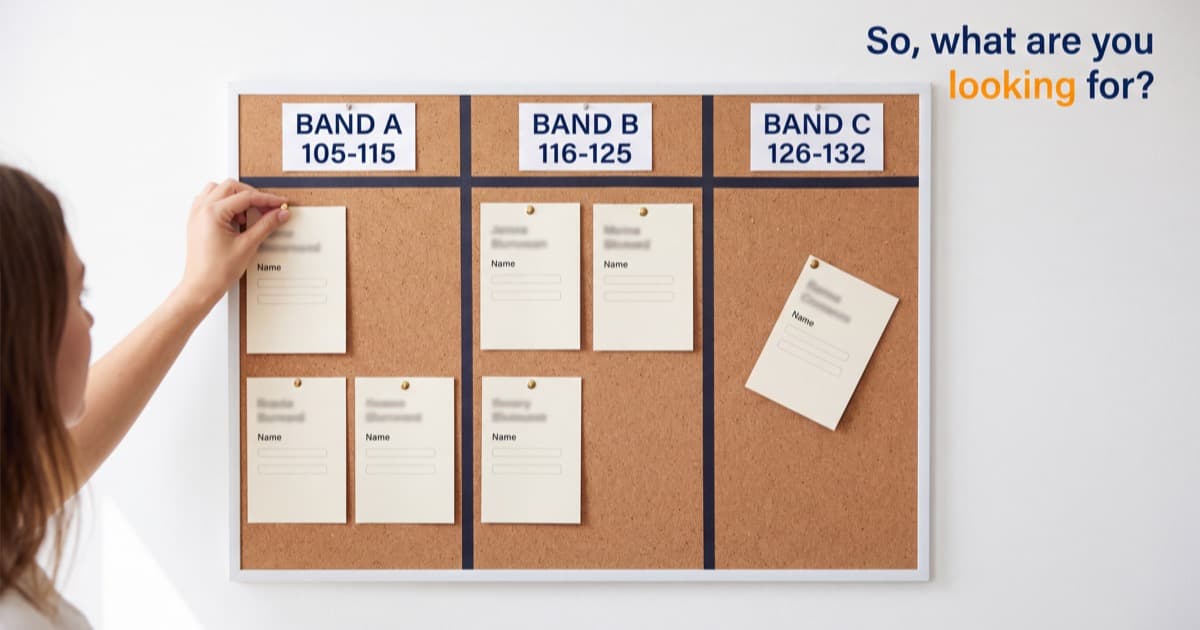
Recruiters ask for your salary expectations in the first screening call, usually inside the first ten minutes, because the answer decides which band your file gets sorted into before anyone has described the job. The salary expectations answer that protects your range does three small things in about fifteen seconds: it defers once with a reason the recruiter can write down, it asks what the role is budgeted at, and if they hold, it gives a researched range whose bottom number you would genuinely accept. One figure, said early, becomes the ceiling. The same screen call is run both ways below.
The Question Lands Before the Job Is Real
A screening call is a sorting exercise. Twenty to thirty minutes, a checklist, and a recruiter who has four more of these today. They confirm you can do the work, they confirm you can start, and they confirm you fit the band. That third one is the fastest to resolve, so it tends to come early, phrased casually enough that answering feels like cooperation.
What makes it awkward is the information gap. At minute nine you do not yet know the level, the scope, the on-call rotation, or whether the posted title means what it means at your current employer. The recruiter knows all of it, plus the approved band and what the last two hires took. They are asking a pricing question about a product you have not been shown.
This is not the counter offer conversation, where an offer exists and both sides are trading against a written number. Nothing is on the table yet. You are being asked to price yourself against a job description, and whatever you say gets typed into a field that follows you through every later round.
What Does a Number Cost You Nine Minutes In?
It costs you the top of the band, and it costs it silently. Recruiters are not trying to trick you. They are filling a form with a required field, and once your figure is in it, the offer is built upward from your number rather than downward from theirs. If the band was 105 to 130 and you said 110, nobody in the process ever has a reason to argue you up to 128. You capped yourself with a guess made before you had the facts.
The other losses are quieter:
Deferring with nothing attached. "I'd rather not say" is a refusal, not a move. It reads as evasive, it gives the recruiter nothing to type, and it usually gets asked again two sentences later, at which point you answer under pressure and lower than you would have.
Naming a range you have not stress tested. Any range you say, you have offered. If you say 115 to 135 and would be unhappy at 118, you have already agreed to 118. The bottom of your range is your real answer.
Answering the wrong question. "What are you making now?" and "what are you looking for?" are different questions with different answers, and a number of US states now ban asking for salary history outright. Sliding from one to the other, in either direction, hands over a number that is about your last job, not this one.
Inside the Recruiter's Screening Sheet
The recruiter is not adversarial and is rarely the person who sets the budget. They have a band handed down by finance, a hiring manager who wants a strong candidate, and a real interest in not spending three weeks on someone who will decline at the end. Your answer is a routing decision: in band, above band, or unknown and needs a second pass.
That means "unknown" is survivable exactly once. A candidate who defers with a reason and a question reads as senior. A candidate who deflects twice becomes work, and work gets deprioritized when four other files are already in band.
| What you say | What gets written down | Where it puts the offer |
|---|---|---|
| A single figure ("around 115") | Expectation: 115 | Built up from 115. The top of the band is now unreachable |
| A flat refusal ("I'd rather not say") | Would not answer, follow up | Asked again later, usually when you have less leverage |
| A range you have not tested ("115 to 140") | Expectation: 115 | The bottom number, every time. The top is treated as a wish |
| A deferral with a reason and a question back | Wants scope first, asked for the band | Their number lands first, and yours can answer it |
A Screen Call Where the Range Survives
Sanne is a talent partner at Sedgemoor Process Water, which runs boiler and cooling tower treatment programs for manufacturing plants. She is screening for a Regional Service Manager role. The approved band is 105 to 132. The candidate has researched the market and would take 120 as a floor.
The pass that sets the ceiling:
Sanne: Before we go further, let me just check we're in the same ballpark. What are you looking for on compensation?
Candidate: Sure. I'm currently at 108, so somewhere around 115 would work for me.
Sanne: Great, that's workable. Let me walk you through the team structure.
Two sentences and the call is over as a negotiation. The candidate volunteered current pay that nobody asked for, then priced the new job as a small raise on the old one. Sedgemoor now has 115 in the field and 132 in the budget, and no mechanism will ever close that gap, because every later conversation starts from the number the candidate supplied.
The pass that keeps it open:
Sanne: Before we go further, let me just check we're in the same ballpark. What are you looking for on compensation?
Candidate: Happy to get to that, and I want to give you a useful answer rather than a made-up one. I don't have a feel yet for how many sites this covers or whether it carries the on-call rotation. What has the role been budgeted at?
Sanne: We're approved for 105 to 132, depending on experience.
Candidate: That's helpful, thank you. Based on what I've seen for multi-site service management in this region, I've been working in the 122 to 135 range, and where I land inside that would depend on the site count and the travel. Does that sound like it fits?
Sanne: It's toward the upper half, but it's not out of range. Let me get you in front of the hiring manager.
The deferral worked because it came with a reason and a question, so Sanne had something to type and something to say back. Asking what the role is budgeted at is an ordinary process question and recruiters answer it more often than candidates expect. The range that followed opened above the candidate's real floor of 120, which is the only reason 120 is still safe: the bottom of a stated range is what you have agreed to. And tying position inside the range to site count and travel gave the number a reason to move up later, once those facts exist.
Rehearsing the Ten Seconds After the Question
The failure is almost never the strategy. It is the silence. Recruiters ask, then wait, and three seconds of quiet is enough to make most people fill it with a figure. Practice the sequence out loud, and practice it against someone who asks twice. The wider set of moves this call sits inside is in the salary negotiation guide.
- Say the deferral in one breath, with a reason attached to something specific you do not know yet. Reasons beat refusals.
- Ask what the role is budgeted at, then stop talking. This is the part that gets skipped under pressure.
- Have your range ready before the call, with the bottom number set at what you would accept without resentment.
- Answer the question that was asked. If they ask what you make now, that is a different question, and "I'd rather focus on what this role is worth" is a complete answer to it.
- Run it again with a recruiter who says "I really do need a number to move forward." Decide in advance what you say to that, because you will hear it.
Before your next screening call, ask yourself one thing: if the recruiter said your number back to you as the final offer, with nothing added, would you still take the job? If the answer is no, that number is not ready to be said out loud yet.