'Wait Until the Next Review Cycle': When Your Manager Puts Off Your Raise
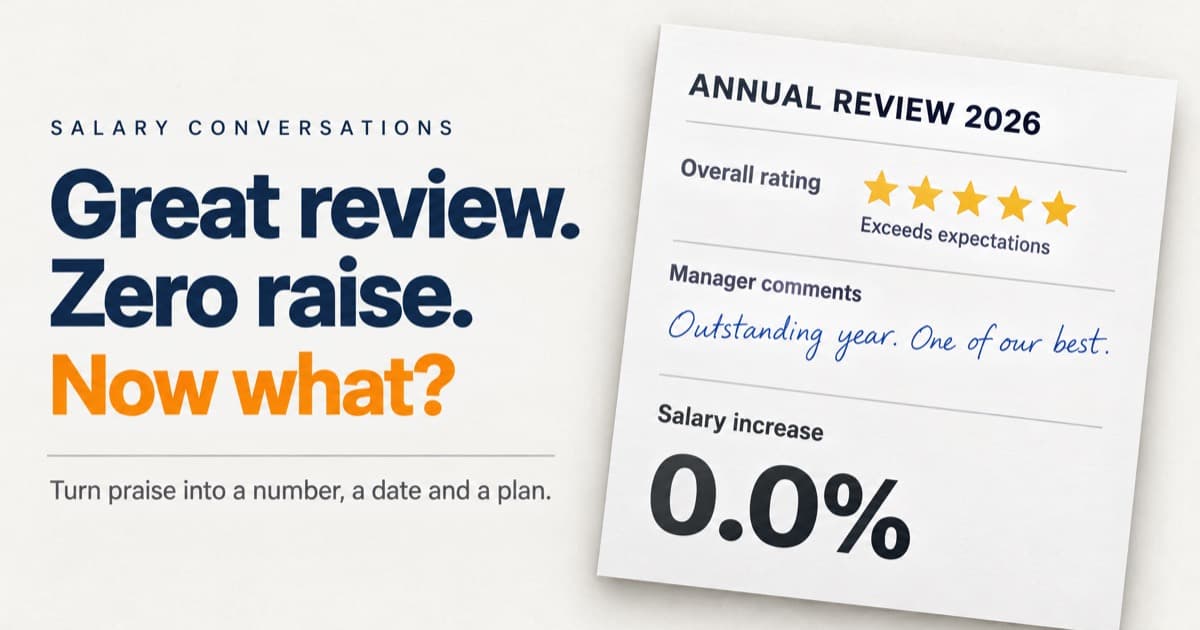
Benedetta first asked for a raise in March. Her manager said the September review was the right place for it. In September, the budget had already been set in July, so he said January. It is now November, January is coming, and her salary is still $68,000.
Here is the answer. When your manager says to wait until the next review cycle for a raise, do not argue with the timing and do not simply agree. Accept the cycle, then turn the wait into terms before you leave the room: the date of the decision, the bar you need to clear by then, and the number you are both working toward. Ask for those three things in writing, in a short email after the meeting. A wait with a date, a bar and a number is a plan. A wait without them is a polite no that renews itself every six months.
The review cycle answer, and when you hear it
"Let's pick this up in the next review cycle" is the most common reply to an off-cycle raise request, and it is not always a dodge. Many companies really do set merit budgets once or twice a year, and a manager who promises money between cycles may have nothing to give. The phrase usually shows up in one of three moments:
- You ask for a raise in a one-on-one a few months before reviews.
- You bring a market number or a competing offer and your manager wants time.
- You raise pay at the end of a review where the increase was smaller than you hoped, and your manager points to the next one.
In all three, the manager is moving the conversation to a date. The question is whether anything will be different on that date, and that depends on what you agree to now.
Why waiting politely costs a year
The polite response is "Of course, that makes sense," and it is the one that costs the most. Nothing about the next review is written down, so the next review starts from zero. Your manager will have forgotten the details of your case, the budget may be smaller, and there is often a new reason to wait: a reorganization, a new director, a quiet quarter.
The money is real. A 6% raise on $68,000 is $4,080 a year. Benedetta's first ask was in March, and if January finally delivers, she will have waited ten months, roughly $3,400 she will never get back. If January slides to the summer cycle too, every month adds another $340. Raises also compound: every future percentage is calculated on the base you have, so a raise that arrives a cycle late keeps you behind for the rest of your time there.
There is a second cost that does not show up on a payslip. Each time you accept "next cycle" without terms, your manager learns that the topic can be moved without a price. The third ask is harder than the first.
What is your manager really telling you with "wait until the next review"?
The words are the same whether the raise is coming or not. What tells them apart is how your manager responds when you ask for specifics.
| What "wait" might mean | How it sounds when you press | What to ask for |
|---|---|---|
| The budget is real and fixed by the calendar | A specific date, and a willingness to talk numbers now | The decision date and the number you are both aiming for |
| Your manager is not yet convinced | Vague praise, then "let's see how the next few months go" | The exact bar you need to clear by that date |
| Your manager cannot approve it alone | "I'll need to take it to my director" | A date when they will bring your case up, and what they need from you |
| There is no plan to give you a raise | Discomfort with any date, number or criteria | A direct question about whether a raise is realistic this year |
The last row is the one people fear, but it is useful to find out in November rather than in January. If your manager will not name a date, a bar or a range, that is the answer, and you can plan around it: a promotion path, a different role, or a job search on your own schedule.
Rehearse the 'wait until the next review' conversation before you have it.
ConvoSparr lets you practice the raise talk out loud with an AI manager who pushes it to the next cycle, then scores whether you pinned down a date, a bar and a number before the call ended.
Benedetta's November check-in at Kestrelmoor
Benedetta is the client services supervisor at Kestrelmoor Animal Hospitals, a group of four veterinary hospitals. She runs front desk scheduling across all of them and has spent the year training the teams at two newly acquired hospitals. Anselm, the operations director, is her manager. She has a check-in with him two months before the January review cycle.
Version one: she accepts the wait again
Benedetta: I wanted to come back to the raise we talked about in September.
Anselm: Right, of course. Honestly, you've had a great year. The cleanest place for this is the January cycle. Let's pick it up properly then.
Benedetta: Okay. That makes sense. I just wanted to make sure it's on your radar.
Commentary: this is the same exchange as March and September. "On your radar" asks for nothing that can be checked later. Anselm leaves the meeting with no date to prepare for, no figure to request from finance, and no criteria he has agreed to.
Anselm: It definitely is. We'll sort it out in January.
Commentary: "sort it out" is not a commitment to anything. In January, Anselm will walk into the budget meeting with whatever number is left after everyone else, because nobody asked him to argue for a specific one.
Version two: she turns the wait into terms
Benedetta: I wanted to come back to the raise we talked about in September.
Anselm: Right. Honestly, you've had a great year. The cleanest place for this is the January cycle.
Benedetta: That's fine with me. I'd like January to be the decision, not another starting point. Can we agree on three things today? When the decision happens, what I need to have done by then, and what number we're working toward.
Commentary: she accepts his timing in the first four words, so there is nothing for him to defend. Then she names exactly what she wants from the wait. Three concrete items are easy to say yes to one at a time.
Anselm: Reviews are finalized around January 14. As for what you need to do, I'd say keep doing what you're doing.
Benedetta: Thanks. Let me make that specific. By January, both new hospitals will be on our scheduling system and running without me on site. If that's done, is that enough for the raise?
Anselm: If both are live without you, yes. That's the case I'd make.
Commentary: "keep doing what you're doing" is not a bar anyone can be measured against. Benedetta writes the bar herself, using work she is already doing, and asks him to confirm it. Now the criteria belong to both of them.
Benedetta: Good. On the number, I'm at $68,000. Supervisors running multi-site scheduling in our area are paid $72,000 to $76,000. I'd like you to take $72,000 to the January meeting.
Anselm: I can't promise $72,000. I can ask for it.
Benedetta: That's all I'm asking. I'll send you a short email this afternoon with the date, the two hospitals and the number, so we're both working from the same note.
Commentary: she gives a market range and asks for the bottom of it, which is easy for him to carry upstairs. "I can ask for it" is a real commitment, and the follow-up email turns a friendly meeting into a record. In January, the conversation starts from that email, not from zero.
Running the ask out loud before the January cycle
Write your three terms down before the meeting: the decision date you will propose, the one or two results you will offer as the bar, and the number you want carried into the budget conversation. Use work you are already doing for the bar, so you are not signing up for a new project. Pick a number from a market range and know where it sits in that range.
Then practice the turn, because that is the line that slips. When "let's wait for the next cycle" arrives in a warm voice, the natural reply is "that makes sense," and the meeting is over. Rehearse "That's fine with me. I'd like that to be the decision, not another starting point" until it comes out as easily as the agreeable version. Rehearse the follow-ups too: what you will say when your manager offers "keep doing what you're doing" instead of a bar, and when they say they cannot promise a number. Afterward, send the email the same day, while the meeting is fresh and nobody can remember it differently.
If your manager told you to wait until the next review cycle last time, do you know today what will have to be true on that date for the answer to be yes?
Updated Nov 12, 2026
Run this scenario for real
ConvoSparr drops you into a live voice call with an AI buyer who runs this exact play. Handle it out loud, then get a transcript, scores, and coaching notes on how you did.
Free to start. No credit card required.