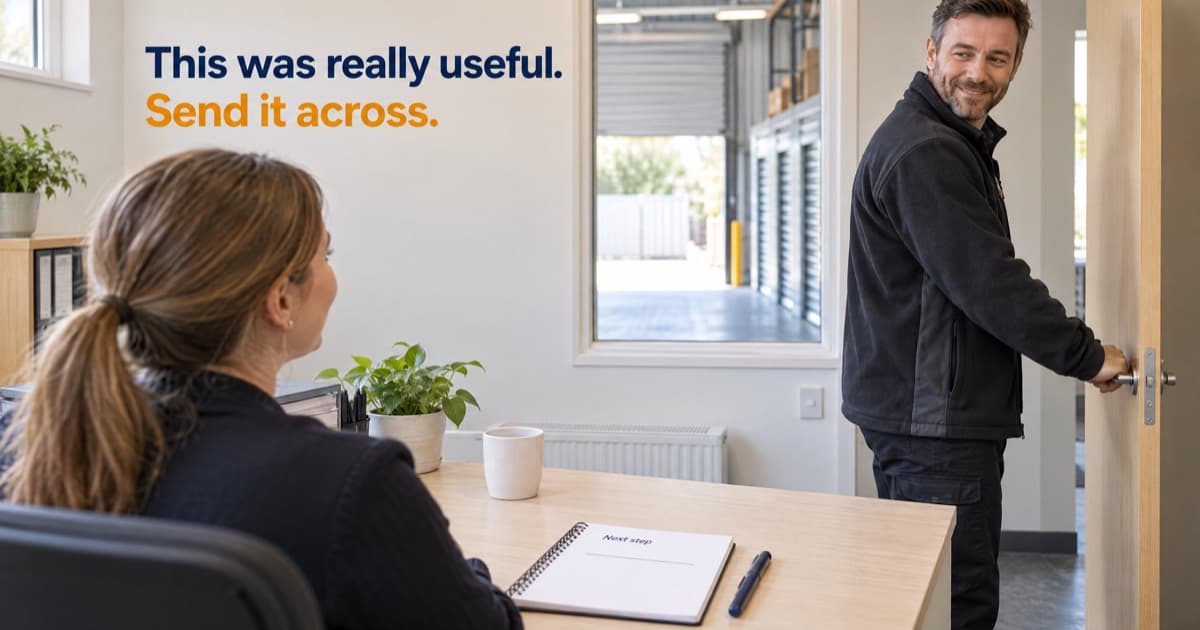
Open your calendar and read back your last five sales calls. Not the notes, the line underneath: how many ended with a date the buyer put in their own calendar while you were still on the line? For most reps the honest count is one. The others ended the way the best-feeling calls usually do. The buyer said this was really useful, you said you would send a recap over, and both of you hung up pleased with each other.
Closing a sales call is not a technique for the final thirty seconds. It is one request, said out loud before anyone leaves, for something the buyer has the authority to grant today: usually a dated working session, sometimes a name added to the next conversation, occasionally the decision itself. You close by picking the largest of those the call has earned, asking for it in one sentence with a day and a time in it, then saying nothing until they answer.
A good call and an empty calendar
Nothing goes visibly wrong in these calls. The discovery was real, the demo landed, the buyer volunteered a problem you can solve. Then the clock hits forty minutes and the rep reaches for the exit that never gets an argument: "let me put together a recap with some pricing and send it across."
That sentence feels like progress because it produces an artifact. What it does is move the decision out of the room where you can hear the hesitation and into an inbox where nobody has to answer. And "send it across" is the cheapest cooperative answer the buyer has: warm, on time, committing nothing. Reps hear agreement. What was offered was politeness.
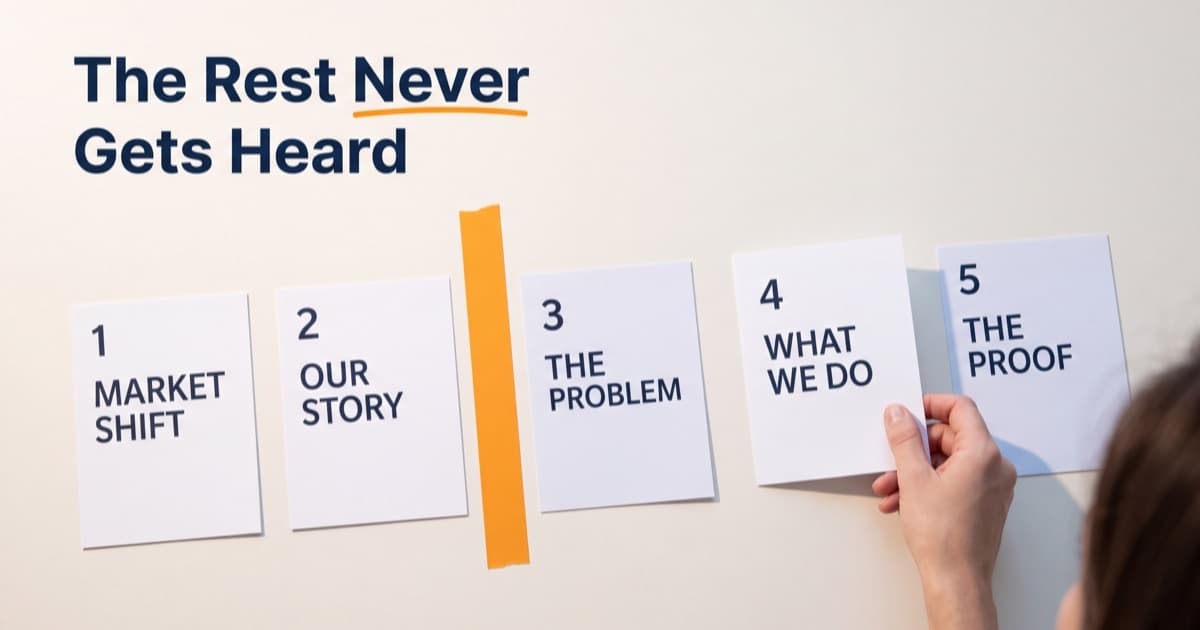
The sales pitch guide covers the whole arc of a call that has to earn attention. This page is about the last two minutes, where it either acquires a next step or quietly becomes a follow-up problem.
Ask for something the buyer can approve alone
The test is not how confident your ask sounds. It is whether the person in front of you can say yes without leaving their chair. Three checks:
Can they grant it by themselves? A trial, a security review, a signature over their threshold, a meeting with their boss: all things they have to go and get. Asking for one turns your close into their errand, and errands slip.
Does it cost them something small but real? Thirty minutes, a colleague's attendance, one week of their actual data. A costless yes buys nothing; the cost is what gives it meaning.
Is it attached to something they said? The ask has to answer the problem they named, in their words. Detached from that, it reads as a step in your process, which is the definition of pushy.
Then say it as one sentence with a day in it, and stop. Not "would it make sense to maybe get something on the calendar," which invites a maybe, but "thirty minutes Thursday or Friday morning with you and whoever runs those two sites, and we put one week of your checklists through it." Two times rather than a yes or no, and send the invite while you are still on the call.
Four endings, and what each one commits the buyer to
Every call ends in one of four shapes, and they feel less different than they are.
| How the call ends | What the buyer has to do | What you can honestly write down |
|---|---|---|
| The recap. "I'll send something over." | Nothing, beyond reading an email | Nothing. A conversation, not a deal |
| The soft ask. "Is this something you'd want to explore?" | Agree in principle, at zero cost | Interest, which dies in a busy month |
| The dated ask. "Friday at 10, thirty minutes, one week of your data." | Give up a real half hour, on a named day | A next step dated by the buyer |
| The commitment ask. "If Friday holds up, can we start the first site in March?" | Decide, or name who decides | A path, and whoever else has to agree |
The jump that matters is from row two to row three, and it is one sentence wide. Most reps who believe they close hard live in row two, because "does that sound like something worth exploring" sounds like an ask and functions like a recap.
The last two minutes of a call at Ambervale Self Storage
Ambervale Self Storage runs fourteen sites. Kofi, their operations director, is forty minutes into a second call about a site inspection platform, and he has twice complained about paper checklists reaching head office three days late. Orla owns the business and signs anything over $20,000. Lenore is selling.
How it usually ends
Lenore: So that is the inspection flow end to end. I know we are up against time, so what I will do is put together a recap with pricing and send it across, and we can take it from there.
Kofi: Perfect, yeah, send that across.
Lenore: Great. And anything you want to dig into, just shout.
Kofi: Will do. This was really useful, thanks.
Four lines, and the deal is now an email. "We can take it from there" assigns the next move to nobody, so it falls to whichever of them is less busy, and that will not be Kofi. Lenore learned nothing, and "this was really useful" is true, free, and the most encouraging thing she will hear for six weeks. The ending was considerate, which is why it is so hard to stop.
How it ends when she asks
Lenore: Before we drop off, can I check one thing? You have mentioned the three day lag on the checklists twice. Is that the piece you would want fixed first, or is it the audit trail?
Kofi: The checklists. The audit side matters to Orla more than it matters to me.
Lenore: Then here is what I would suggest instead of a recap. Thirty minutes, you and whoever runs the two busiest sites, and we take one real week of your checklists and run them through this. If it does not hold up against your own paperwork I will tell you so on the call. Is Thursday at 2 possible, or is Friday morning easier?
Kofi: Thursday is tight. Friday at 10 I could do.
Lenore: Friday at 10, and I will send the invite while we are still on. One more thing, and I am not asking for a meeting with her: you said Orla signs anything over 20. What does she normally need to see, and when, to be comfortable rather than surprised?
Kofi: She will want to hear it from me first. If Friday goes well I would talk to her the week after.
Lenore: Then that is the plan. Friday at 10, and if it holds up, you and Orla the week after. I will write it up in those words so you can forward it without editing it.
Six lines, and three things exist that did not before: a working session on a day Kofi picked, a decision path that names the person with the signature, and a written artifact he can forward, which is a different object from a recap he has to read.
The ask works because of what precedes it. Lenore asks which problem comes first, so the session aims at his mess rather than her demo. She puts her own skin in it by promising to say so if it fails, which makes a buyer curious rather than guarded. And she treats Orla as a process question rather than a favor to ask for.
How do you ask for the close without sounding pushy?
Pushiness is not clarity. It is asking for something the buyer has no reason yet to give, or asking again for something they already declined. A clear ask for a small, relevant, dated next step reads as competence, and an interested buyer is relieved by it.
Two habits keep it comfortable. Attach the ask to the buyer's own words, so it is visibly about their problem and not your pipeline. And leave a real door open: "if this is not a priority this quarter, say so and I will stop chasing you" gets an honest answer surprisingly often, and an honest no beats a polite maybe you carry for two months.
Then let the silence work. The three seconds after the ask belong to the buyer, and filling them with "or whenever suits, no pressure" withdraws the request you just made. It is the most common way a good close gets taken back by the rep who made it.
When the person who decides was never on the call
Often the best close available is not a commitment, because the person who can commit is somewhere else. Reps ask for the meeting, the request most likely to earn a soft yes and no invitation.
Ask about the process instead: what does that person usually need to see, who normally puts it in front of them, and by what date. Three questions your contact can answer on the spot, and the answers are a plan that does not rely on goodwill. Then close on what they can approve alone, usually the session that produces what their boss needs to see. The 'I need to talk to my boss' scenario covers this moment when it arrives as an objection rather than a fact.
The version to avoid sounds respectful and vanishes: "makes sense, let me know how it goes." Nobody ever lets you know.
A pipeline full of maybes looks healthy for six weeks
This is why the recap ending survives despite never working. It does not fail immediately. It fails at the end of the quarter, all at once, in a forecast that looked reasonable because every deal had a warm call behind it.
The tell is easy to check and uncomfortable to look at: count how many of your open deals have a next step with a date the buyer agreed to out loud. The rest are not deals yet, whatever the calls felt like, and each one still eats follow-up time.
The fix is one sentence, said where you currently reach for the recap. The first time most reps ask cleanly for a dated next step is in front of the buyer they least want to lose. On ConvoSparr you can run the last two minutes against a buyer who offers the friendly "send it across," asks what the meeting is for, and pushes the date a week, until the ask is no longer the part you improvise.