
Teodoro: What's the biggest headache with scheduling right now?
Rosalind: Honestly? It's fine. It works.
Six words back, on a question you spent the morning sharpening. Nothing went wrong. She is not screening you and she is not annoyed; she will stay warm for another twenty-five minutes. She answered the question you asked, at the altitude you asked it.
That is the whole problem with question lists. They are easy to find and most are fine. Reps do not lose discovery by picking the wrong ten questions. They lose it in the two seconds after a thin answer lands, when they accept it and move to item four.
So the discovery call questions worth memorizing are not the openers. They are the four or five short follow-ups you ask after a thin answer, because the first answer to any question is the tidy summary a buyer has given three other vendors, and the second is the one with a number, a date, or a name in it. A mediocre list asked twice beats a great list asked once.
Why do good discovery call questions get one-word answers?
Three reasons, and only one is about the question itself.
Register. A broad question asks for a summary, and people summarize by deleting specifics. "How's scheduling going" requests a headline, so you get a headline. The buyer is matching the size of your question, as a cooperative person does.
Trust arithmetic. Detail is disclosure. Telling a stranger in minute three that your managers each burn hours a week fixing a schedule is telling a vendor where your team is weak. Buyers release that in layers, and the first layer is the harmless one. What earns the next layer is not a cleverer question, it is evidence you listened to the last one.
"Fine" is frequently true. Kirbyvale's scheduling does work: stores open, shifts get covered, nobody misses payroll. The cost is not in whether it works, it is in what it takes to make it work, and nobody volunteers that under a question about whether it works.
So a one-word answer is not a failed question, it is an unfinished one. Hear "it's fine" and think wrong question, and you go hunting for a better list. Think not done yet, and you ask the second question.
The second question is the one that pays
You do not need a bigger list. You need three moves you can run on any answer, in any order, without preparation.
Put a clock on it. "How long has it been that way?" A problem that has survived two years unfixed is not urgent, and learning that in minute six beats forty polished minutes about it. A problem that started in March has a cause, and the cause is usually your entry point.
Put a unit on it. "Who does that, and how long does it take them?" Ask for the unit before the total. Buyers rarely know an annual figure and will not guess at one, but almost everyone knows it is their eleven store managers, on Sunday nights, for about two hours. The total is arithmetic you do together a minute later. A number the buyer assembled is one they repeat internally; a number you asserted is one they let stand and never mention again.
Put a person on it. "Who notices when it slips?" Pain nobody notices has no budget attached. Pain with a name on it has a sponsor, a complaint history, and usually a meeting where it came up.
One habit makes all three land: reflect the answer back in a sentence before you extend it. "So it's the eleven managers, on Sundays." Three seconds, and it often pulls the next layer out with no question at all. It also keeps you from talking too much on discovery calls.
Question types, and what each one can and cannot get you
Most lists mix these as if they were interchangeable. Each type has one job it does well and one place it fails.
| Type | Sounds like | What it reliably gets | Where it fails |
|---|---|---|---|
| Broad opener | "What's the biggest challenge with X?" | The topic, and permission to dig | Returns the rehearsed summary. Treated as the answer, it ends discovery in one line |
| Clock question | "How long has that been the case?" | Urgency, and the trigger behind it | Gets nothing if the buyer has not yet admitted there is a problem |
| Unit question | "Who does that, and how long does it take?" | A cost in the buyer's own numbers | Asked as a total ("what does that cost a year?"), it gets a shrug or a made-up figure |
| Last-time question | "What's the last thing your team bought like this, and how did it get signed?" | The real approval path, including who stalled it | Rarely asked, because "how do decisions get made?" seems to cover it. That one gets the org chart |
| Consequence question | "What if this is still true next quarter?" | Whether the buyer will spend on it | Sounds like pressure before the cost is on the table. It belongs late |
Read down the third column and you have the call: topic, urgency, cost, path, stakes. Read down the fourth and you have why most calls end in notes nobody can forecast from.
The call where "it's fine" turns into a number
Teodoro Sarr sells for Vesslight, a fictional workforce scheduling platform for multi-site retail. Rosalind Nyquist is director of store operations at Kirbyvale Markets, a fictional forty-one store grocery chain. Same rep, same buyer, same facts sitting there to be found.
Asked once:
Teodoro: What's the biggest headache with scheduling right now?
Rosalind: Honestly? It's fine. It works.
Teodoro: Got it. Are you using anything for it today, or is it more manual?
Rosalind: Spreadsheets mostly. Each store builds its own. Standardizing it comes up, but it's not on fire.
Teodoro: Understood. Let me show you how we handle multi-site templates, then.
Nothing here is rude or clumsy. Two reasonable questions, two honest answers, notes that read: spreadsheets, decentralized, not a priority. Then Teodoro does what thin answers push everyone toward and starts presenting, because presenting is the only move left when you have nothing to work with. The call ends warm and goes nowhere.
Asked once more:
Teodoro: What's the biggest headache with scheduling right now?
Rosalind: Honestly? It's fine. It works.
Teodoro: Fair enough. Let me ask it the other way: what does it take to keep it working? Who builds next week's schedule?
Rosalind: Each store manager does their own. Forty-one of them.
Teodoro: Forty-one managers, each building their own. When?
Rosalind: Sunday, usually. Some do it Saturday night so it isn't hanging over the weekend.
Teodoro: Roughly how long does it take one of them?
Rosalind: Two hours? Longer if someone calls out and they redo it.
Teodoro: So call it eighty hours a week across the chain, on a weekend. Has it always been that way?
Rosalind: It got worse after the nine stores from the Delridge acquisition. Different pay structure, different split-shift rules. Our old template doesn't fit them.
Teodoro: Who notices when a schedule goes wrong at one of those nine?
Rosalind: Bertram, our district manager over there. He's raised it twice. Last quarter two of his stores went into overtime three weeks running, because managers covered call-outs with whoever was already at forty hours.
Teodoro: Do you know what those three weeks cost?
Rosalind: I'd have to pull it. Somewhere around nine thousand dollars for the two stores. Across the region it's bigger, which is why Bertram keeps raising it.
Teodoro: Last one, then I'll stop asking: what's the most recent operations tool the chain bought, and what happened between deciding and signing?
Rosalind: The inventory count app, last year. About five months. Finance wanted a per-store cost, not a total, and I didn't have one, so it sat.
Teodoro: Then the useful next step isn't a demo. It's forty-five minutes with you and Bertram walking one Delridge store's overtime weeks, and I bring the per-store number in the format finance asked for. Does Thursday work?
Rosalind: Thursday. Send it to Bertram too.
Count what the second version holds that the first does not: forty-one managers, eighty weekend hours a week, an acquisition that broke the template, a sponsor who has escalated twice, roughly $9,000 of overtime in one quarter, a five-month purchase cycle, the reason the last purchase stalled, and a Thursday meeting with an attendee the buyer added herself.
Teodoro did not ask harder questions. He asked the same opener and refused to let "it's fine" end it, in the shape clock, unit, person, cost, last time. Notice the two smallest moves too. "Forty-one managers, each building their own" is a reflection, not a question, and it produced the Sunday detail. "Let me ask it the other way" is how you re-ask a question that returned a headline without the buyer feeling re-interrogated.
Four ways reps blunt their own questions
Stacking. "How does that work today, and is it a pain point, and who owns it?" Three questions in one breath is one question in practice, and the buyer answers whichever is easiest. Ask one. Stop talking.
Answering it inside the question. "Is that because the spreadsheets don't sync?" You handed over the answer, a cooperative buyer takes it, and the reason now belongs to you. Ask "what makes it hard?" instead. A reason the buyer stated is one they repeat to their CFO.
Asking permission to ask. "Do you mind if I ask a nosy question about budget?" The preamble tells the buyer a question is intrusive before they decide whether it is. Asked plainly, it plays as normal diligence.
Reading silence as refusal. After "do you know what those three weeks cost?" comes a pause, and the pause is the buyer doing arithmetic. Fill it and you get nothing. This one dies live, along with its cousin: the follow-up that evaporates the second the buyer says something interesting. Both are mouth problems, not knowledge problems, and both sit behind the discovery call mistakes that feel like great calls.
Write your five before the next call
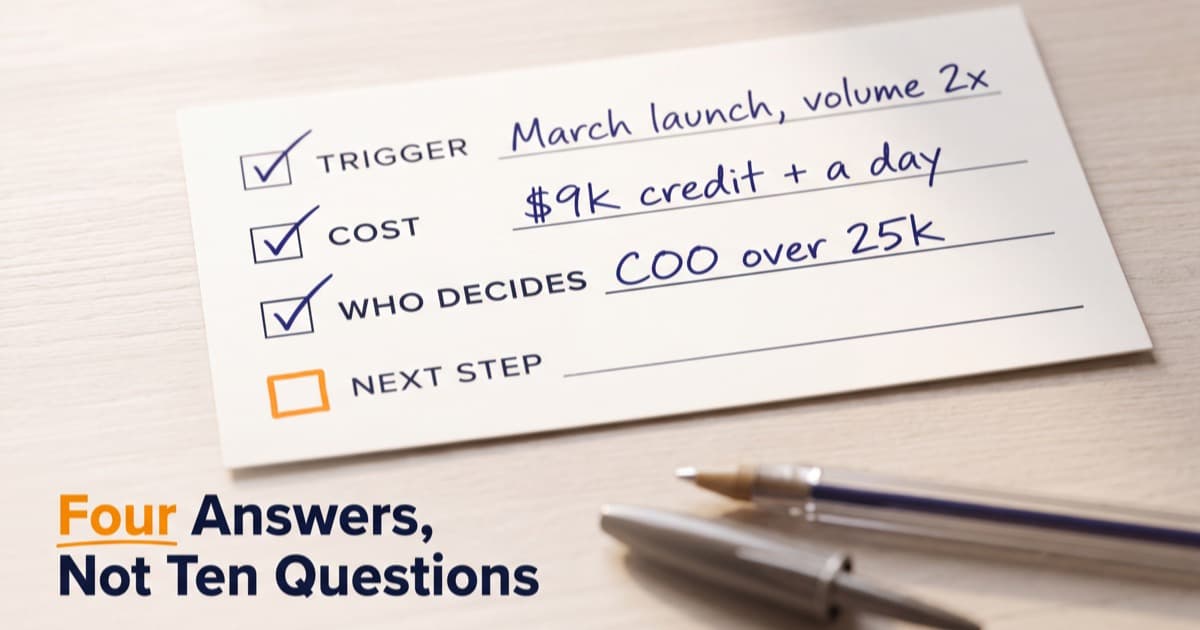
Not ten questions. Five follow-ups on a card, in this order, run against any answer any buyer gives you:
- Let me ask it the other way: what does it take to keep that working?
- Who does that, and how long does it take them?
- How long has it been that way, and what changed?
- Who notices when it slips?
- What was the last thing your team bought like this, and what happened between deciding and signing?
One rule goes with them: after every answer, say it back in a sentence before you extend it. The wider map of what a discovery call is judged on is in the discovery call guide, and the opening minutes have their own rules in how to open a discovery call.
Print the five and put them where you can see them. Then check them off during the call rather than afterward, because afterward is when everyone finds out which one they skipped.