Cheaper Quote vs Smaller Scope: The 'Your Competitor Is Cheaper' Objection
Eleven thousand dollars separated the two quotes, and neither document explained why. That is the normal shape of this objection. When a buyer tells you a competitor is cheaper, the answer is almost never a defense of your price and almost never a match: a lower quote is usually a smaller job, and the difference turns up later as work somebody on the buyer's side does for free. Get both scopes onto the same page before anyone says the word discount, because once the two numbers are treated as comparable, the only lever left is yours.
Where the Cheaper Number Usually Comes From
Competitors are rarely quoting the same thing at a lower margin. They are quoting less, and the quote says so in a place nobody reads.
A smaller count. Seats, sites, users, records. The cheaper quote counts what the buyer has today and yours counts what they have in their busiest month.
Implementation billed separately. Setup, data migration and integration work sit in a second document that arrives after signature, or in a partner's statement of work.
A different support tier. Email only, two business days, weekdays. Yours might include somebody reachable on the day the buyer needs help, which is never a Tuesday morning.
A first-year price. A ramp, or an uplift capped in your paper and uncapped in theirs. Three-year totals frequently invert the comparison outright.
None of that is a trick, and saying it is one makes you sound like a rep who has lost. It is a scoping difference, and scoping differences are checkable.
Why Matching the Price Loses You Twice
The reflex is to find eleven thousand dollars somewhere. It costs you twice.
The first is the money, and that is the smaller loss. The second is the frame. Moving your number confirms the buyer's assumption that the two quotes describe the same job, which was the one thing you needed to challenge. From that moment the conversation is a price contest, and a price contest is the one contest a smaller product can win. You cannot out-cheap somebody who is selling less than you are.
A third cost arrives in March. If you win on a matched price and the buyer later finds the competitor's quote excluded four things yours included, you get no credit for including them. You are the vendor who was overcharging and got caught.
What Is the Buyer Risking by Paying More?
Not the money. The buyer is risking having to defend the choice to somebody who will only ever see two numbers on one page. That person will not read either scope document, and will ask one question: why did we pay eleven thousand more.
So the job on this call is to hand your buyer a sentence they can repeat without you in the room. Not a value story, not a return on investment model. One checkable difference, phrased the way they would say it to a finance lead in a hallway. "Theirs covers four hundred people and we have nine hundred in January" is that sentence. "We chose the better platform" is not, and it is what a rep who argued about quality leaves behind.
The Line Items the Two Quotes Do Not Share
Build this before the call, from the competitor's published scope where you can get it. The right-hand column changes minds, because it names a person rather than a feature.
| Line | What the cheaper quote covers | Who absorbs the rest |
|---|---|---|
| Named users | 400 at signature, priced on today's headcount | The ops team, keeping the other 500 in a spreadsheet beside the tool |
| Implementation | Self-serve setup, documentation only | A separate statement of work, or the buyer's own staff over the holidays |
| Support hours | Email, two business days, weekdays | The duty manager on a Saturday, phoning whoever answers |
| Cross-department cover | Swaps inside a single department | Hand edits every time somebody covers outside their team |
Ninety Seconds After the Buyer Names the Other Number
Kirnwood Mountain Resort runs about 900 seasonal staff at peak across lifts, ski school, rentals, patrol and food service. Malia Quintero, Director of Mountain Operations, has been evaluating scheduling platforms since August and needs one live before the December hiring ramp. Your annual quote is $49,000. Croftline came back at $38,000.
First pass, and the number becomes the whole conversation:
Malia: I have to be straight with you. Croftline came in at thirty-eight. You are eleven over.
Rep: I hear you. I would say we are a more mature product, and the difference shows up in reliability and in the depth of the reporting.
Malia: They demoed reporting too. It looked fine.
Rep: Right. Let me see what I can do on the number. I might have room to get closer to forty-two if I go to my manager.
Malia: That would help. Send me something and I will put both in front of finance.
Rep: Will do. And I really do think we are the stronger option here.
That call is over. "More mature" is not checkable, so it reads as an opinion, and an opinion loses to a number. Offering forty-two before anyone compared the documents told Malia your price was soft, so the real price is somewhere below forty-two and she now has to find it. And "put both in front of finance" is the hallway meeting where two figures sit on one page with no scope attached.
Second pass, and the number becomes a line item:
Malia: I have to be straight with you. Croftline came in at thirty-eight. You are eleven over.
Rep: That is a real gap and I am not going to pretend it is not. Can I ask what headcount their quote is priced at? Ours is written for nine hundred, because that is where you told me January lands.
Malia: Let me look. It says four hundred named users.
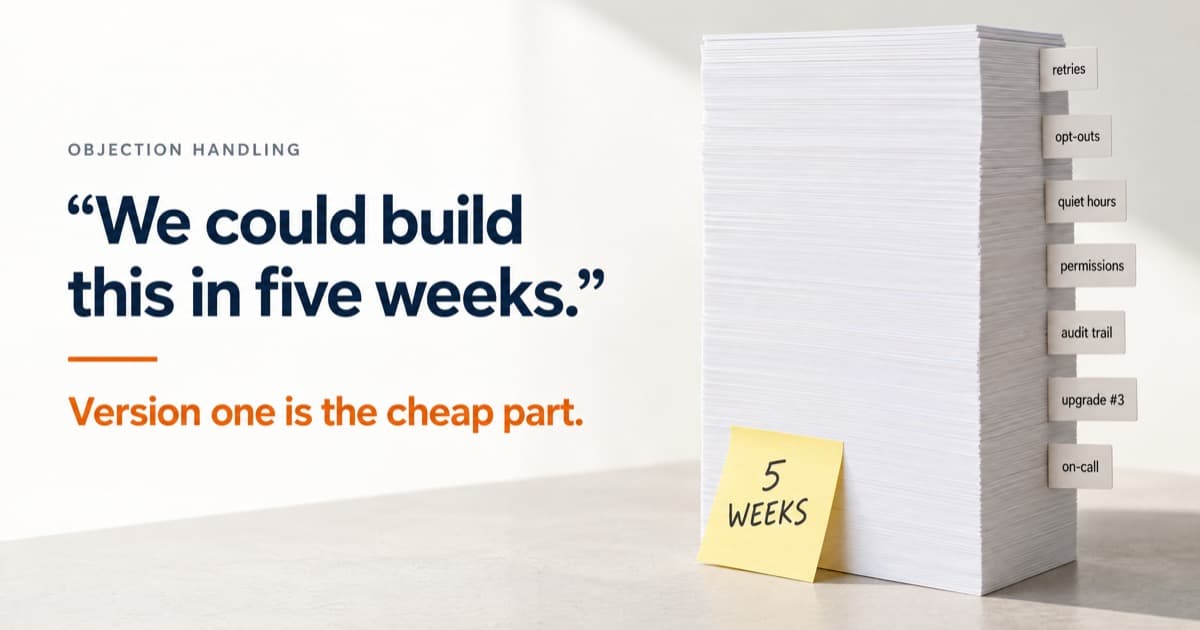
Rep: Then the two quotes are not describing the same winter. Four hundred covers you in October. The other five hundred are the people you onboard in six weeks, and they would sit outside the system.
Malia: We could add them later.
Rep: You could, and it is worth asking them what four hundred more costs at renewal rather than at signature. The second one I would check is implementation. Is setup inside their thirty-eight, or quoted after?
Malia: There is a line here for onboarding services. No number against it.
Rep: That is the one that tends to move most. I am not asking you to take my word for any of this. Ask them for both in writing, headcount at peak and setup included or excluded, and put their answer next to ours. If it comes back at thirty-eight for nine hundred people with setup included, you should take it, and I will tell you so.
Malia: And if it does not?
Rep: Then you have a sentence for finance that is not about which product we each think is better. Something like: theirs covers four hundred and we have nine hundred in January.
Three things did the work. Asking what the competitor's quote was priced at, rather than claiming it was thin, put Malia in front of her own document while you were still on the call. Naming what happens in six weeks made the gap concrete, on her calendar rather than yours. And telling her to take the cheaper deal if it genuinely matches is the line that buys the rest, because it is the only thing a rep protecting a commission would not say.
The competitor's number lands mid-call, not in an email.
You get one pass at this, live, with no time to look anything up. ConvoSparr lets you practice the call out loud against an AI buyer who names a lower quote and pushes back when you deflect, then scores whether you discounted, argued, or got the two scopes compared.
Before You Send a Revised Quote
The most expensive thing you can do after this call is quietly rebuild your quote at a lower number and send it across. A revised quote with no change to the scope is a written admission that the first one was inflated, and it stays in the buyer's file. If your number moves, something in the scope moves with it in the same document: a shorter term, a smaller user count, deferred onboarding. Otherwise the number stands.
To rehearse it, set up a negotiation session where the counterpart opens on a competitor's price rather than yours. Then run these, out loud:
- Acknowledge the gap in one sentence, without conceding that the quotes are comparable.
- Ask what the other quote is priced at: count, term, and whether setup is in or out.
- Name the month the difference bites, using the buyer's own calendar.
- Hand over the checkable sentence they will repeat when you are not there.
- Say out loud that they should take the cheaper deal if it truly matches.
The fifth is the hardest to say and the only one that cannot be faked, which is why it is worth practicing before the call rather than deciding during one.
Updated Sep 20, 2026
Run this scenario for real
ConvoSparr drops you into a live voice call with an AI buyer who runs this exact play. Handle it out loud, then get a transcript, scores, and coaching notes on how you did.
Free to start. No credit card required.