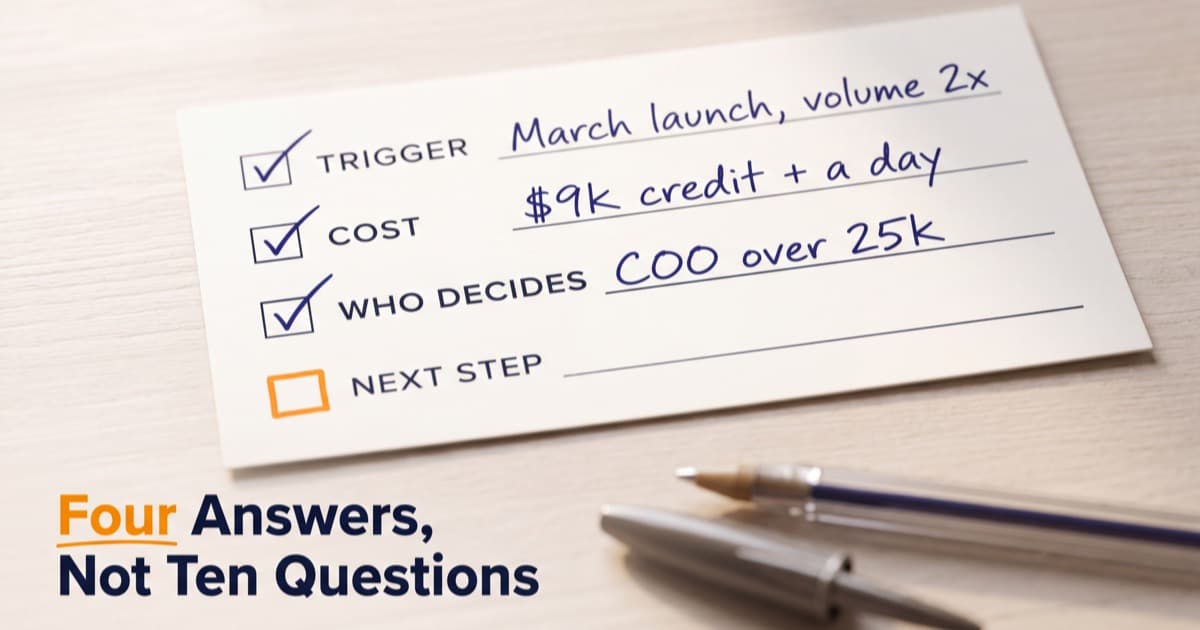
How does a deal with daily active users, a champion who picks up on the first ring, and a product that demonstrably works still end the quarter unsigned?
Every SaaS pipeline review has two or three of them. The demo landed. The trial got extended once, cheerfully. Somebody on the buyer's side has built a workflow around your product and would be genuinely annoyed to lose it. And the deal has not moved in six weeks, because nothing in any of that required anyone to spend money.
Here is what this guide is built on. In SaaS, the person using the product and the person buying it are rarely the same person and almost never in the same conversation. A user is deciding whether the thing works. A buyer is deciding whether to move budget, absorb a switching cost, and defend the choice later. Run one call for both and you get enthusiasm with no purchase order. So a SaaS sales calls playbook is not one call done well. It is four different calls, each with its own evidence, its own question, and its own next step, and the job is knowing which one you are actually on.
What makes a SaaS sales call different from any other sales call?
A SaaS sales call is different because the product has usually been in the buyer's hands before the call, and because the purchase is a subscription rather than a transaction. Those two facts change what your call has to do.
The evidence is already in the room, and it is not yours. In most sales conversations you assert value and the buyer discounts your assertion. In SaaS the buyer has used the thing. Your claims are checkable against their own two weeks of experience, which means an oversold benefit costs you more here than anywhere else, and an accurate observation about their usage buys more credibility than any case study.
The user is not the payer. The dispatcher who loves your scheduling tool does not sign for it. Their director does, after finance asks what it replaces. Enthusiasm and authority sit in different chairs, and a call that only visits the first chair produces a warm account and a cold forecast. This is the same gap covered from the pitching side in selling to a CFO: the same product, priced by a person who never touched it.
The competitor is usually a spreadsheet. Head-to-head bake-offs feel like the main event and are the minority of lost deals. Most SaaS deals lose to the current way of doing it, which is free, imperfect, and already staffed. Nobody gets fired for keeping it.
The deal does not close once. A signature buys you twelve months of scrutiny. Everything you overstate in the sales cycle returns as a renewal problem, which is why the strongest SaaS reps deliberately underclaim in month one.
There is a late gate you do not control. Security review, procurement, legal, a vendor consolidation list. A deal that is verbally won in October and unstarted on those in November is a deal that closes in January. Ask early what the last step looks like, not because you can speed it up, but because it belongs on the timeline you are forecasting.
The four calls a SaaS deal runs on
Almost every SaaS conversation is one of four calls. They are not stages on a CRM board, they are different jobs, and the common failure is running call two with the questions from call one.
| The call | What the other side is deciding | Evidence that moves it | A real next step |
|---|---|---|---|
| First call or trial kickoff | Is this worth my team's attention for a month? | A specific problem you can name better than they can | A named success measure and who will judge it |
| Pilot review | Did the thing we agreed to measure move? | Their own usage against their own stated measure | A dated conversation with whoever controls the budget |
| Expansion | Does this survive being used by people who did not choose it? | A working team's results, plus the rollout cost stated honestly | A pilot in the least friendly team, not the friendliest |
| Renewal | Would we buy this again at this price today? | Twelve months of outcomes the buyer can repeat to their boss | A renewal decision made ninety days early, in writing |
Read the fourth column again. In every one of these calls, the next step is a decision by a person, on a date. "They are going to keep using it and we will talk in a few weeks" is not in that column, and a pipeline built on it forecasts feelings.
The first call has its own guide in this library (how to open a discovery call is the general version), and the one addition SaaS needs is this: before the trial starts, get the buyer to name the number they will judge it by, out loud, in their words. Not "see if the team likes it". A measure. Overtime hours, time to build the weekly schedule, missed visits, invoices touched twice. Without it, the pilot review call has nothing to review and collapses into a satisfaction survey.
Usage is evidence, and most reps read it backward
Product usage is the most under-used asset in SaaS selling, mostly because reps treat it as a report card rather than a set of questions.
The backward read sounds like this: logins are up, so the deal is healthy. It is a comfortable read and it explains nothing, because aggregate usage hides the only two things worth knowing.
Who is not using it. A pilot at three sites where two are busy and one is silent is not a 67% success. It is one specific story about a person who tried the product and went back to what they had. That person is the closest thing you will get to the objection your buyer will hear internally, months later, when you are not in the room.
Whether the usage is the usage you promised. A team can log in daily and still be using your product as a viewer for a schedule they build somewhere else. The number goes up. The problem you sold against is untouched, and the renewal conversation is going to be strange.
So bring usage into the call as an observation with a question attached, never as a scoreboard. "Your north branch has not built a schedule in here since the second week. I would rather understand why than guess at it" is a sentence that gets you a real answer. "Adoption is at 68% across the pilot" gets you a nod.
One discipline holds this together. Whatever number the buyer named at kickoff is the number you report against, even when a different number flatters you more. If they said overtime hours and overtime is flat while logins tripled, the call opens with overtime being flat. You lose ten seconds of comfort and gain the only thing that matters on a renewal: the buyer believing you will tell them the truth about their own account.
A pilot review call at a company where the product is working
Kelverton sells crew scheduling software. Birchmore Grounds is a commercial landscaping company with fourteen branches, running a sixty-day pilot at three of them. Imogen is the account executive. Vikram is the director of operations who sponsored the pilot, and Camille is the VP of finance who has never been on a call.
At kickoff Vikram named the measure himself: overtime hours across the three pilot branches. Two branches are using the product daily. The north branch stopped in week two.
The call that logs as a good one:
Imogen: Hi Vikram, thanks for the time. Wanted to check in on how the pilot has been going.
Vikram: Good, honestly. The dispatchers like it. It is a lot better than what we had.
Imogen: That is great to hear. Anything you would want to see improved?
Vikram: Mobile could be faster. Nothing major.
Imogen: Noted, I will pass that on. So we are coming up on day sixty. Should I put a proposal together for the full rollout?
Vikram: Yeah, send it over. I will take a look and we will go from there.
Imogen: Perfect, I will get that to you this week.
Everything in there is pleasant, and nothing in it is a decision. Three things went wrong. The measure Vikram set was never mentioned, so the pilot proved nothing anyone can defend. The silent branch never came up, which means the strongest counter-argument to the rollout is still unexamined and now belongs to whoever raises it internally. And "send it over" moved the deal from a conversation to a document, which is the point where most SaaS deals go quiet. That handoff is the same failure as ending a call with a promise to follow up, dressed in better clothes.
The call that changes what happens next:
Imogen: Before I show you anything, I want to give you the honest version of the pilot, including the part that did not work.
Vikram: Go ahead.
Imogen: You said at kickoff you would judge this on overtime. Across east and central, overtime is down about nine hours a week combined since week three. North has not built a schedule in the tool since week two, so it has no result at all. I would rather understand north than round it into an average.
Vikram: North is Dale. He builds the week on paper on Sunday night. He has done it for eleven years.
Imogen: Did his crew leads ever get logins?
Vikram: I assumed they did.
Imogen: They did not. Two of eleven activated. That is on us, and it is fixable in a morning. But it tells you something about the rollout: this works where the crew leads can see the schedule on their phones, and it does nothing where they cannot. If we roll out to fourteen branches without checking activation branch by branch, you will get eleven north branches.
Vikram: That is fair.
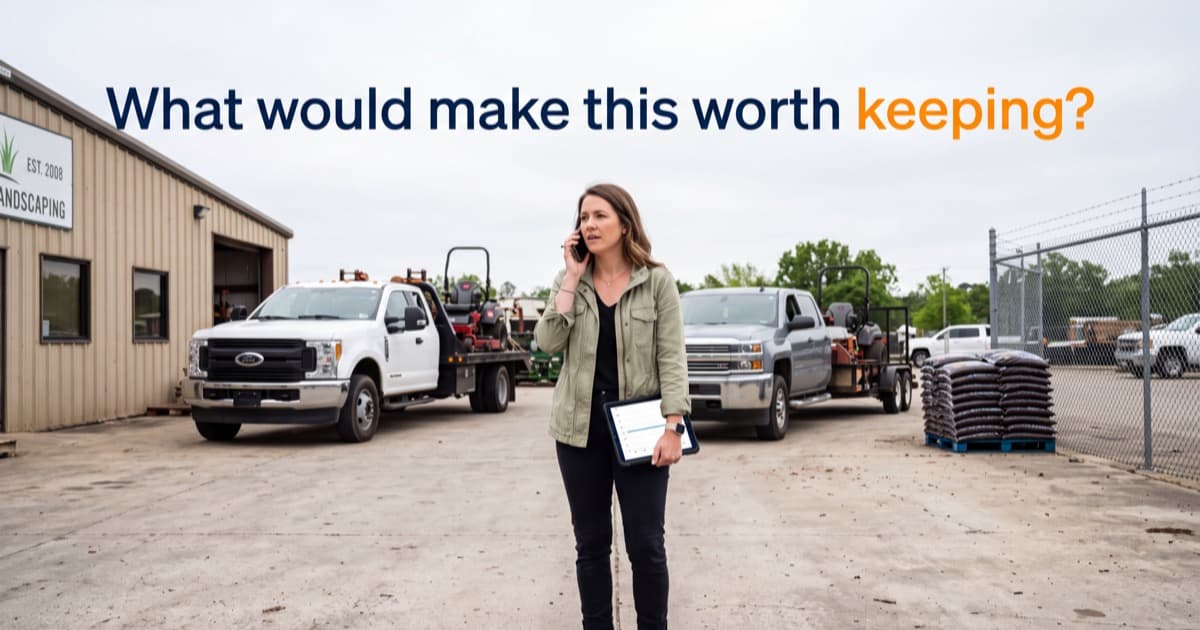
Imogen: So let me ask the question that decides this. What would make this worth keeping past the pilot, for you and for whoever signs it?
Vikram: For me, the overtime number holding at scale. For Camille, it would be what it replaces. We pay for two scheduling tools now and one of them is only used by the branches.
Imogen: Then the conversation you and I should be having is not a proposal. It is a thirty-minute call with Camille where you tell her the overtime number from your own branches, and I bring what happens to the second tool and what the activation work costs. Can we get that on her calendar in the next two weeks, and I will send the numbers to you first so nothing is a surprise?
Vikram: She has time Thursday after next. Send me the numbers Friday.
Look at what the second pass actually did. It led with the failed branch, which is the fastest way to make every other number credible. It reported against the measure the buyer chose rather than the one the vendor liked. It converted a silent site into a rollout rule instead of an excuse. Then it asked one question, "what would make this worth keeping", which is the pilot review version of asking a buyer to state their own criteria, and it got the two criteria that mattered from two different people in one answer. Finally, it traded a document for a meeting with the person who controls the money, with Vikram carrying the number rather than the vendor.
The rep did not get a signature on that call. She got a dated conversation with the payer, which is the only thing a pilot review can honestly produce.
Your champion is one job change from being nobody
Single-threaded SaaS deals are the ones that vanish without a loss reason. Champions get promoted, reorganized, hired away, or handed a priority that outranks you, and the deal has no other root in the account.
Multi-threading fails when it sounds like distrust, so say the reason out loud. "You are going to have to defend this to people I have never spoken to. I would rather answer them directly than write you a document to defend for me" is a sentence almost every champion agrees with, because it moves work off their desk.
Three people are worth reaching in most SaaS deals, and each needs a different call.
The economic buyer wants what it replaces, what it costs to switch, and what happens if they wait two quarters. Bring the arithmetic, not the feature list.
The technical evaluator wants to know how it fails, not how it works. Answering "what happens when the API is down" with a real answer buys more trust than a demo, which is the whole point of the technical evaluator scenario.
The reluctant user is the one everybody skips. Find the equivalent of the north branch inside the buying group and talk to them before finance does. Their objection is going to be raised anyway; the only question is whether you are there to answer it.
The renewal call is decided in the ninety days before it
A renewal conversation held thirty days out is a price negotiation. A renewal conversation held ninety days out is a business review, and the difference in outcome is not subtle. Late renewals get benchmarked against competitors, pushed into procurement cycles, and used as leverage; early ones get decided while the account is calm.
The mechanics are unglamorous.
Write down what the buyer said they wanted, on the day they said it. In their language, in the account record. The person you renew with may not be the person you sold to, and a year later nobody remembers the original promise unless you kept it in writing.
Report against it quarterly, including the misses. A quarterly note that says one of three targets is behind and here is what we are doing is worth more than four notes claiming everything is green, because the first kind is believed.
Ask the renewal question early and plainly. "If the decision were today, would you renew at this number?" A hesitation ninety days out is a gift. The same hesitation three weeks out is a discount request you will meet in a hurry, which is exactly the reflex the price negotiation guide exists to break.
The four mistakes that make a SaaS deal look safer than it is
Confusing product love with purchase intent. Users say "we would be lost without this" and reps hear a closed deal. Nothing about that sentence involves a budget. The test is whether anyone has said a number and a date out loud.
Letting the trial run long as a favor. An extension without a new measure and a new end date is not generosity, it is the deal losing its only deadline. Extend once, with a specific question attached: what will we know in three weeks that we do not know now?
Selling the roadmap. A feature promised in a sales call becomes a renewal grievance if it slips, and roadmap-driven deals close on the wrong reasons. Sell what runs today; mention what is coming as a maybe, in words the buyer would repeat accurately.
Treating security review as paperwork. It is a gate with its own owner, its own queue, and its own ability to end your quarter. Ask in the pilot review who runs it and how long it took the last vendor, and forecast accordingly.
Before your next SaaS call
Back to the question at the top, the deal with happy users that will not close. Take one of those accounts and answer three things without opening the CRM: which of the four calls you are actually due for, what number the buyer named as their measure, and who signs. If any of the three is a guess, that is the content of your next call, and it is worth more than another demo.
Then say the questions out loud before you use them on a real account. "What would make this worth keeping" sounds simple written down and lands differently when a director is quiet for four seconds afterward. ConvoSparr lets you run the whole conversation as a live voice call against an AI buyer who does not agree just to be pleasant, then scores what you did with the silence, the pushback, and the ask.