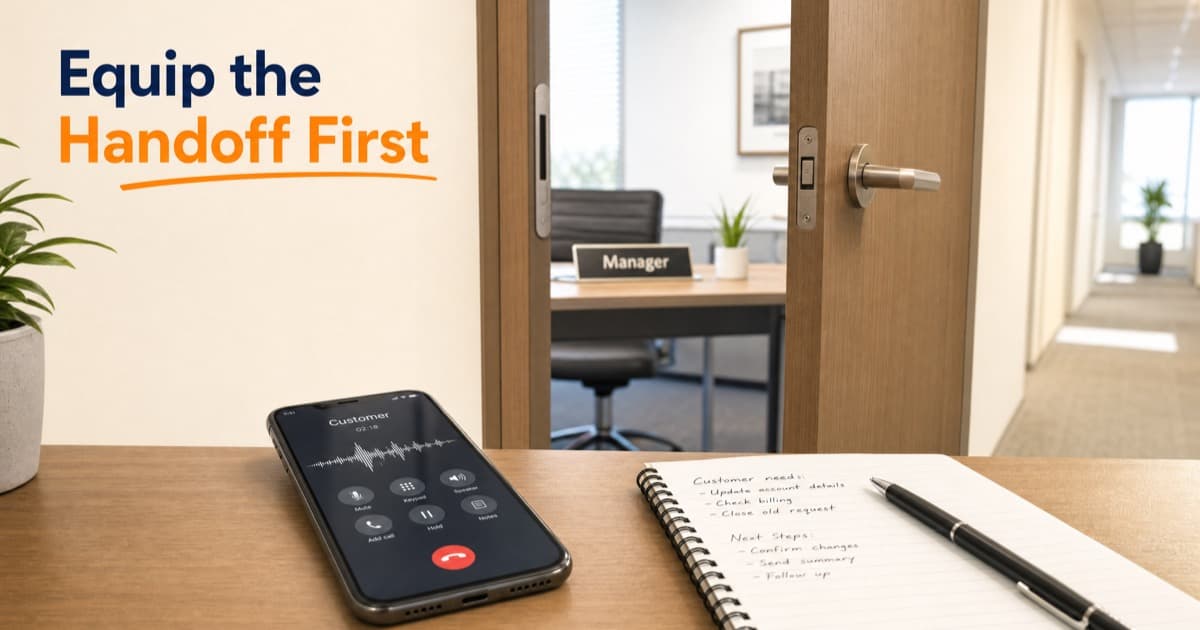
The 'Let Me Think About It' Objection: Three Meanings, One Question
"Let me think about it" is not a no, and it is not really a maybe either. It is a buyer telling you that one question is still open in their head and that they would rather work on it alone than say it to you. The question is almost always one of three: whether the price is worth it, whether someone else will sign off, or whether this has to happen now. Do not reassure, discount or schedule a check-in. Ask one thing: "Of course. What would you be weighing tonight that we could settle while we're both on the call?" Then stop talking. The answer tells you which of the three you are facing, and each one has a short, specific reply.
The pause after you name the price
The line almost never arrives early. It comes at the end of a call that went well: the buyer nodded through the walkthrough, asked a sensible question or two, heard the number, and then went quiet for a second before saying some version of:
- "Let me think about it."
- "I need to sleep on it."
- "This is helpful. Let me mull it over and come back to you."
- "Give me a few days to think."
That is why it stings. Nothing went wrong that you could point to, and the buyer sounds friendly. Most reps take the friendliness at face value, agree to a follow-up "early next week," and log the deal as warm. A week later the follow-up email goes unanswered, and two weeks after that the opportunity is quietly marked lost.
The timing is the clue. A buyer who says this right after the price, or right after you ask for a next step, has hit something specific at that moment. Your job is to find out what, before the call ends and the thinking moves somewhere you cannot hear it.
Why rushing to reassure makes it worse
Reps lose this moment in three predictable ways, and all three skip the step of finding out what the buyer is stuck on.
Reassuring at random. "Totally understand. Just so you know, setup only takes a week, and we have great support, and lots of customers your size love it." The rep is guessing at the worry and throwing answers at all of them. If the real issue was the general manager's approval, none of those answers touched it.
Discounting before anyone asked. "If it helps, I could probably take ten percent off if we sign this month." The buyer never said the price was the problem. Now the price is lower, the buyer has learned that waiting earns money, and the real question is still unanswered.
Scheduling the check-in. "No problem, I'll follow up Tuesday." This feels respectful and is the most expensive option, because it hands the whole decision to a conversation you will not be part of.
What does a buyer mean when they say "let me think about it"?
The phrase is a polite cover for one of three open questions. Each sounds the same on the call, and each needs a completely different reply.
| What they are weighing | What you will hear when you ask | What actually helps |
|---|---|---|
| Value: is this worth the money? | "It's a lot per month for something we might not need often." | Put their own numbers next to the price, out loud, together |
| Approval: will someone else agree? | "I'd need to run it past my GM, and I'm not sure how he'll take it." | Help them build the two sentences they will say to that person |
| Timing: does this have to happen now? | "Honestly, everything's on hold until after the season." | Connect the decision date to a date they already care about |
There is a fourth possibility: they are not interested and are being kind. The question surfaces that too. A buyer with no real interest will not name anything to weigh, and a clear no today costs you far less than three weeks of chasing a deal that was never there.
Casimir hears it at the end of a packing-house walkthrough
Cobbleridge Fruit Packers grades, packs and stores apples for a few dozen orchards. They run fourteen cold rooms, and last spring a compressor failed over a weekend; by Monday morning, $62,000 of fruit was soft and had to go to juice at a fraction of the price. Tamsin is the operations manager. Casimir is an account executive at Briskwell, which sells wireless temperature sensors that alert a phone the moment a room drifts. The call has gone well. Casimir has just said the price: $1,900 a month for all fourteen rooms.
Answering worries she never raised:
Tamsin: Okay. That's helpful. Let me think about it.
Casimir: Of course, totally understand. Just so you know, installation is one afternoon, there's no long contract, and our support team is really responsive. And honestly, if price is a concern, I could probably get you fifteen percent off if we can sign before the end of the month.
Tamsin: Sure. I'll look it over.
Casimir: Great, I'll follow up Tuesday.
Casimir answered three questions Tamsin never asked and offered fifteen percent off a price she never objected to. She now knows that waiting is worth money. And Tuesday's email will land with a buyer who still has the same open question, which Casimir still does not know.
Asking what she is weighing:
Tamsin: Okay. That's helpful. Let me think about it.
Casimir: Of course. What would you be weighing tonight that we could settle while we're both on the call?
Tamsin: Honestly? The price makes sense to me. Augustin, my GM, signs anything over a thousand a month, and the last time I brought him a monthly tool he asked why we'd pay every month for something that might never go off.
Casimir: So it's Augustin's question, not yours. What did the compressor failure in the spring cost, all in?
Tamsin: The $62,000 of fruit, plus a Saturday crew to sort it.
Casimir: Then the sentence for Augustin might be: one weekend like last spring pays for almost three years of this. Would it help if I joined fifteen minutes with the two of you, so he can ask me directly?
Tamsin: Thursday at eight, before the trucks. I'll send the invite.
One question turned a friendly stall into a named person, a real reason and a meeting on the calendar. Casimir did not defend the price, because Tamsin had already accepted it. He worked on the actual gap: she did not have an answer ready for her boss. The figure came from Tamsin, not from a slide, which makes it far more convincing to Augustin. At $1,900 a month, $62,000 covers about 33 months, so "almost three years" is honest. And the next step includes the person who actually decides.
The pause after the price is where this objection lives.
ConvoSparr lets you practice that exact moment out loud with an AI buyer who says 'let me think about it' after you name the number, answers only if you ask the right question, then scores whether you found what they were weighing.
Drilling the question until it sounds like yours
The question only works if it comes out calm and on time. Under pressure, most reps start reassuring before they have decided to. Build the habit before the real call:
- Write your version of the question. Keep "tonight" or "this week" in it, so the buyer pictures the thinking they are about to do alone. Say it aloud until it sounds like you and not like a script.
- Practice the silence after it. Count three seconds in your head. The first answer is often "nothing really," and the real one comes after a pause if you leave room for it.
- Prepare one reply for each meaning. For value, have a way to put their own number next to yours. For approval, a two-sentence summary they could repeat. For timing, a calendar question tied to their season or year-end.
- Rehearse the honest exit. If they truly have nothing to weigh, ask: "Is it fair to say this isn't a priority right now?" A clear answer frees your pipeline.
"Let me think about it" sounded like a closed door on Tamsin's call. It turned out to be one sentence she did not yet know how to say to Augustin. Most of the time, that is what the phrase is hiding, and the only way to find out is to ask what they will be weighing tonight.
Updated Nov 3, 2026
Run this scenario for real
ConvoSparr drops you into a live voice call with an AI buyer who runs this exact play. Handle it out loud, then get a transcript, scores, and coaching notes on how you did.
Free to start. No credit card required.