They Offered the Title First: How to Negotiate Salary for a Promotion
How to negotiate salary for a promotion: when the number is really set, the three levers left once base is fixed, and the sentence that reopens it.
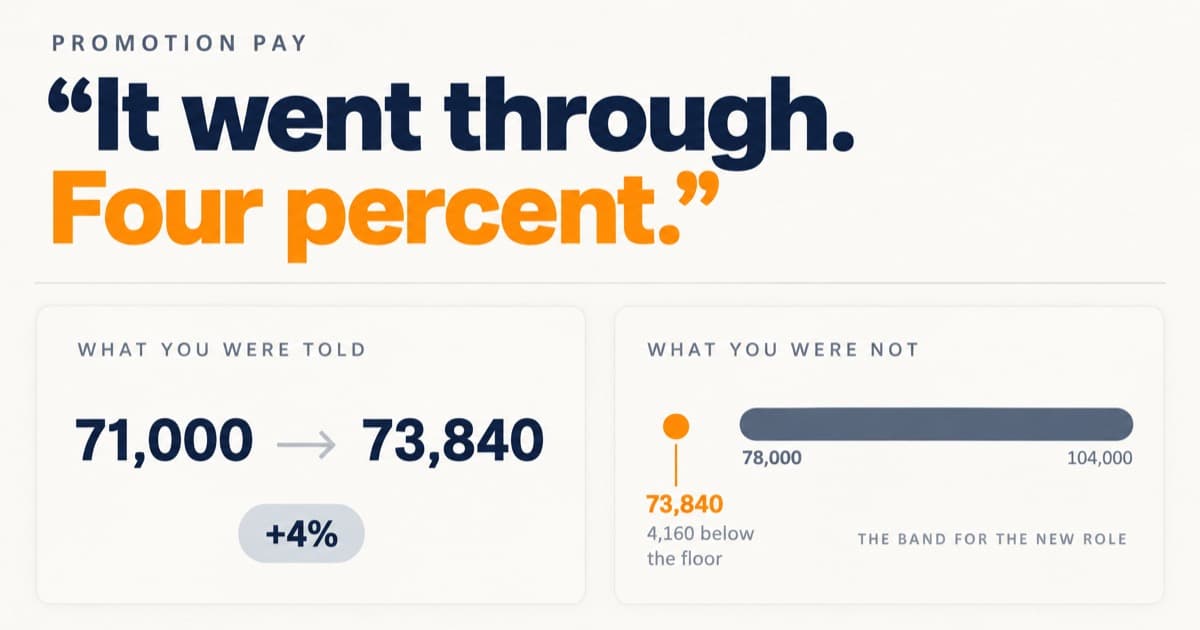
"Good news. It went through. You are Service and Parts Manager from the first of next month, and it comes with four percent. I pushed for it, so, congratulations."
Radhika had run the parts counter at Marden Implement for two years, absorbed the service scheduling when the coordinator left, and spent nine months doing most of the job she was now being offered. She said thank you, because that is what you say. The number came and went in three words, wrapped inside a sentence she could not interrupt without sounding ungrateful, and the meeting moved on to start dates.
Here is the part most promotion advice skips. By the time a promotion is announced to you, the base pay attached to it has already been through a planning cycle, validated against a salary band and signed off by someone who is not in the room. That does not make the number final. It makes the useful question "what is the band for this role, and where in it does this put me" rather than "can you do better." And if base truly is fixed this cycle, three other things are not: the effective date, the bonus target, and a written review at a named month with a named number. They sit in different budget lines, and a manager who cannot move base this week can often move all three.
Why the number is already half-written when they tell you
Most companies past a certain size set promotion pay inside a planning window, not inside a conversation. A manager submits a slate of proposed promotions with proposed salaries. Finance or HR checks each one against the band for the target role and against the department's merit pool. An executive signs the whole sheet at once. Then the manager is sent to deliver the news.
That sequence explains most of what feels strange about these conversations. It explains why your manager announces the number instead of proposing it, why the figure often looks like a percentage of your old salary rather than a position in the new role's range, and why "is there any flexibility" so often gets a genuinely apologetic no. You are asking someone to reopen a sheet that has already been approved, using a budget they have already committed.
The timing advice that follows is unglamorous. The strongest moment to influence a promotion number is before the slate is submitted, in an ordinary one to one, weeks before anyone says congratulations. The salary negotiation guide covers the full arc of a comp conversation. This page is the version where your counterpart is your own manager, you have no competing offer, and the decision has already been made once.
If you have missed that window, and most people reading this have, you have not missed the conversation. You have missed the easiest version of it.
How much of a raise should a promotion come with?
Percentages are the wrong unit. Comparing your promotion to last year's three percent merit increase tells you nothing about whether it is fair. What matters is where your new salary lands inside the band for the new role.
Run the arithmetic on Radhika's offer. She was at 71,000. Four percent takes her to 73,840. If the band for Service and Parts Manager at Marden Implement runs 78,000 to 104,000, her promotion leaves her below the floor of the job she is about to do. That is not a negotiation opinion. It is a policy problem on their side, and it is the strongest thing she can point at, because it is their own structure rather than her preference.
This is why the first question to ask is almost never a number. It is "what is the range for this role, and where does this put me in it?" Three things can come back.
Below the band floor. Fix it now. Most compensation policies do not allow a person to sit under the minimum of their own grade, so raising you to the floor is a correction rather than a negotiation.
In the bottom quarter of the band. Normal for someone new to a level. This is where you negotiate the review instead of the base: a specific month, a specific target inside the band, written down.
No answer, because your manager does not know the range or will not share it. Ask who does. A manager who cannot answer was handed a number too, which is worth knowing before you push on them for it.
Reading about it only gets you halfway.
Run this exact conversation out loud against a realistic AI buyer on ConvoSparr and get a scored review of how you handled it.
Promotion raise versus outside offer: which levers each one moves
Internal promotions get coached with advice written for external offers, and it misfires. An outside offer is built fresh by someone with a hiring budget and a vacancy costing them money every week. An internal promotion is a line item in a sheet that closed last month.
| Lever | Internal promotion | Outside offer |
|---|---|---|
| Base salary | Hard this cycle unless it breaches the band floor or the scope changed after the slate closed | The main lever, and expected to move |
| Effective date | Genuinely movable, and often worth more than the argument about base | Rarely negotiable beyond a start date |
| Bonus target percentage | Usually set by grade, so it moves when the grade does | Set with the offer and negotiable alongside base |
| Written review at a named month | The strongest realistic ask, because it costs nothing today | Less common, and reads as doubt about the offer |
| One-time payment | Sometimes available as a spot award from a separate pool | Standard as a signing bonus |
| Your evidence | Scope you already carry, visible to everyone in the building | What you claim you can do, taken partly on faith |
The last row is the advantage nobody uses. An external candidate is selling a forecast. You are describing nine months of work your manager watched you do. That asymmetry is the whole case, and it only works if you say the scope out loud instead of assuming it got counted.
Fifteen minutes in the dealership back office
Same offer, same manager, two ways of answering it.
Taking the number as given:
Tomasz: Service and Parts Manager from the first. Four percent. I pushed for it.
Radhika: That is great, thank you. Honestly I was hoping for a bit more, given everything I have been covering. Is there any flexibility on the four?
Tomasz: I hear you. The increases were all approved together back in August, so it is locked for this round. I can look at it again next year.
Radhika: Okay. No, that makes sense. Thanks for pushing for it.
Nothing went wrong, and that is the problem. She asked for flexibility without giving Tomasz anything he could take back to anyone, and "a bit more, given everything I have been covering" cannot be entered into a system. He gave the only honest answer available to him, and the conversation ended with a promise carrying no date, no figure and no record. Twelve months from now the merit sheet will treat 73,840 as her starting point.
Putting scope in front of the number:
Tomasz: Service and Parts Manager from the first. Four percent. I pushed for it.
Radhika: Thank you, and I want the role. Can I ask one structural thing before we do start dates? What is the band for Service and Parts Manager, and where does 73,840 sit in it?
Tomasz: I would have to check the exact range. I think it starts somewhere around seventy-eight.
Radhika: That is what I understood too, which is why I wanted to raise it now rather than in six months. If the floor is 78,000, the promotion puts me under the minimum for the job. Can you take that back as a band correction rather than as me asking for more money? It is a different conversation for whoever signs it.
Tomasz: That is fair. If it is genuinely below the floor, that gets fixed. Let me pull the range this afternoon.
Radhika: Thank you. And whatever the range says, two things that do not cost budget this cycle. I have been running service scheduling since February, so could the effective date be backdated to the first of this month rather than next? And can we write down a review in March against a specific number in the band, so it is not a memory?
Tomasz: The date I can probably do. The March thing I would want to phrase carefully, but yes, I can put it in writing.
The second version is not more confident. It is more usable. Every ask converts into something Tomasz can carry to a person with authority: a band correction, a date, a documented review. She never argued that she deserved more, which is an opinion he would have had to defend for her. She pointed at the company's own structure, then handed him two requests that do not touch the closed sheet. She also said yes to the role in her first sentence, which keeps the rest from reading as a threat.
Four ways people talk themselves down
Saying thank you and asking later. Later does not come. Once the promotion is announced to the team, the number is history and reopening it needs a reason that did not exist a month ago. This conversation is the negotiation.
Arguing the percentage. "Four percent feels low" invites a comparison to everyone else's three percent, which your manager will win. Band placement moves the argument onto ground where the company's own policy does the work for you.
Naming the scope only after naming the number. Lead with a figure and the work you have been carrying sounds like justification assembled afterward. Lead with what you have been doing since February, then let the number follow it.
Hearing "the budget is set" as the end. It is the start of the second half. Effective dates, spot awards, bonus grades and documented review commitments are not the same budget as base, and most managers have more room there than they volunteer.
To feel the difference before it matters, the raise conversation practice page covers rehearsing the ask, and the asking for a raise scenario runs it live against a manager who pushes back.
The one thing to settle before you walk in
Decide, before the meeting, what you will say in the eight seconds after they name the figure. Not your target number. The first sentence. For most people it is some version of accepting the role and asking for the band in the same breath, because that combination buys the rest of the conversation without spending goodwill.
So: they have just told you the title and the percentage, and it is your turn. What comes out of your mouth?
Practice this out loud
Run this conversation against a live AI buyer and get a scored review.
Start free, no cardPractice this callPractice this before it counts
ConvoSparr puts you in a live voice call with an AI buyer who pushes back like a real one. Every session ends with a transcript, scores, and coaching notes.
Free to start. No credit card required.
Keep reading
All articles