What Has to Be True to Qualify a Lead on the First Call?
How to qualify a lead on the first call: the four answers that decide it, and the sentence to use when one of them comes back vague.
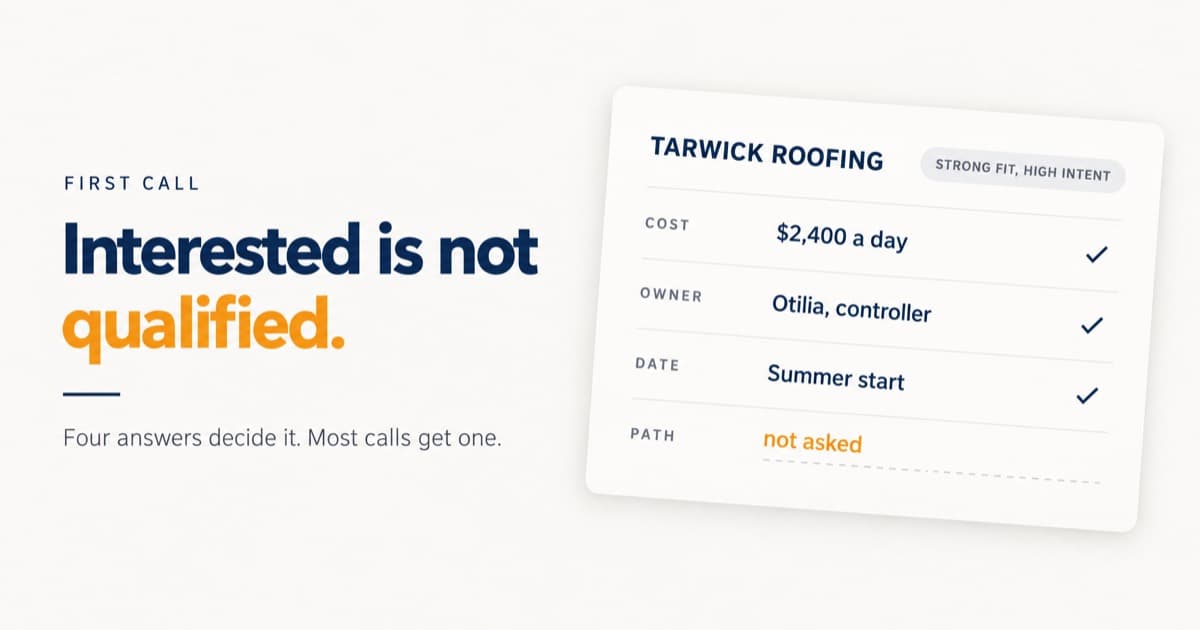
Sinead Varga finished a first call in March with nine pages of notes and a CRM line reading "strong fit, high intent." Tarwick Roofing had the crew count, the problem, a budget range she had heard out loud, and a VP of operations who said "this is exactly what we've been talking about internally" before the twenty minute mark.
It never reached a second meeting. Not lost to a competitor, not stalled on price. Six weeks of polite replies, then nothing. Looking for the moment it went wrong, she could not find one. Every line was agreement.
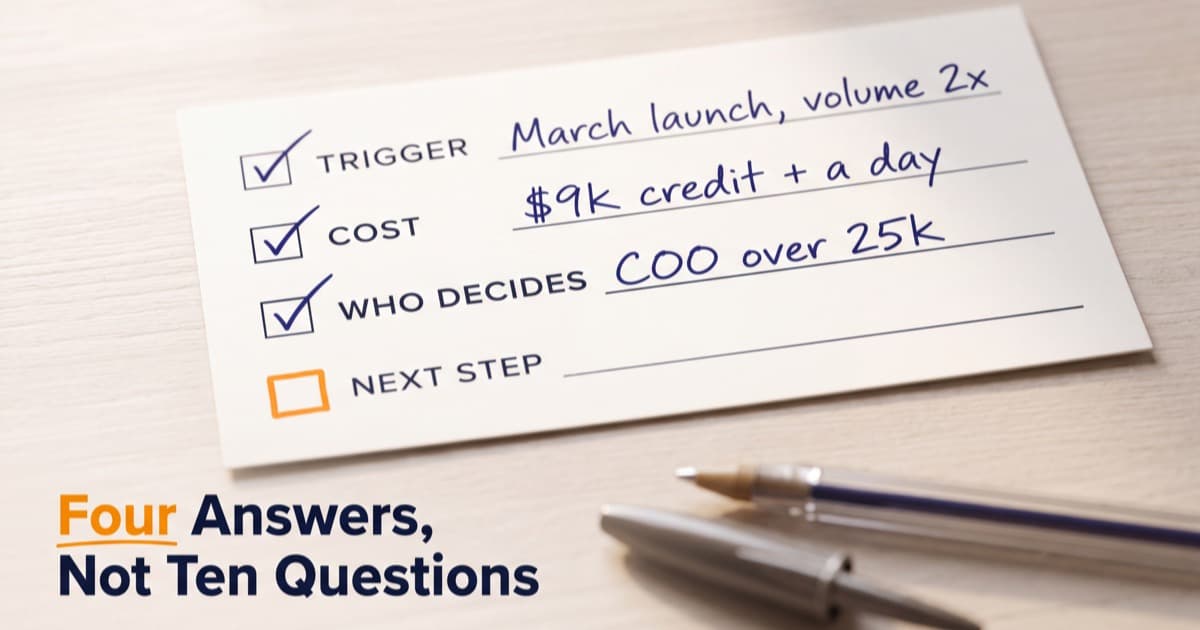
That is the trap. Agreement is the cheapest thing a buyer can give you and it looks identical to progress in a CRM. To qualify a lead on the first call you need four answers in the buyer's own words: a consequence they can put a number on, a person who owns that consequence, a date that forces the issue, and the path a purchase this size took the last time. A lead is qualified when you can repeat those four answers to your manager without guessing at any of them. Enthusiasm is not one of the four and never substitutes for one.
Interested and qualified are two different answers
Interest is about the topic. Qualification is about the purchase. A buyer can be sincere about the first while the second is nowhere near true. Caleb Halbrook meant every word he said to Sinead. What he never said, because she never asked, was that he had asked for this eighteen months earlier and been told to wait for the next fiscal year, and nothing since had changed the reason for the wait.
Interest costs a buyer nothing. Qualification costs them something: a number they have to admit, a colleague they have to name, a date they have to say out loud. So run this test at the end of a first call. What did the buyer tell you that they would rather not have? If the answer is nothing, you had a nice conversation.
The four answers a first call has to produce
Not ten boxes. Four answers, each with a specific sound when you actually get it.
A consequence with a unit. Not "it's a big problem," but the cost in the buyer's own arithmetic. Ask for the unit, never the total: "when a crew gets sent to the wrong site, what does that day cost you?" Buyers rarely know an annual figure and will not invent one, but almost everyone knows what one bad day costs. The total is arithmetic you do together a few seconds later, and a number the buyer assembled is one they repeat in meetings you are not in.
An owner. "Who hears about it when it happens?" A problem with no name attached has no sponsor, no complaint history and no budget. The owner is often not the person you are talking to, and learning that on call one is the best thing a minute can buy.
A date. "What's on the calendar between now and spring that makes this harder?" Urgency you supply is pressure. Urgency the buyer supplies is a deadline: a season, a contract start, an audit, a hire nobody backfilled. No date means no reason to buy this quarter, which is an answer, not a failure.
A path. "What's the most recent thing your team bought like this, and what happened between deciding and signing?" This gets the real approval route, including who slowed it down. "How do decisions get made here?" returns an org chart. This one returns a story with a villain in it.
Reading about it only gets you halfway.
Run this exact conversation out loud against a realistic AI buyer on ConvoSparr and get a scored review of how you handled it.
BANT, MEDDIC, and what one call can actually reach
Most qualification arguments are really arguments about scope. The frameworks are not wrong, they are sized for a whole deal cycle, then run on a twenty minute call and trusted.
| Framework | What it asks you to establish | What a first call honestly reaches | Where it misleads on call one |
|---|---|---|---|
| BANT | Budget, authority, need, timeline | Need and timeline, plus whether budget exists as a category | "Authority" gets answered by whoever is on the phone, and they always say yes |
| MEDDIC | Metrics, economic buyer, decision process, pain, champion | Metrics and pain, and a first read on the economic buyer | No champion is identifiable on call one. Someone enthusiastic is a candidate, and promoting them is how a deal dies in silence |
| CHAMP | Challenges, authority, money, prioritization | Challenges, and prioritization if you ask about the calendar | Prioritization sounds answered when a buyer says "it's a priority." It is answered when they say what it is ahead of |
| The four answers | Consequence, owner, date, path | All four, because each is a fact the buyer already holds | Nothing is inferred. If you cannot say the answer in their words, you do not have it |
The third column is the honest ceiling of a first call: lower than most scorecards assume, higher than most calls reach.
The Tarwick Roofing call, answer by answer
Sinead Varga sells for Belmara, a fictional crew scheduling platform for trade contractors. Caleb Halbrook is VP of operations at Tarwick Roofing, a fictional commercial roofing contractor running nine crews. Same rep, same buyer, same facts available in both versions.
The call that produced a follow-up:
Sinead: How are you handling crew scheduling today?
Caleb: Whiteboard in the ops room, and a spreadsheet my coordinator keeps. Held together with tape, honestly.
Sinead: That's what we hear a lot. Is it causing problems day to day?
Caleb: Constantly. Crews show up at the wrong site, materials land somewhere else. It's a headache.
Sinead: Makes sense. Is this something you're looking to solve this year?
Caleb: Yeah, it's on the list. We know we need something.
Sinead: Great. Let me send a proposal over and we'll walk through it.
Notice how much of that Sinead said. She supplied "causing problems," "solve this year" and the next step, and Caleb agreed with all three, because agreeing is easy and none of it was false. Her notes read: whiteboard, spreadsheet, wrong sites, on the list. Four facts, none costly.
The call that produced a date:
Sinead: How are you handling crew scheduling today?
Caleb: Whiteboard in the ops room, and a spreadsheet my coordinator keeps. Held together with tape, honestly.
Sinead: When a crew ends up at the wrong site, what does that day cost you?
Caleb: A crew day is five guys and a truck. Call it twenty-four hundred dollars by the time you count the drive.
Sinead: Roughly how often?
Caleb: Two a month? Storm season it's every week for a stretch.
Sinead: So call it thirty crew days a year, north of seventy thousand dollars. Who hears about it when it happens?
Caleb: Me. And Otilia, our controller, because it lands in job costing as unbilled labor and she has to explain it to the owner at month end.
Sinead: Has she raised it?
Caleb: Three times this year. Her words were "this is the line I can never forecast."
Sinead: What's on the calendar between now and spring that makes this harder rather than easier?
Caleb: We picked up the school district contract. Fourteen roofs, all in the summer break window, hard completion dates with penalties. Two weeks of the current system during that and we're paying penalties out of margin.
Sinead: Last question, then I'll stop. What's the most recent thing the company bought like this, and what happened between deciding and signing?
Caleb: Estimating software, year before last. Four months. I wanted it in June, we signed in October, because the owner won't sign anything Otilia hasn't priced against a full quarter.
Sinead: Then a proposal to you is the wrong next step. The right one is forty-five minutes with you and Otilia, pricing this against one quarter of your unbilled labor line in the format she already uses. Before the school contract starts, not during it. Does the week of the fourteenth work?
Caleb: Make it the fifteenth. I'll get Otilia on it.
Count what the second version holds: $2,400 an incident, thirty a year, a named owner who has escalated three times in a sentence Sinead can quote, a contract with penalty dates, a four month purchase history, and the person whose analysis unblocks a signature, booked onto a meeting.
Sinead did not ask harder questions. She asked one question per answer she needed and stopped talking after each. Two moves are worth stealing: she priced a single incident rather than the year, and she did the multiplication out loud so Caleb could correct her instead of producing the figure himself. The wider shape of a call built this way is in the discovery call guide, and the follow-ups that open up a thin answer are in which discovery call questions earn a real answer.
What does a disqualified lead sound like?
It sounds pleasant. A disqualified lead rarely says no, because the buyer is refusing nothing. They are describing a situation in which nothing is going to move.
You have one when the consequence has no unit ("it's frustrating, but I couldn't put a number on it"), when the owner is everyone or nobody, when the date is always next year, or when the path ends at someone your buyer cannot get you to. One missing is a gap to work on. Three missing on a warm, friendly call means the interest is real and the purchase is not.
Disqualifying is not walking away, it is picking the accurate next step. "Sounds like the trigger here is the fiscal year, so let's talk in November" costs nothing. A proposal built on a call where nobody said anything expensive costs a month.
Three habits that manufacture a false yes
Asking questions a buyer can answer with agreement. "Is that costing you time?" has one polite answer. "What does one of those days cost?" has an honest one. Any question that a nod could answer is one you answered for them.
Accepting a job title as an authority answer. A VP of operations does have authority over operations. Whether they can sign a $40,000 contract without the owner and the controller is a separate fact, and the way to get it is never "are you the decision maker?" It is the purchase history question, which gets the same answer without asking anyone to admit a limit.
Booking a next step you invented. "I'll send a proposal" is a step the rep chose, so it tests nothing. A step the buyer accepts that costs them something, a colleague's time, an internal date, is itself a qualification signal. Watch which ones get softened, because the softening is the real answer. The other ways a call can feel excellent while producing nothing are in the discovery call mistakes that feel like great calls.
Say the four answers out loud before you dial
Write them on one card: consequence, owner, date, path. Then say each question out loud once, in full, the way you intend to ask it live. The unit question especially, because four seconds of silence follow it and reps who have never heard themselves ask it fill that silence with a guess.
Afterward, run the test that would have saved Sinead six weeks in March. Say the four answers aloud as if reporting to your manager, in the buyer's words, with the numbers in them. Wherever you catch yourself saying "I think" or "he seemed to," that is the agenda for call two.
Practice this out loud
Run this conversation against a live AI buyer and get a scored review.
Start free, no cardPractice this callPractice this before it counts
ConvoSparr puts you in a live voice call with an AI buyer who pushes back like a real one. Every session ends with a transcript, scores, and coaching notes.
Free to start. No credit card required.
Keep reading
All articles