What do I say when they tell me they already have someone? Every page that answers that question answers it the same way: here are thirty lines, pick one. So you copy four into a doc, keep the doc open on the second monitor, and the next time a buyer says it you read one out. It works beautifully, right up to the period at the end of the sentence.
Then the buyer answers. And the doc has nothing for that.
Here is the answer in plain terms. An objection handling script is not one line, it is two: the line you say when the objection lands, and the line you say when the buyer pushes back on the first one. Almost every script you will find covers the first line, because the first line is the easy half. The second line is where the call is decided, and it is missing nearly everywhere, which is why memorizing thirty openers changes so little about how your calls end.
Why Do Objection Handling Scripts Stop Working on the Second Turn?
Because they are written from one side of the call. A script is a sentence you plan to say. An objection is a move, and a move gets answered.
A buyer's reply to your line is not random. Answer a buyer who just told you they have a vendor and you get back one of about three things: the vendor's name, a polite close ("so we're all set"), or a question about price. That is the whole distribution. The second turn is the most predictable moment in the call, and it is the one moment reps walk into with nothing prepared.
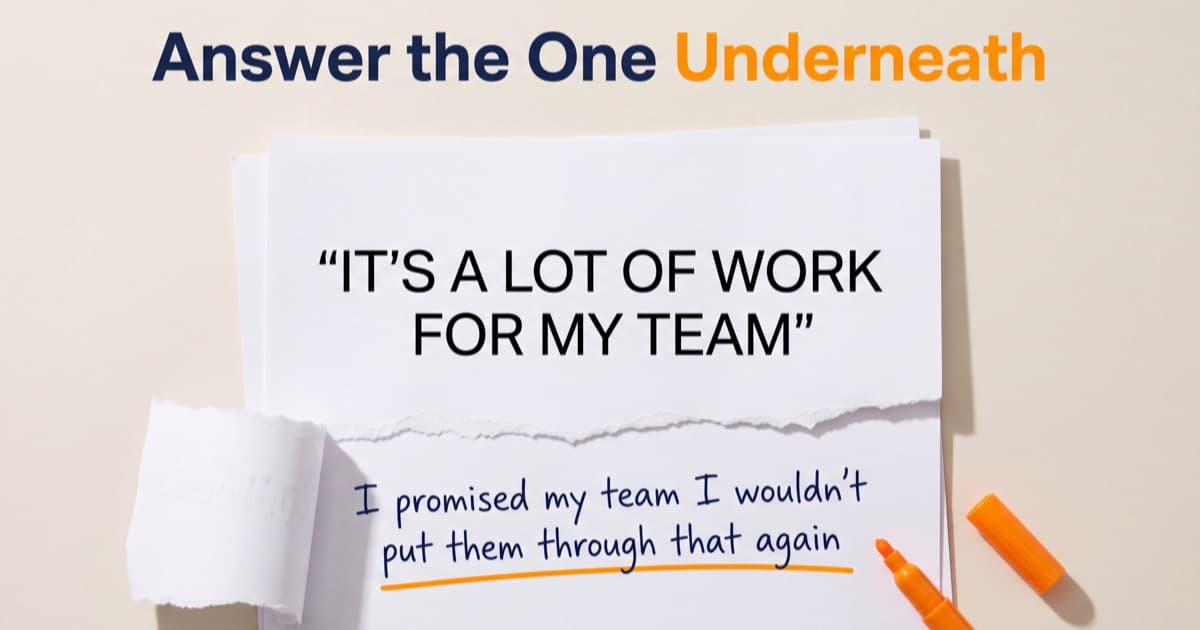
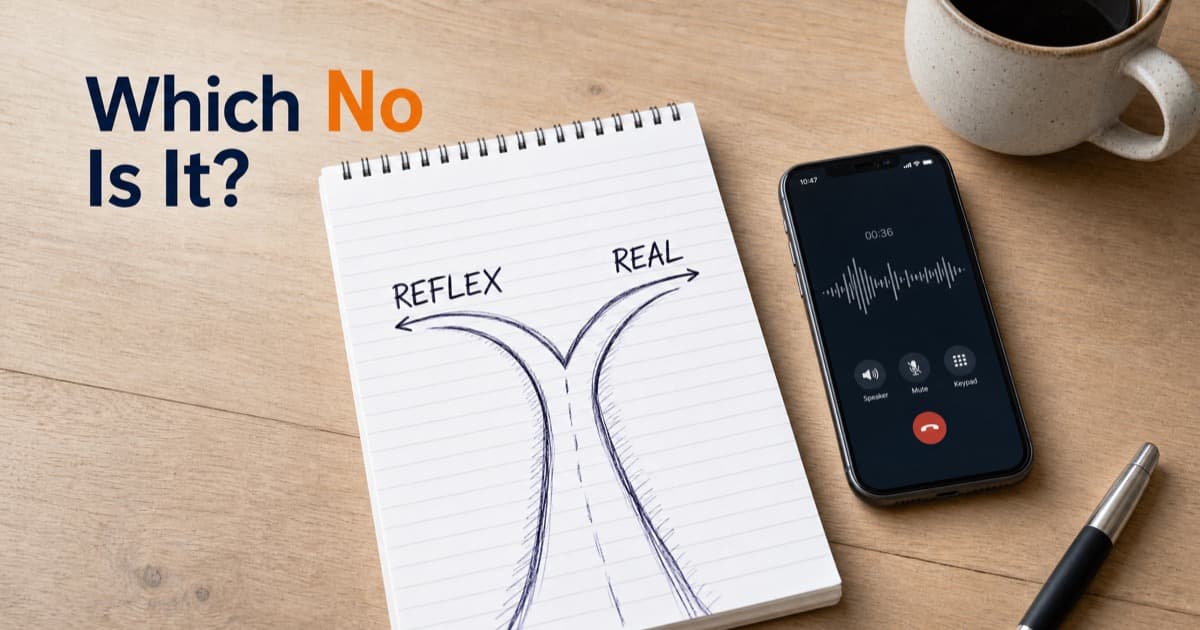
The second reason matters more. A buyer's first line is usually a reflex and their second line is usually true. "We already have someone" is a reflex. "We have someone, but the certificate chasing still lands on my team" is a fact you can sell against. If your script ends after your line, you hang up holding the reflex. Telling those two apart is the subject of brush-off vs real objection; writing two turns deep is how you get far enough in to see which one you have.
| Script format | What it sounds like | What the buyer does next | Where you are after thirty seconds |
|---|---|---|---|
| Rebuttal line | "A lot of brokerages tell us that, and what they find is..." | Waits, then repeats the objection in softer words | You have spoken twice and learned nothing |
| Question only | "What made you go with them?" | Answers in one sentence, then asks what you want | You have one fact and no reason to still be on the call |
| Two-turn script | An acknowledgment, a question, and a planned reply to the answer you expect | Gives you the real reason, because you were still there for it | You have a reason, a next step, and nothing left to improvise |
The objection handling guide covers the full arc of a call. This page is narrower: six objections you will hear this week, written out to the second turn.
The Six Objections, and the Line After Your Line
Each one is four parts: what they say, what you say, the comeback to expect, and the line that carries you past it. Say them in your own vocabulary or they will sound recited, and recited is worse than unprepared.
1. "Send me some information and I'll take a look."
You say: "Happy to. So I send you one page instead of everything, what part of this would you be checking for?"
Expect back: "Just whatever you've got." The reflex on top of the reflex.
Then say: "Fair enough. Then let me ask one thing so the page is about you rather than about us: how is this getting handled today, a spreadsheet or something built into your system?"
2. "We already use someone for this."
You say: "Good, most teams your size do. Who did you land on?"
Expect back: the name, then a closing move. "Two years now, so we're set."
Then say: "That makes sense, they are strong on the filing side. The reason I called is the part they do not cover: the chasing. Is that landing on your team, or does the carrier handle it?"
3. "It is not a priority this quarter."
You say: "Fair. What is, this quarter?"
Expect back: a real project, or a vague "just a lot going on."
Then say: "Then I would rather not sell you anything today. Does that project touch any of this? If it does, fifteen minutes in January is worth it. If not, I will call you in the spring."
4. "What does it cost?" (asked in the first two minutes)
You say: "Between $600 and $1,400 a month depending on producer count. I can be exact in thirty seconds if you tell me roughly how many."
Expect back: "That is more than we would want to spend."
Then say: "That is a fair reaction to a number with nothing attached to it yet. What would you weigh it against, somebody's hours or the penalty side?"
5. "I would have to run it by my team."
You say: "Of course. Who else is in that conversation?"
Expect back: one or two names.
Then say: "Their first question is usually the same one: what happens to the records we already have. Want the answer to that now, so you are not defending it alone?"
6. "We tried something like this and it did not stick."
You say: "That is the most useful thing you could have told me. What was it, and where did it fall over?"
Expect back: a weary account of a rollout that died.
Then say: "So it died at the import. If I cannot tell you exactly how this one gets past that same point, there is no reason for you to look at it. Do you want me to try, or should I leave it?"
Inside One Call at Kessendale Insurance Partners
Neve sells Oakhedge, a certificate tracking tool, into commercial insurance brokerages. Oskar runs operations at Kessendale Insurance Partners, eleven producers, no compliance hire. She has ninety seconds and she is about to hear script two. Here is the version where she stops where the doc stops.
Stops at the script:
Oskar: We already use someone for this.
Neve: Good, most brokerages your size do. Who did you land on?
Oskar: We're on Verrafile. Two years now. So we're covered.
Neve: Got it. So what we do differently is automated renewal reminders, carrier-side pulls, and an audit log your producers can actually use.
Oskar: Sure. Send me something and I'll take a look.
Neve: Absolutely, what's the best address?
Her first line was good. Warm, no argument, and it earned the vendor name. Then the doc ran out, and what came next was a feature list, which is what every rep says when nothing is planned. A feature list invites exactly one reply. She got it.
Here is the same opening, carried one line further.
Carries one line further:
Oskar: We already use someone for this.
Neve: Good, most brokerages your size do. Who did you land on?
Oskar: We're on Verrafile. Two years now. So we're covered.
Neve: That makes sense, they are solid on storage. The reason I called is the part they do not cover: the chasing. When a subcontractor's certificate lapses, does that land on your team?
Oskar: No, that's us. That's Margit and one of the account managers.
Neve: How many a month, roughly?
Oskar: I don't know exactly. Eighty, ninety requests? It spikes in March when the big renewals hit.
Neve: So two people, ninety chases, and a month where it doubles. Worth twenty minutes before March to see that number if nobody sends the first three emails?
Oskar: Yeah, before March would be the time.
Same objection, same buyer, same first line. All that changed is that she had a sentence ready for "so we're covered," and it did one job: it moved the call off the vendor she cannot beat and onto the work she can.
Notice what she never did. She did not say Verrafile was bad, and she did not ask whether he was happy with them, a question with one polite answer. She named a piece of work, asked who it lands on, then asked for a number. Ninety chases a month is not something Oskar had said out loud before, and once he has, the twenty minutes are easy to ask for.
Making a Written Line Sound Like Your Own
A script that stays on the page comes out flat, and flat is louder on a phone than in your head. Three things fix that, none of them rewriting.
Say it out loud first. Every line above shortens by about a third the first time it leaves your mouth, because writing tolerates clauses that speech does not. Keep the shortened version.
Memorize the shape, not the words. The shape of script two is: agree, name the gap, ask who owns it. Memorize the sentence instead and one unexpected word from the buyer derails it, which is how most frameworks break down in practice.
Then stop talking. Every second line here ends in a question, and a question is worth only as much as the silence after it. Fill that silence with a third sentence and you have turned it into a monologue.
What Still Goes Wrong After You Memorize These
You answer an objection nobody made. "We already use someone" is not "we are happy with them," and a rep primed for the second one defends against a complaint that was never voiced.
You stack scripts back to back. They brush you off, you run script one, they brush you off again, you run script three. Two is the limit before the buyer stops hearing a conversation and starts hearing a process. If the second line opens nothing, take the exit and set a real time to call back.
You treat the second line as a rebuttal. Every second line here asks for information or asks for a decision. The moment one starts asserting something about your product, you are back in the feature list.
You never ask for anything. Six good exchanges and no next step is still a lost call. The second line buys you the right to ask for twenty minutes. Ask.
So what do you say when they tell you they already have someone? You say "who did you land on," you listen for the close that follows, and you have the next sentence ready before you dial. That sentence is the script. The first one was the doorway.